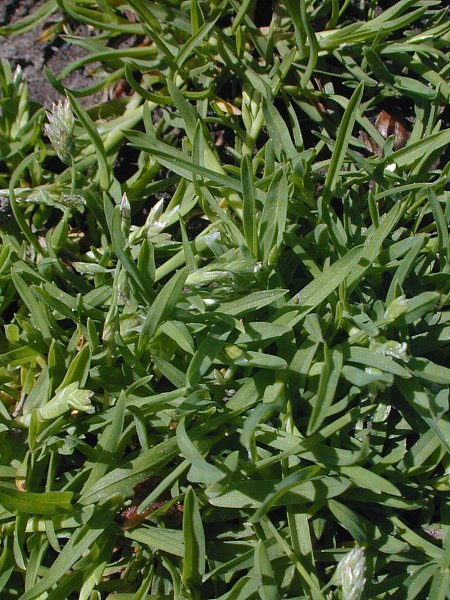
Description: This grass is a spring or fall annual that completes its life cycle within a short period of time (about 6 weeks). It is usually quite small, consisting of a low tuft of vegetation about 4" across and 1½" tall. However, substantially larger plants are sometimes observed. The typical plant has sprawling culms about 2½" long that are unbranched, except at the base. They are light green, glabrous, terete, and largely covered by the sheaths. The blades of the alternate leaves are 1½" long and 2-3 mm. across; they are dull to bright green, hairless, and keel-shaped at their tips. The leaf sheaths are light to medium green, hairless, open, and longitudinally veined. At the junctions of sheaths and blades, the ligules consist of short chaffy membranes.
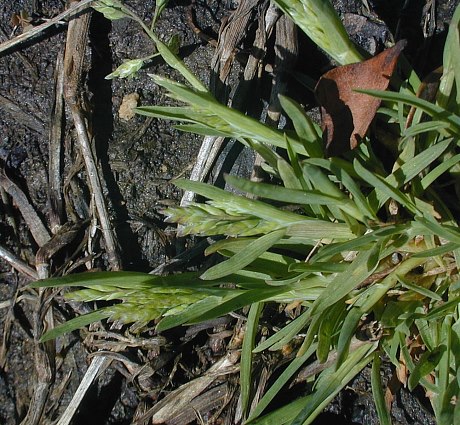
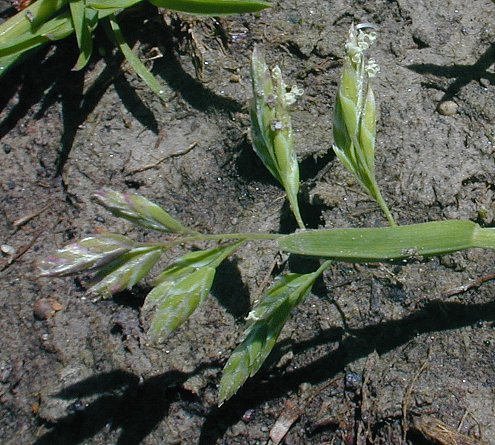
Each culm terminates in a flattened panicle of spikelets about ¾" long and ½" across. In atypical plants, the culms, leaf blades, and panicles are larger in size than what is indicated above. The somewhat flattened spikelets are light or whitish green. Each spikelet is about 4.5 mm. long and 2 mm. across; it consists of 2 glumes and 3-6 lemmas that are arranged in two overlapping columnar ranks. The curved glumes are oblong-lanceolate in shape and membranous along their margins; the larger glume is about 2.0 mm. long, while the smaller glume is about 1.5 mm. long. The curved lemmas are elliptic-ovate in shape, membranous along their margins, and faintly veined; sometimes there is a reddish purple patch near the apex of each lemma. The lemmas are often pubescent along their veins. Unlike many other Poa spp. (bluegrasses), there is no web of hairs at the base of each lemma. The blooming period occurs during the spring or fall. During the hot weather of summer (or sub-freezing weather of winter), this grass dies down and becomes tan, dispersing its seeds. The root system is shallow and fibrous. This grass reproduces primarily by reseeding itself. Less often, it may form rootlets at the nodes of the leaves, creating clonal offsets. Small colonies of plants are formed occasionally.
Cultivation:
The preference is full sun to light shade, moist conditions, cool
temperatures, and loam
or clay-loam soil. Growth and development occur primarily during the
spring and, to a lesser extent, the autumn. This is one of the first
grasses to develop seedheads
during the spring.
Range & Habitat:
Annual
Bluegrass is common in most areas of Illinois, although it
hasn't been collected from all counties (see Distribution
Map).
It is native to Eurasia, but not North America.
Habitats include damp paths in meadows, damp paths in woodlands, fields
and pastures, lawns and gardens, vacant lots, and waste ground.
Disturbed
areas are strongly preferred. This grass is more abundant during the
spring than the autumn.
Faunal Associations: Because Annual Bluegrass (Poa annua) dies down during the summer, it supports fewer insect species than other bluegrasses (Poa spp.). However, some bluegrass feeders that are active during the spring include caterpillars of the Common Roadside Skipper (Amblyscirtes vialis), caterpillars of the Hobomok Skipper (Poanes hobomok), both adults and nymphs of the Velvet-striped Grasshopper (Eritettix simplex), and nymphs of the Migratory Grasshopper (Melanoplus sanguinipes). These insects feed on the foliage. Insects that have been observed to feed on Annual Bluegrass specifically include the Rose-Grass Aphid (Metopolophium dirhodum), the Bird Cherry & Oat Aphid (Rhopalosiphum padi), and the Annual Bluegrass Weevil (Listronotus maculicollis); Annual Bluegrass is the preferred host plant of the weevil, whose larvae feed on the roots. The seeds of bluegrasses are eaten by the Mourning Dove, House Sparrow, and Field Sparrow. Small mammalian herbivores, like the Cottontail Rabbit and Meadow Vole, eat both the foliage and seedheads.
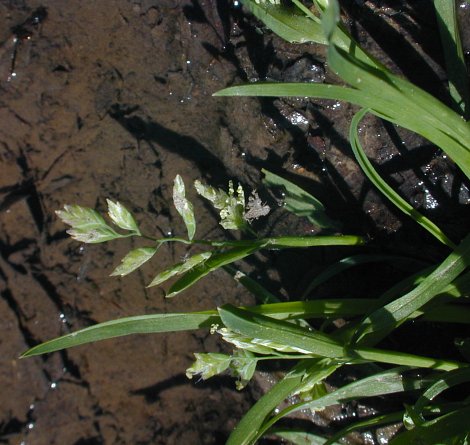
Photographic
Location:
Dirt path across a lawn in Urbana, Illinois, and puddle of water along
a wooded path in east-central Illinois.
Comments:
This dwarf grass is easy to overlook, particularly when it grows in
close proximity to other grasses. For a Poa sp.
(bluegrass), it has short leaf blades and rather plump-looking
seedheads. It is fairly easy to identify because of its small size and
low sprawling stems. To determine the technical characteristics of this
and other bluegrasses, it is highly desirable to use a good 10x hand
lens, or even a field microscope. Such instruments can be used to
detect the presence (or absence) of hairs along the veins and
bases of the lemmas. Some bluegrasses superficially
resemble Eragrostis spp. (love grasses), but the
latter have tufts of hair at the junctions of their blades and sheaths.
Bluegrasses lack such tufts of hair.