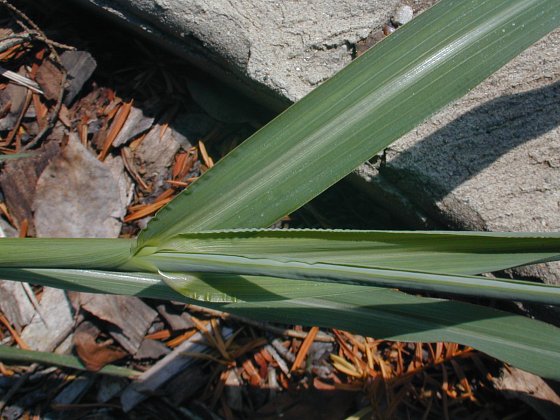
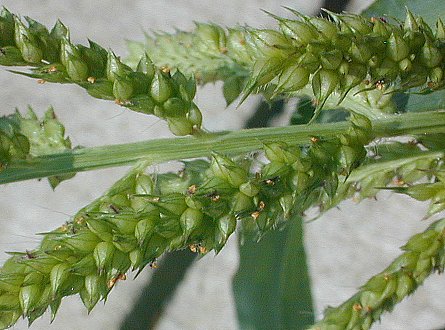
Description: This grass is a summer annual about 1½–4' tall. One or more culms are produced from the base of the rootstock that are sprawling, ascending, or erect; each culm has alternate leaves along its entire length. These culms are green, glabrous, and terete; they are mostly hidden by the leaf sheaths. The leaf blades are up to 1½' long and 1" across, although they are usually smaller in size. These blades are light to medium green, linear-lanceolate, and hairless on both the upper and lower sides. The leaf sheaths are light green to medium green, terete to somewhat flattened, rather loose, and usually hairless; sometimes the sheaths are slightly pubescent toward their apices. The ligules are undeveloped, while the nodes of the culms are slightly swollen and often reddish. Each fertile culm terminates in a panicle of spikelets about 4-12" long and about one-half as much across. Each panicle has 10-25 ascending branches that are straight or slightly incurved; they become shorter as they approach the apex of the panicle. The spikelets extend along the entire length of these branches, except at their bases; these spikelets are arranged along each branch in 2-4 dense rows that face upward or outward. The panicle is barely exerted from the uppermost leaf of the culm; its rachis and branches are light green and angular. The spikelets are 3-4 mm. long, ovoid in shape, and light green. Each spikelet consists of 2 glumes, 2 lemmas, and a perfect floret. The first glume is 1-2 mm. long and ovate in shape, while the second glume and sterile outer lemma are 3-4 mm. long and ovate in shape. Both the second glume and sterile lemma are appressed together, largely hiding the fertile lemma and its floret.
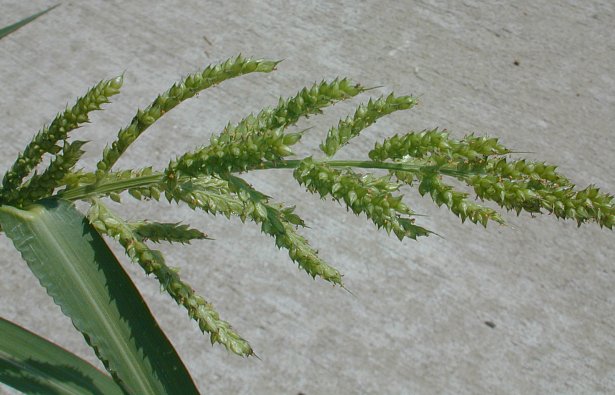
The
outer surfaces of the second glume and sterile lemma have 5
longitudinal nerves that are slender and dark green; these nerves have
bristly hairs, while the surface between the nerves is light
green and hairless to slightly pubescent. In this variety of Barnyard
Grass, the tips of the second glume and sterile lemma are slender and
pointed; sometimes the sterile lemma has an awn up to 3 mm. long. Each
floret has 3 yellow anthers and a pair of stigmas that are pale purple
and plumose. The blooming period can occur from mid-summer into
the autumn, lasting about 2 weeks for a colony of plants. The florets
are
cross-pollinated by the wind. Afterwards, the florets of the spikelets
are replaced by grains (one grain per spikelet).
The grains are 1.5–2 mm. long, broadly elliptic and somewhat
flattened in shape, tapering
to a point at both ends. The root system is fibrous and relatively
shallow. This grass spreads
by reseeding itself. At favorable sites, it can form substantial
colonies.
Cultivation:
The preference is full to partial sun, wet to moist conditions, and a
fertile loamy soil. The seeds germinate only after the weather has
become warm. Barnyard Grass tolerates mesic conditions and less fertile
soil, but the size of individual plants will be reduced.
Range & Habitat:
This variety of Barnyard Grass can be found in every county of
Illinois (see Distribution
Map), where it is common and native. It is almost as common
as the awned variety of Barnyard Grass, Echinochloa muricata
muricata. Habitats include muddy borders of ponds and streams
(in both sunny and partially shaded areas), mud flats, sandbars and
gravel bars in rivers, seasonal wetlands that dry up during the summer,
prairie sloughs, cropland and abandoned fields, gardens, construction
sites, ditches along roadsides and railroads, and waste areas.
Disturbed areas are preferred. This grass can survive severe
degradation of a wetland area; it also occurs at surprisingly dry sites
with a history of disturbance.
Faunal Associations: Insects that feed on Barnyard Grass (Echinochloa muricata, Echinochloa crus-galli) include Phoetaliotes nebrascensis (Large-headed Grasshopper), caterpillars of Lerema accius (Clouded Skipper), Chaetocnema denticulata (Toothed Flea Beetle) and Chaetocnema pulicaria (Corn Flea Beetle), larvae of the leaf-miner flies Agromyza parvicornis (Corn Blotch Leafminer) and Cerodontha dorsalis (Grass Sheath Miner), and larvae of the gall fly Calamomyia echinochloa (Grass Crown Midge); see Brust et al. (2008), Bouseman et al. (2006), Clark et al. (2004), Needham et al. (1928), and Felt (1917). In addition to these insects, this grass is a primary host or secondary summer host of several aphids: Anoecia setariae, Aphis middletonii (Erigeron Root Aphid), Carolinaia rhois, Forda marginata, Geoica utricularia, Hysteroneura setariae (Rusty Plum Aphid), Metopolophium dirhodum (Rose-Grain Aphid), Rhopalosiphum maidis (Corn Leaf Aphid), Rhopalosiphum padi (Bird Cherry & Oat Aphid), Schizaphis graminum (Greenbug), Sipha flava (Yellow Sugar Cane Aphid), Sitobion avenae (English Grain Aphid), Tetraneura nigriabdominalis, and Tetraneura ulmi (Elm Sack Gall Aphid); see Blackman & Eastop (2013). These aphids feed on the roots and other parts of this grass. The seeds are an important source of food to many species of birds, especially dabbling ducks, during the autumn (see the Bird Table for a listing of these species). The seeds are also eaten by the Prairie Deer Mouse and wild House Mouse (Whitaker, 1966). Barnyard Grass is edible to cattle and other livestock, although high nitrates in the foliage may cause bloat if it is eaten in quantity; muskrats feed on the plants to a limited extent (Georgia, 1913; Martin et al., 1951/1961).
Photographic
Location:
Along a sidewalk on the campus of the University of Illinois at Urbana,
Illinois.
Comments:
Barnyard Grass has an unstable taxonomic history. The awnless variety
of Barnyard Grass, Echinochloa muricata wiegandii,
as described here, has the following scientific synonyms: Echinochloa
pungens wiegandii, Echinochloa crus-galli mitis,
and Echinochloa muricata occidentalis. The typical
variety of native Barnyard Grass, Echinochloa muricata
muricata, and the introduced species of Barnyard Grass, Echinochloa
crus-galli, have sterile lemmas with awns about 5–20 mm. in
length. Otherwise, they are quite similar in appearance to awnless
varieties of Barnyard Grass. An uncommon awnless variety of Barnyard
Grass, Echinochloa muricata microstachya, has
purple spikelets with papillose hairs (appearing swollen at their
bases), otherwise it is difficult to distinguish from var.
wiegandii (which has green spikelets and ordinary hairs).
Another awnless species, Echinochloa frumentacea
(Billion
Dollar Grass), has more densely branched panicles than the preceding
species, and its panicles are more narrow because the branches are more
erect or they curve
inward to a greater extent than those of the preceding species. The
spikelets of Billion Dollar Grass are often purplish brown, instead of
green.