Description: This perennial fern consists of irregular tufts of compound leaves; these deciduous leaves are produced directly from spreading rhizomes during the spring. The compound leaves are ¾–1¼' long and similarly across; they are broadly ovate or triangular-ovate in outline. Each compound leaf has 12-20 pairs of leaflets that are joined together at their bases by a winged rachis. The wing of this rachis is strongly angular and irregular; it is more broad at leaflet bases and more narrow between adjacent pairs of leaflets. For each compound leaf, the lowest pair of leaflets are descending, while the remaining pairs of leaflets are widely spreading. The 2 lowest leaflets are broadly lanceolate in outline, while the remaining leaflets become more narrow as they ascend the rachis (changing from lanceolate to oblong-lanceolate in outline). All of the leaflets taper into narrow tips. The leaflets are pinnatifid with 8-20 pairs of lobes; the lobes of upper leaflets are short-oblong with obtuse tips, while the lobes of lower leaflets are more lanceolate with tapered tips.
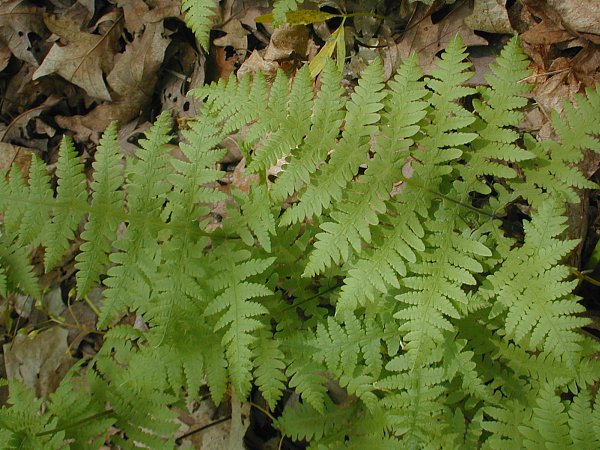
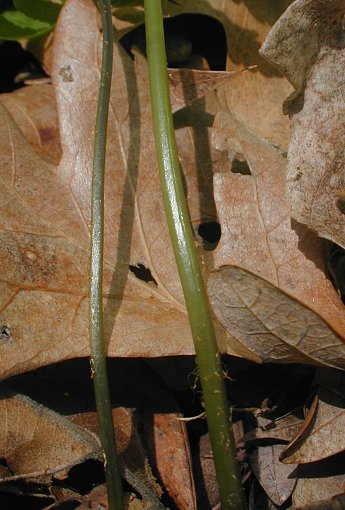
The lobes of the lowest leaflets are shallowly pinnatifid, while the lobes of the middle to upper leaflets are crenate to smooth (entire) along their margins. The upper leaf surface is pale green to dark green and hairless to slightly pubescent. The lower leaf surface is pale green to medium green and nearly hairless to moderately pubescent; the lower leaf surface is especially hairy along the rachis of the compound leaf and the central stalks of the leaflets. The petioles of the compound leaves are ½–¾' long; they are light green, stramineus (straw-colored), or pale reddish green. In addition, the petioles are terete and glabrous; sometimes there are a few light-colored scales near their bases. The sori (spore-bearing structures) are located on the undersides of the leaflets on their lobes; they are small, round, and reddish brown at maturity. The sori lack indusia (protective membranes); they are located near the tips of veinlets, where they can be either near or remote from the margins of the lobes. The spores are released during the summer and distributed by the wind. The root system is rhizomatous and fibrous.
Cultivation:
The preference is dappled sunlight to medium shade, moist to dry-mesic
conditions, and a somewhat acid soil with abundant organic matter
(including a layer of fallen leaves). This fern normally grows
underneath deciduous trees; it is adaptable to shade gardens.
Range
&
Habitat: The native Beech Fern is occasional to
locally common in western
and southern Illinois, while elsewhere in the state it is
occasional
to absent (see Distribution
Map). Habitats include upland woodlands, wooded slopes,
and wooded bluffs. In Illinois, this fern is commonly associated
with oak trees (instead of beech trees); it is usually found in higher
quality woodlands where the original ground flora is intact.
Faunal Associations:
Specific information about floral-faunal relationships for this species
is unavailable.
Photographic Location:
A wooded slope near Charleston, Illinois, in Coles County.
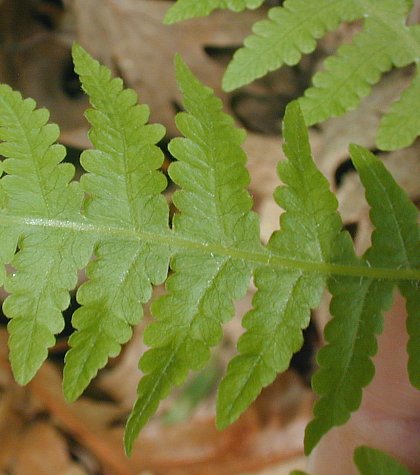
Comments: This medium-small fern has attractive leaves. Beech Fern (Phegopteris hexagonoptera) can be distinguished from other ferns by its winged rachis; this winged extension of the rachis is strongly angular and it connects all of the leaflets. The leaves of this fern are unusual because they are about as wide at the base as they are long; other ferns usually have leaves that are longer than they are wide. The other species in this genus that occurs in Illinois, Long Beech Fern (Phegopteris connectilis), has leaves that are longer than they are wide, and the winged extension of its rachis doesn't extend to the lowest 1-2 pairs of leaflets. Like the more common Beech Fern, the sori of the Long Beech Fern lack indusia; this characteristic distinguishes them from closely related ferns in the Thelypteris genus (as well as many other ferns). Two scientific synonyms of the Beech Fern are Thelypteris hexagonoptera and Dryopteris hexagonoptera. Other common names of this species are the 'Broad Beech Fern' and 'Southern Beech Fern.'