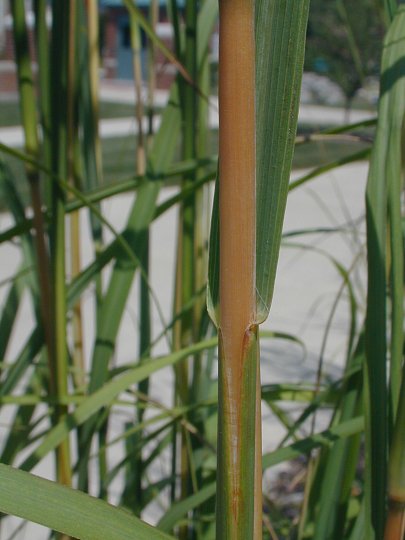
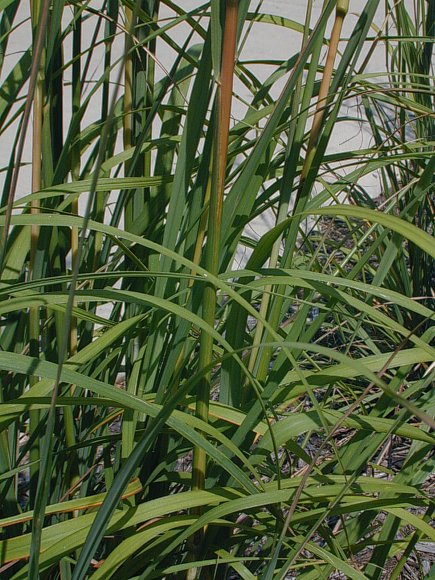
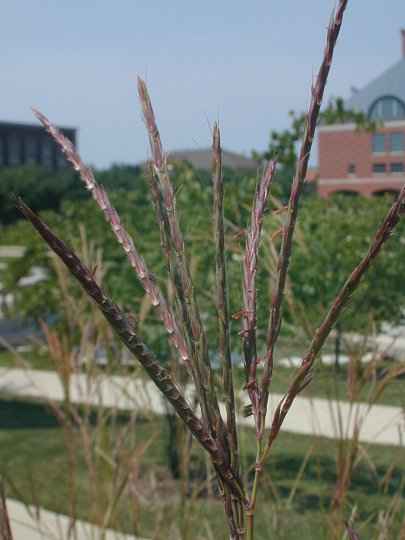
Description: This perennial grass is 3-8' tall, more or less erect, and unbranched or little-branched. Each culm is terete, tan-colored, and hairless; its nodes are dark-colored, slightly swollen, and glaucous. There are several alternate leaves that become smaller as they ascend the culm; they are located mostly along the lower one-third of the culm. The leaf blades are up to 1½' long and ½" across; they are dull green to glaucous blue, linear in shape, mostly hairless, and outward-arching. The leaf sheaths wrap tightly around the culm; they are dull green to glaucous blue, and mostly hairless. Sometimes there are short hairs near the ligules. Each culm terminates in 2-6 narrow racemes of spikelets that together form an inflorescence. These spike-like racemes originate near the base of the inflorescence and spread outward, forming a V-shape in 3-dimensions. Individual racemes are 2-6" long.
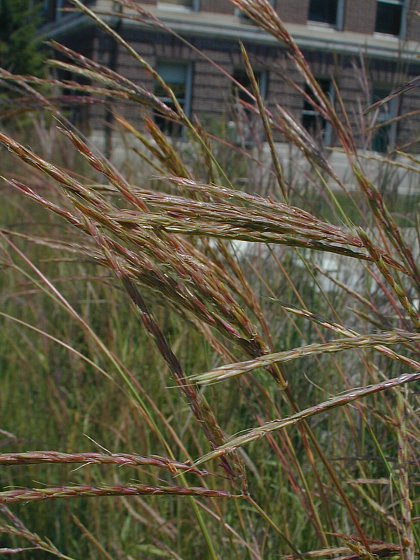
The spikelets occur in pairs along each raceme; either they are appressed against the central rachis (central stalk) of the raceme, or they are slightly spreading. One spikelet in a pair is sessile and perfect, while the other spikelet is pedicellate and staminate. The pedicels of the latter spikelets are covered with short fine hairs. Both kinds of spikelets are up to 10 mm. in length and similar in size; they have narrowly lanceolate glumes. The fertile lemma of the sessile spikelet has a straight awn up to 12 mm. (½") long. The spikelets are dull greyish green to purplish red in color; their anthers are yellow to dull red. The blooming period occurs during late summer or early fall, lasting about 1-2 weeks. The florets are cross-pollinated by the wind. Afterwards, the perfect florets are replaced by grains (one grain per spikelet). The root system is fibrous and short-rhizomatous. Big Bluestem is a bunchgrass as tight tufts of culms are produced from these rhizomes.
Cultivation:
The
preference is full sun, moist to slightly dry conditions, and a fertile
loam or clay-loam. Other kinds of soil are tolerated, including those
containing sand and gravel. This is an easy grass to grow, although it
can be aggressive because of its large size. During the winter, the
tall naked culms have a tendency to topple over.
Range & Habitat:
Big Bluestem is a common grass that has been found in every county of
Illinois (see Distribution
Map), where it is native. Before the prairies covering much
of the state were
plowed under, Big Bluestem covered large areas because it is one of the
dominant species of the tallgrass prairie. Habitats include black soil
prairies, clay prairies, gravel prairies, dolomite prairies, sand
prairies, hill prairies, savannas, sandy savannas, grassy fens,
limestone and sandstone glades, roadsides, and fallow fields. Big
Bluestem is often used in prairie restorations and it is occasionally
used as an ornamental grass in horticulture. It tolerates occasional
wildfires, but not heavy grazing.
Faunal Associations: The caterpillars of several skippers feed on the foliage, including Atrytone logan (Delaware Skipper), Atrytonopsis hianna (Dusted Skipper), Hesperia leonardus (Leonard's Skipper), Hesperia metea (Cobweb Skipper), Hesperia ottoe (Ottoe Skipper), Hesperia sassacus (Indian Skipper), and Problema byssus (Byssus Skipper). Big Bluestem is an important food plant of many grasshoppers (see Grasshopper Table). Other insects that feed on this prairie grass include Conocephalus brevipennis (Short-winged Meadow Katydid), Neoconocephalus ensiger (Sword-bearing Conehead), the thrips Frankliniella unicolor and Chirothrips texanus, Sphenophorus destructor (Destructive Billbug), and many leafhoppers, including Flexamia prairiana and Laevicephalus unicoloratus. The seeds are eaten sparingly by granivorous songbirds, including the Field Sparrow, Tree Sparrow, and Chipping Sparrow. The foliage is readily eaten by hoofed mammalian herbivores, including bison, cattle, and other livestock. The Meadow Vole and Prairie Vole eat the foliage as well.
Photographic
Location:
The campus of the University of Illinois at Urbana-Champaign.
Comments:
This is the dominant grass of the tallgrass prairie. Big Bluestem is a
warm-season grass with a C4 metabolism. As a result, it develops slowly
during the cool weather of spring and doesn't become tall until
mid-summer. This provides an opportunity for cool-season grasses and
forbs to develop and produce flowers before the Big Bluestem becomes
dominant. The common name refers to the size of this grass and the
color of its leaves (both sheaths and blades). While some specimens of
Big Bluestem have blue leaves, others have dull green leaves. Other Andropogon
spp. (Beard Grasses) tend to be shorter grasses that have
hairier
spikelets. Usually, their pedicellate spikelets are much smaller than
their sessile spikelets, or they are undeveloped.