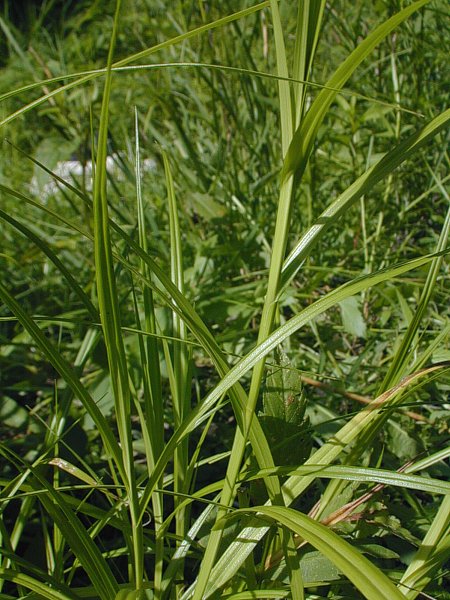
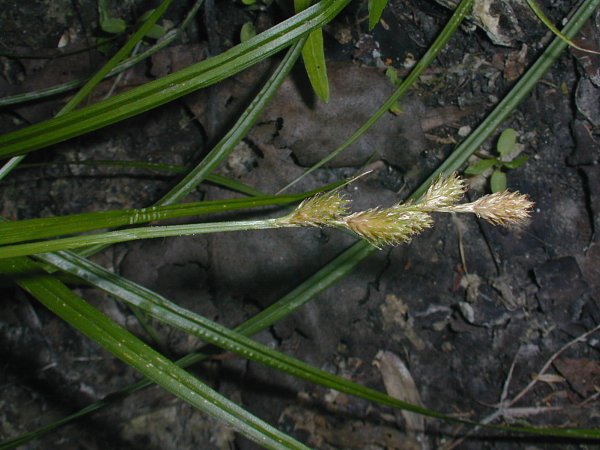
Description: This perennial sedge is about 1½–3' long with its culms erect or ascending. It often forms loose tufts of leafy culms; the majority of these shoots are sterile and they don't produce floral spikelets. The culms are light green, glabrous, and 3-angled. About 5-10 alternate leaves are produced per culm; for fertile shoots, these leaves are located along the lower one-half of the culm, while for sterile shoots these leaves are located along the entire length of the culm, including its apex. The leaf blades are up to 7 mm. across and 16" long; they are ascending to arching and rather floppy. The leaf blades are light to medium green, linear in shape, furrowed along the middle, glabrous, and slightly rough-textured along their margins. The leaf sheaths wrap tightly around the culm; the two outer sides of each sheath are light green, longitudinally veined, and glabrous, while its inner side is translucent-membranous. Each fertile culm terminates in an inflorescence up to 2½" long that consists of 5-12 spikelets. These spikelets are partially overlapping to slightly separated along the rachis (central stalk) of the inflorescence. The spikelets are gynecandrous (staminate florets are located at the base of the spikelets, while pistillate florets and their perigynia are located above).
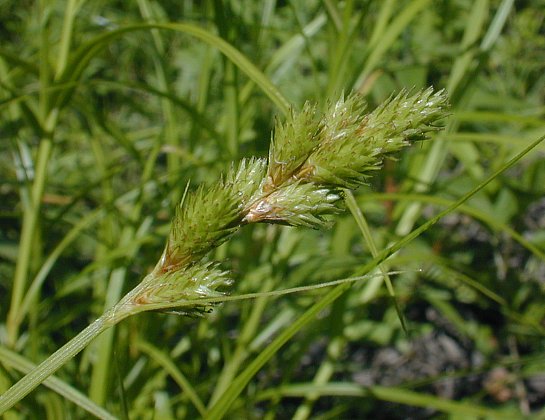
Individual spikelets are 6-10 mm. in length, obovoid in outline, and prickly in appearance because of the beaks of the ascending perigynia. The perigynia are 3-5 mm. long, 1.25–1.75 mm. across, and flattened-lanceoloid in shape, tapering to slender beaks. The bases of perigynia are somewhat wedge-shaped, while their upper halves have narrowly winged margins. The pistillate scales are 2-3 mm. long and lanceolate in shape; they are green-veined in the middle, while their margins are membranous. Immature spikelets are light green, while mature spikelets become light brown. At the base of the lowest spikelet in an inflorescence, there is usually a green bract that is linear in shape and ½" in length or longer; the second lowest spikelet may have a conspicuous bract at its base as well. The blooming period usually occurs during early to mid-summer, although some plants occasionally bloom later. The florets are cross-pollinated by the wind. Mature achenes are about 1.5 mm. in length, broadly oblongoid and somewhat flattened in shape, glabrous, and brown; both the top and bottom of each achene are apiculate (tapering abruptly into short narrow tips). The root system is fibrous and rhizomatous. This sedge often forms small colonies of plants.
Cultivation:
The preference is full sun to light shade and wet to moist conditions.
Various kinds of soil are tolerated, including those that are gravelly,
sandy, peaty, silty, and loamy.
Range & Habitat:
The native Blunt Broom Sedge is common in southern Illinois and
occasional to locally common in other areas of the state (see Distribution
Map).
Habitats include floodplain and bottomland woodlands, low areas along
vernal pools in woodlands, swamps, moist meadows in wooded areas, moist
meadows along
rivers, powerline clearances in wooded areas, wet black soil prairies,
wet sand prairies, wet dolomite prairies, marshes, peaty bogs, gravelly
seeps, low areas along ponds and lakes, and ditches. This sedge occurs
in a
greater variety of habitats than most others. Blunt Broom Sedge adapts
well
to areas with a history of disturbance, although it is also
found in higher quality natural areas.
Faunal
Associations:
Blunt Broom Sedge and other sedges (Carex
spp.) in wetland and woodland habitats are host plants of
the larvae of various butterflies, skippers, and moths (see Lepidoptera
Table). Other
insects feeding on these sedges include Stethophyma
lineata (Striped Sedge Grasshopper), Stethophyma
celata (Otte's Sedge Grasshopper), Stethophyma gracile
(Graceful Sedge Grasshopper), Scudderia
curvicauda (Curve-tailed Bush Katydid), leafhoppers
(especially Cosmotettix spp.), Iziphya americana
and other aphids, semi-aquatic leaf beetles (especially Plateumaris spp.), Sphenophorus costicollis
(Sedge Billbug) and other billbugs, the seed bugs Cymus angustatus
and Oedancala dorsalis,
the plants bugs Mimoceps
insignis and Teratocoris
discolor, and the stink bug Eurygaster
alternata. Among vertebrate animals, the seeds of sedges
in wetland and
woodland habitats are a significant source of food for various upland
gamebirds, waterfowl, and granivorous songbirds (see Bird
Table).
Photographic Location:
A moist meadow underneath a powerline clearance and a low shaded area
along a vernal pool at Busey Woods in
Urbana, Illinois.
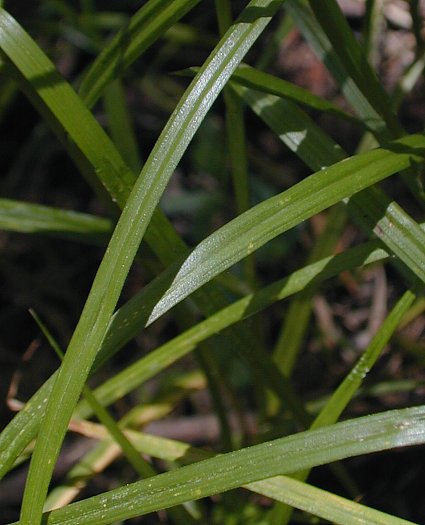
Comments: Blunt Broom Sedge is a member of the Ovales section of sedges (Carex spp.); species in this section are often difficult to distinguish from each other. These sedges have slender leaves, narrow inflorescences of small prickly spikelets, pistillate florets with 2 stigmata, and flattened perigynia with rounded bodies and narrow beaks. They differ from each other primarily in the distribution of their spikelets along the rachis of the inflorescence (widely separated, congested and overlapping, or somewhere inbetween), the number of spikelets per inflorescence, the shape of these spikelets (rounded or conical at one or both ends), and the size and/or shape of their perigynia. Blunt Broom Sedge has spikelets that are neither widely separated nor strongly clustered together, they are relatively numerous (5-12 spikelets per inflorescence), and they are more rounded at the top than the bottom. The perigynia of Blunt Broom Sedge are at least twice as long as they are across, narrowly winged along the upper half of their margins, and more wedge-shaped at the bottom than rounded. This sedge also produces more leaves per culm (5-10) than many other sedges, and it also produces an abundance of sterile shoots. Some authorities describe two varieties of Blunt Broom Sedge: the typical variety has perigynia that are 3-5 times as long as they are wide, while var. sangamonensis has perigynia that are 2-3 times as long as they are wide.