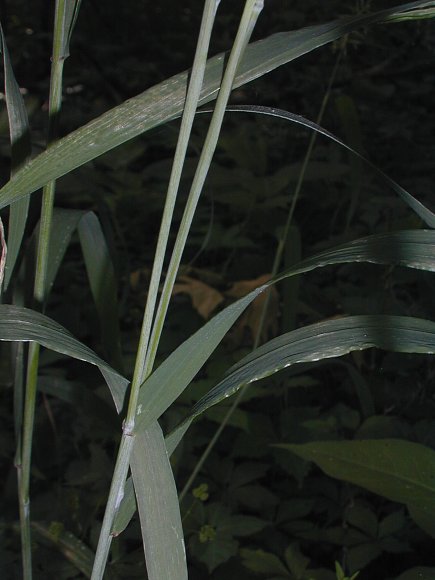
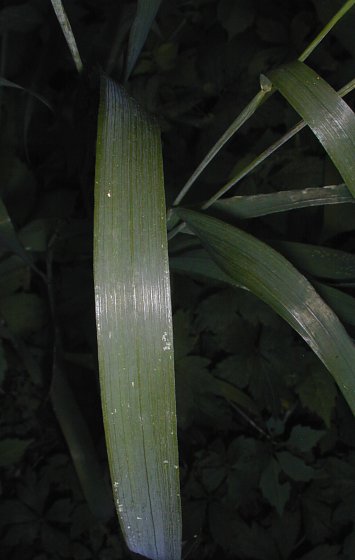
Description: This perennial grass is 2½–5' tall. The erect central culm is green, terete (circular in cross-section), glabrous, and unbranched. Alternate leaves occur along most of the length of the culm. The leaf blades are up to 12" long and 15 mm. across; they are grayish green to dark green, usually hairless (less often short-pubescent on their undersides), ascending to widely spreading, and rather floppy. The leaf sheaths are grayish green, longitudinally veined, hairless to short-pubescent, and sometimes glaucous. The ligules are white-membranous, although they eventually turn brown. The narrow nodes are swollen and sometimes whitened. The central culm terminates in a spike-like raceme about 3½-8" long; this raceme is more or less erect and cylindrical in outline. Pairs of divergent spikelets are distributed bilaterally along the rachis (central stalk) of this raceme at some distance from each other; they are more or less perpendicular to the rachis and widely spreading. The basal stalklets of the paired spikelets are less than 3 mm. in length.
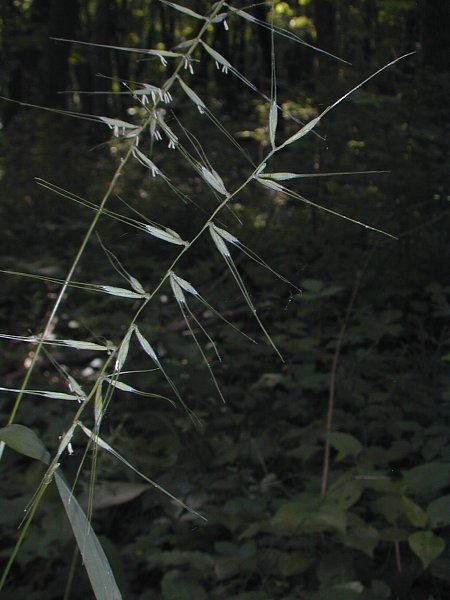
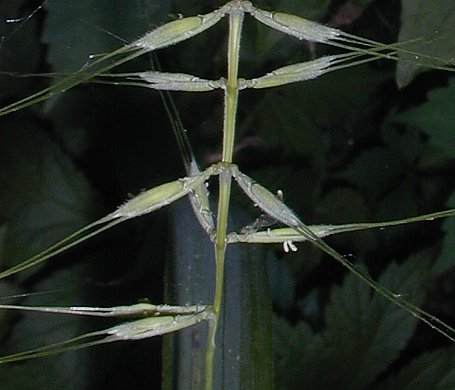
Each spikelet has 2-4 fertile lemmas. Usually, there are no glumes, although sometimes the lower spikelets have glumes that are reduced to awns up to 15 mm. long. Individual lemmas are about 7-12 mm. long and their straight awns are 10-40 mm. (½–1½") long. When 1-2 inner lemmas are present in a spikelet, they tend to be smaller in size and have shorter awns than the 2 outer lemmas. During the blooming period, the lemmas are whitish green or grayish green, linear-lanceolate in shape, convex along their outer surfaces, and 3-5 veined. In the typical variety of Bottlebrush Grass, the lemmas are hairless, while var. bigeloviana has pubescent lemmas. The awnless paleas are about the same length as the lemmas. Each floret of a fertile lemma has 3 white anthers, a pair of plumose stigmas, and an ovary. The blooming period occurs during the summer, lasting about 1-2 weeks for a colony of plants. The florets are cross-pollinated by the wind. Afterwards, the spikelets become stramineus (straw-colored) at maturity and they break apart into individual lemmas. The narrow grains are contained with adherent pericarps (persistent lemmas and paleas). The root system is fibrous. This grass spreads by reseeding itself; it often forms small colonies of several plants.
Cultivation:
The preference is partial sunlight to light shade, moist to slightly
dry conditions, and loamy soil that contains decaying organic matter.
This grass is adaptable to cultivation.
Range & Habitat:
The typical variety of Bottlebrush Grass occurs in every county of
Illinois, where it is fairly common; var. bigeloviana
is widely scattered across the state and apparently less common (see
the Distribution
Map for this latter variety). Both varieties of this grass
are native to the state. Habitats of both varieties include mesic
deciduous woodlands, rocky upland woodlands, woodland openings,
woodland borders, areas along woodland paths, small meadows in wooded
areas, savannas, rocky glades, and partially shaded riverbanks.
Bottlebrush Grass is usually found in average to high quality woodlands
and adjacent areas. This species is often used in savanna and woodland
restorations; it is also cultivated as an ornamental grass in gardens.
Faunal Associations: The caterpillars of a butterfly, Enodia anthedon (Northern Pearly Eye), feed on foliage of Bottlebrush Grass, as do larvae of the leaf-mining moths Elachista epicmicta, Elachista illectella, Elachista leucofrons, Elachista orestella, and Elachista praelineata (Bouseman & Sternburg, 2001; Microleps website, 2010; Needham et al., 1928). Other insects that feed on this grass include the stem-boring larvae of Papaipema cerina (Golden Borer Moth), the leaf-mining larvae of a Scythrid moth, Asymmetrura graminivorella, the leaf-mining larvae of a leaf beetle, Chalepus walshii, and the leaf-mining larvae of a fly, Cerodontha angulata (Panzer et al., 2006; Needham et al., 1928; Clark et al., 2004). Other insects that feed on Elymus spp. in shaded or partially shaded areas include two aphids, Carolinaia howardii and Carolinaia rhois, and two leafhoppers, Elymana acuma and Sorhoanus orientalis (Blackman & Eastop, 2013; DeLong, 1948). These grasses are summer hosts of the aphids. Among vertebrate animals, the seeds of Elymus spp. are eaten by the White-footed Mouse (Whitaker, 1966), while the foliage, prior to the development of the seedheads, is edible to livestock. Because of their long awns, the seedheads of these grasses, including those of Bottlebrush Grass, can cause mechanical injury to livestock.
Photographic
Location:
A mesic deciduous woodland at Busey Woods in Urbana, Illinois. The
photographs show Elymus hystrix bigeloviana, which
has pubescent lemmas.
Comments:
Bottlebrush Grass (Elymus
hystrix) has a distinctive inflorescence and an attractive
appearance. The bottlebrush appearance of the floral raceme makes it
easy to identify. The spikelets of other Wild Rye grasses (Elymus
spp.) are less remote from each other and more erect along
the rachises (central stalks) of their floral racemes. Other Wild Rye
grasses also have a pair of long glumes at the bases of their
spikelets, while the spikelets of Bottlebrush Grass usually lack such
glumes (or they have been reduced to awns up to 15 mm. long). Because
of these structural differences, Bottlebrush Grass was assigned to a
different genus in the past and referred to as Hystrix patula.
Because this grass forms a naturally occurring hybrid with Virginia
Wild Rye (Elymus
virginicus), it was reassigned to the Elymus genus. The
hybrid of these two grasses is referred to as Ebinger's Wild Rye (Elymus × ebingeri).
This hybrid displays characteristics that are intermediate between the
two parents. In particular, the spikelets are distributed along its
floral racemes at intermediate densities, and the glumes of this hybrid
are
often reduced to long awns that exceed 15 mm. in length (or the bodies
of its glumes are linear in shape, rather than linear-lanceolate).