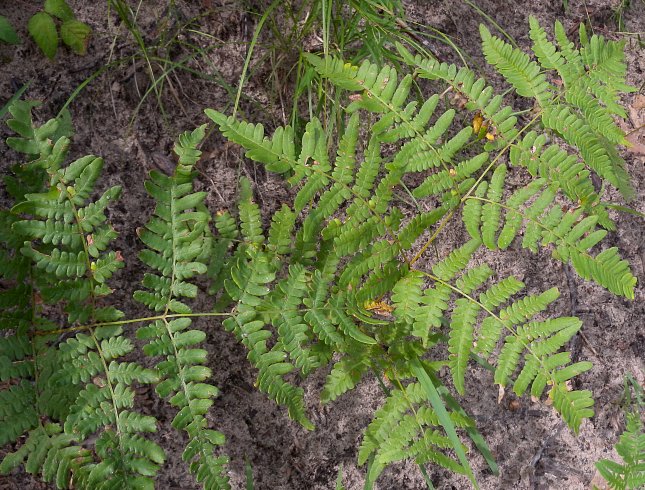
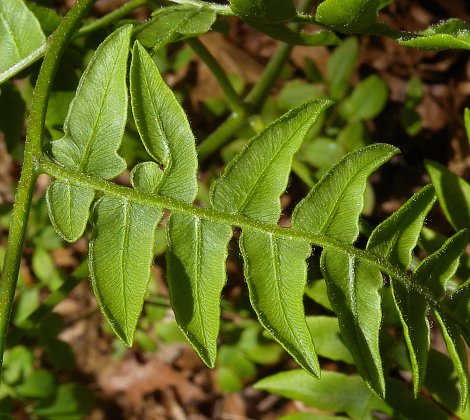
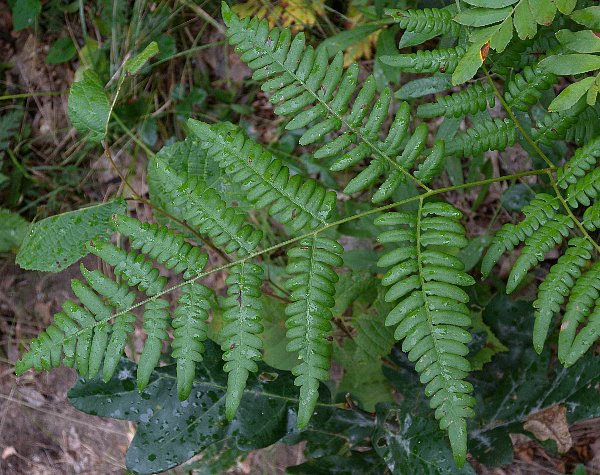
Description: This perennial fern develops an erect and rather stout petiole up to 3' tall, from which there extends a single compound leaf up to 3½' long and 3' across that is triangular in outline. In shady areas, the compound leaf usually extends horizontally in relation to the ground, while in sunny areas it is more ascending. The compound leaf varies in color from yellowish green to medium green; its upper surface is glabrous or nearly so, while its lower surface is glabrous to sparsely short-pubescent. The compound leaf has an irregular structure; it is mostly bipinnate-pinnatifid and, to a lesser extent, tripinnate-pinnatifid. Along the central rachis of the fern, there are up to 12 pairs of leaflets that become progressively smaller in size; the leaflets toward the base of the rachis are much longer than the leaflets toward its tip. Individual leaflets are mostly pinnate-pinnatifid, although some of the larger leaflets toward the base of the rachis are partly bipinnate-pinnatifid; there are up to 15 pairs of subleaflets per leaflet that gradually become shorter toward its tip, where there is a terminal subleaflet. The subleaflets are mostly pinnatifid; they have up to 12 pairs of oblong lobes and a terminal lobe. When ultimate leaflets are present, they are either smooth or they have up to 4 pairs of basal lobes that are oblong in shape. The terminal lobes of leaflets and subleaflets are elongated in shape and finger-like in appearance; they are 3-6 mm. (1/8–1/4") across and 2-4 times longer than they are wide. The petiole, central rachis, and lateral stalks of each compound leaf are light green to yellowish green and glabrous to finely short-pubescent.
The margins of the
subleaflets, ultimate leaflets, and lobes are smooth and sometimes
slightly undulate; they curve downward. The reproductive structures
(indusia, sporangia) are
located along these rolled margins on the underside of the compound
leaf. These reproductive structures are produced sparingly; when they
occur, the spores are usually released during the summer or autumn. The
root
system system is fibrous and long-rhizomatous; individuals rhizomes can
extend many yards (or meters), sending up new clonal shoots every
1-6 feet. As a result, sizable colonies of plants are fairly common.
The growing tips of rhizomes are either glabrous or sparsely white
hairy. The compound leaves are deciduous and sensitive to frost; they
die down and turn brown during the winter.
Cultivation:
The preference is light shade to full sun, moist to dry conditions, and
an acidic rocky or sandy soil (especially the latter). This fern can
spread aggressively. The foliage is susceptible to various fungal
diseases.
Range &
Habitat:
The native Bracken Fern is occasional to locally common in northern and
west-central Illinois, becoming less common elsewhere in the state
(see Distribution
Map).
This fern is widely distributed throughout the
world. Habitats include open woodlands, sandy woodlands, rocky wooded
slopes, sandstone cliffs, sandy savannas, sandy thickets, stabilized
foredunes near Lake Michigan, sedge
meadows, moist sand prairies, and sandy banks of roadsides. Bracken
Fern is particularly common in burned-over areas; its dried leaves
provide abundant fodder for wildfires.
Faunal Associations:
Some insects are known to feed on Bracken Fern. They include the
caterpillars of some moths: Papaipema pterisii
(Bracken Borer Moth), Callopistria cordata
(Silver-Spotted Fern Moth), Callopistria granitosa
(Granitosa Fern Moth), and Homochlodes fritillaria
(Pale Homochlodes). Other insects that feed on this fern include larvae
of the sawfly Aneugmenus
flavipes, larvae of the sawfly Strongylogaster multicincta,
the aphid Macrosiphum
ptericolens, and the aphid Mastopoda pteridis.
Extra-floral nectaries are located at the bases of
the major branches of each compound leaf. These nectaries attract ants
and other insects; their purpose is not well-understood. The leaves are
rarely eaten by mammalian herbivores because of their bitter taste and
toxicity. Young leaves produce a cyanide compound when they are
damaged. The leaves also contain an enzyme that can cause thiamine
deficiency and several carcinogenic compounds that are associated with
cancer of the digestive tract and bladder. Both cattle and horses have
been seriously poisoned by eating too much Bracken Fern. Because this
fern often forms large colonies, it provides leafy cover to many kinds
of wildlife. The Indigo Bunting and Chestnut-Sided Warbler have been
known to construct nests on Bracken Fern.
Photographic
Location:
A stabilized foredune at the Indiana Dunes State Park in NW Indiana, a
sandy woodland at the Oak Openings Nature Preserve in NW Ohio,
and a sandy savanna at the Iroquois County Conservation
Area in Iroquois County, Illinois.
Comments:
This large fern varies in attractiveness depending on the condition of
its leaves. Because of its relatively large size and tendency to be
locally abundant, Bracken Fern lends an exotic tropical aura to the
temperate woodlands and savannas where it occurs. This effect is
magnified when it occurs with other large ferns, like Osmunda
regalis (Royal Fern) and Matteuccia struthiopteris
(Ostrich Fern). Because of the triangular shape of its compound leaves
and its tall erect petiole, Bracken Fern is easy to recognize, although
somewhat variable across its range: several varieties have been
described. In Illinois, var. latiusculum is by far
the most common variety of Bracken Fern; the only other variety in the
state, var. pseudocaudatum, is found in widely
scattered locations in the southern half of the state. This latter
variety has terminal lobes that are even longer than those of var.
latiusculum: they are 6-15 times longer than they are across.