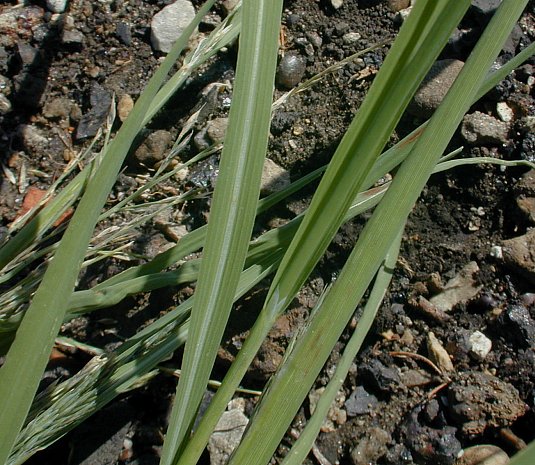
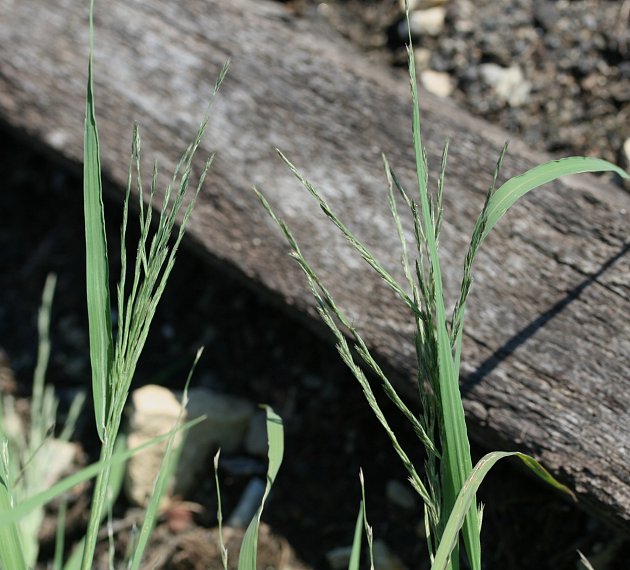
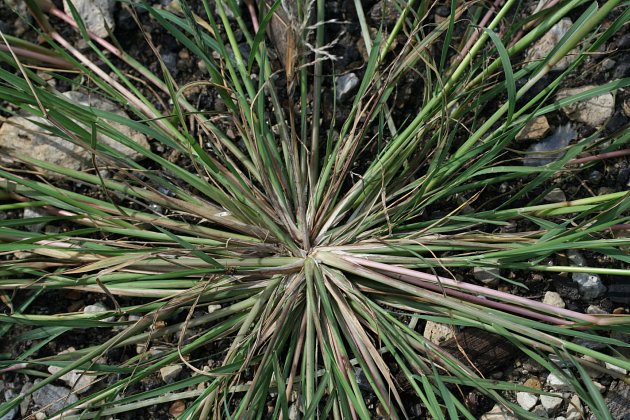
Description: This grass is a summer annual. In open areas, it forms a large tuft of foliage spanning about 2' across and 1½' high. In areas with dense vegetation, it is more erect and about 2-3' tall. The culms are often decumbent near the base, where they often form rootlets along the lower nodes. The culms are terete, glabrous, and branched; they are variably colored, including bone white, light green, or light reddish green. The blades of alternate leaves are up to 8" long and 5 mm. across; they are light to medium green, rough-textured, and ascending to widely spreading. The sheaths are light to medium green and sometimes tinted purplish red near the base of the plant; they are longitudinally veined, hairless, and often rather loose. At the junctions of sheaths and blades, the ligules are white-membranous and at least 3-5 mm. long. The nodes along each culm are dull and dark-colored. The culms terminate in panicles of spikelets. The typical panicle is about 4-8" long and 2-3½" across; it has a rachis (central stalk) and several lateral branches.
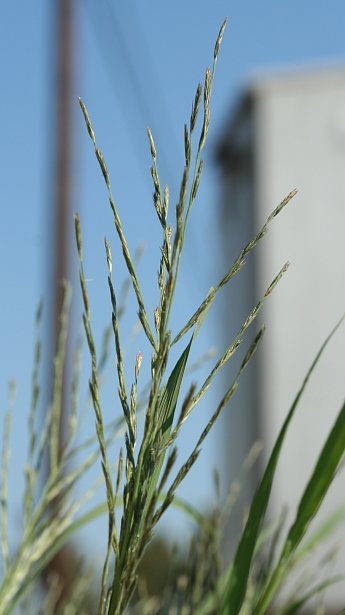
Both the rachis and lateral branches are stiff, rough-textured, and straight. The lateral branches originate from the rachis in pairs or individually; they are up to 3½" long and ascending. Many appressed spikelets occur along the length of each lateral branch; they are nearly sessile. The spikelets are about 7-11 mm. long, 2 mm. across, and somewhat flattened; each spikelet has a pair of glumes at the bottom and 5-10 lemmas above that are organized into 2 overlapping ranks. The glumes are linear-lanceolate to lanceolate with green midveins along their keels; one glume is about 2 mm. long, while the other is about 3 mm. long. The lemmas are linear-lanceolate to lanceolate and about 4-5 mm. long; each lemma has a green midvein on its keel, 2 green lateral veins, and a slightly awned tip (less than 1 mm. in length). Each lemma encloses a palea with a perfect floret. The blooming period occurs from mid-summer to early autumn, lasting about 1-2 weeks for a colony of plants. The florets are cross-pollinated by wind. The grains are about 2 mm. long, ovoid, and somewhat flattened. The root system is fibrous. This grass reproduces primarily by reseeding itself.
Cultivation:
The
preference is full sun, wet to moist conditions, and rather sterile
soil that is alkaline and/or salty. The C4 metabolism of this grass
enables it to withstand hot weather and periods of drought.
Range & Habitat:
The native Bearded Sprangletop is occasional in SW
Illinois, and uncommon or absent in the rest of the state (see
Distribution
Map). At one time, this species was uncommon and largely
restricted to SW Illinois, but it has become more common and is
spreading into new areas. Habitats include wet open woodlands,
disturbed areas of marshes, sand flats, construction sites, roadside
ditches, and low gravelly areas along railroads. This grass flourishes
in low areas where road salt accumulates; it also likes low areas where
limestone gravel is present. In the Great Plains and western states,
this grass can be found in brackish marshes. In Illinois, this species
is more common in disturbed areas.
Faunal Associations: Little information is available about floral-faunal relationships for Bearded Sprangletop. A polyphagous insect, Melanoplus sanguinipes (Migratory Grasshopper), eats the foliage of a related grass, Leptochloa filiformis (Red Sprangletop), and many other species of grasses (Wyoming Agr. Exp. Sta., 1994). In marshes and other wetlands, the Green-Winged Teal, Blue-Winged Teal, Mallard, and probably other dabbling ducks eat the seeds of Bearded Sprangletop (Havera, 1999). I suspect that the Mourning Dove and many sparrows eat the seeds of this grass occasionally when it occurs along railroads and roadsides.
Photographic
Location:
A low gravelly area along a railroad in Champaign, Illinois.
Comments:
Bearded Sprangletop (Leptochloa
fascicularis) is a rather weedy-looking
grass that likes to sprawl across open ground. Nonetheless, its stiff
inflorescence can be more or less erect. This grass is very
similar in appearance to a more western species, Malabar Sprangletop (Leptochloa
fusca). The latter species has larger
glumes and its foliage is even more rough-textured. Some authorities
classify Bearded Sprangletop as a subspecies of the latter species, or Leptochloa fusca fascicularis.
Other Leptochloa spp. (Sprangletop grasses) in
Illinois are perennials; they have spikelets that lack awns and their
glumes and lemmas are shorter in length. These species also occur in
wetlands, primarily in southern Illinois.