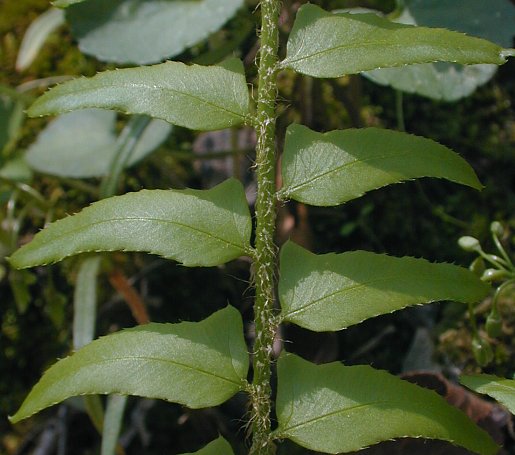
Description: This perennial fern is 1½–2½' tall, consisting of a loose tuft of several leaves that are erect to ascending. The compound leaves are up to 2' long, 5" across, simple-pinnate in their structure, and evergreen. Fertile leaves are longer than infertile leaves. Each compound leaf has 20-40 leaflets, which are arranged in two ranks on either side of the rachis (or central stalk); the compound leaf is oblong or oblong-lanceolate in outline. Most of the leaflets are arranged alternately along the rachis; they are yellowish green to dark green, lanceolate to lanceolate-oblong in shape, glabrous, leathery, and rather lustrous in appearance. Leaflet margins have narrow fine teeth that are spaced moderately apart from each other. Leaflet bases are often asymmetric – one side of a leaflet base is longer and more pointed than the other. Leaflet venation is pinnate; the lateral veins are straight, but they are not very conspicuous.
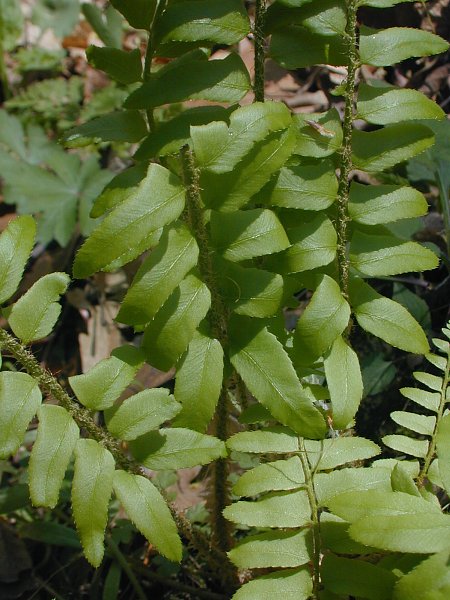
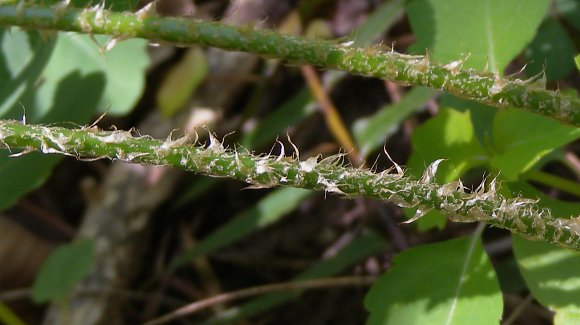
The leaflets also have short petiolules (basal stalklets) that are less than 1/8" (3 mm.) in length; they are attached closer to the less pointed sides of the leaflet bases. The rachis (or central stalk) of each compound leaf is light green to medium green, rather stout, and conspicuously scaly; the membranous scales are white to light brown. The light to medium green petiole (up to 6" long) is shorter than the rest of the compound leaf; it is also rather stout and even more scaly than the rachis. The sori (spore-bearing structures) are restricted to the upper leaflets of fertile leaves; they are small, round, and reddish brown. The sori can be found in two rows along the central vein and near the terminal points of lateral veins on the leaflet undersides; sometimes they cover the entire underside of a leaflet. The sori develop and release their spores to the wind during the summer or early fall. The root system consists of a stout dark rhizome with remnants of leaf stalks above and abundant fibrous roots below. Plants can occur individually or in small loose colonies.
Cultivation:
The
preference is light shade, mesic to slightly dry conditions, and soil
that is loamy or rocky with abundant leaf litter.
Range & Habitat:
The native Christmas Fern is occasional to locally common in southern
and central Illinois, becoming uncommon in northern Illinois (see
Distribution
Map).
Habits include mesic woodlands, rocky upland woodlands,
wooded bluffs, slopes of wooded ravines, and shaded cliffs.
This fern is
especially likely to be found where either limestone or sandstone comes
close to the ground surface in hilly woodlands. These habitats are
dominated by deciduous canopy trees.
Faunal Associations:
An aphid, Amphorphora
ampullata,
sucks plant juices from the Christmas Fern and other ferns. During the
winter, the evergreen fronds of this fern are eaten sparingly by
White-Tailed Deer. In addition, young fronds may be eaten by such
upland gamebirds as the Ruffed Grouse and Wild Turkey. Overall, the
value of this fern to wildlife is limited.
Photographic
Location:
The edge of a wooded bluff in Vermilion County, Illinois.
Comments:
The common name refers to the practice of gathering the evergreen
leaves during Christmas time as a holiday decoration. This attractive
fern is fairly easy to identify because of its scaly stalks and
leathery leaflets with asymmetrical bases. It is the only member of its
genus in
Illinois. A related species, Polystichum
braunii (Braun's Holly Fern) is typically found in the
coniferous forests of northern boreal areas. This latter species has
bipinnate or
pinnate-pinnatifid leaves and its ultimate leaflets have stout sharp
teeth. Thus, it has a very different appearance from the Christmas
Fern. Some Asplenium spp. (spleenworts)
superficially resemble the Christmas Fern because of their
simple-pinnate leaves; their leaflets sometimes have asymmetric
bases. However, the spleenworts are smaller in size (up to 1½'
tall) and more delicate in appearance; the petioles and rachises of
their leaves are
not conspicuously scaly and the margins of their leaflets lack the
narrow fine teeth of the Christmas Fern.