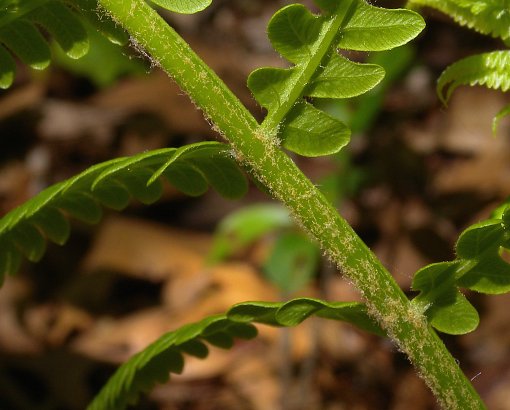
Description: This perennial fern consists of a loose rosette of sterile leaves about 2-4' tall; these leaves are ascending to nearly erect. In the middle of this rosette, fertile leaves are produced during the spring or summer; they are erect and somewhat shorter than the fertile leaves. The sterile leaves are pinnate-pinnatifid in structure and oblong-lanceolate to lanceolate-ovate in outline; they have 12-25 pairs of leaflets along their rachises (or central stalks). The leaflets are pinnatifid and narrowly lanceolate in outline; they have 10-20 pairs of lobes, tapering gradually into narrow tips. At the bases of leaflet undersides (at the junction of their stalks with the rachis of the leaf), there are persistent tufts of woolly brown hairs. Leaflet lobes are broadly oblong in shape and smooth along their margins; these margins are initially ciliate, but they soon become eciliate (hairless). The tips of these lobes are more or less well-rounded. Venation of individual lobes is pinnate, consisting of a straight central vein and several forked lateral veins.
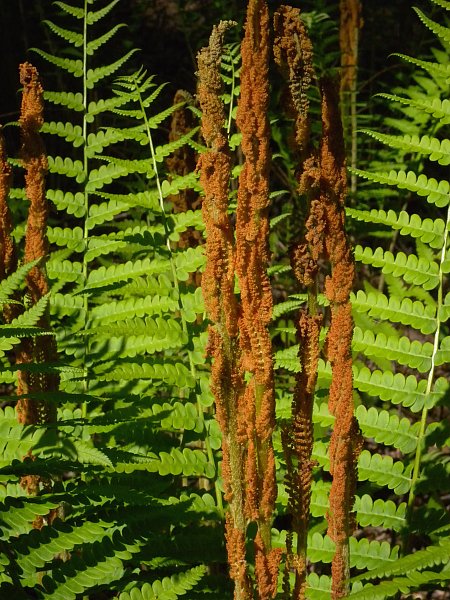
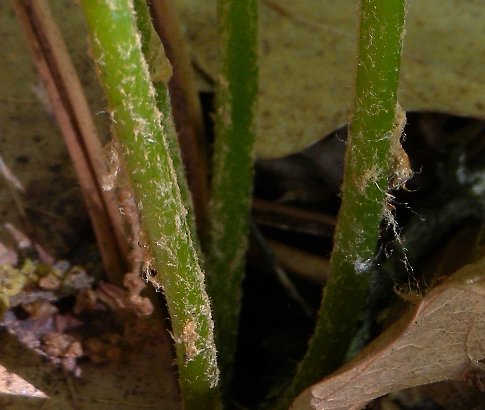
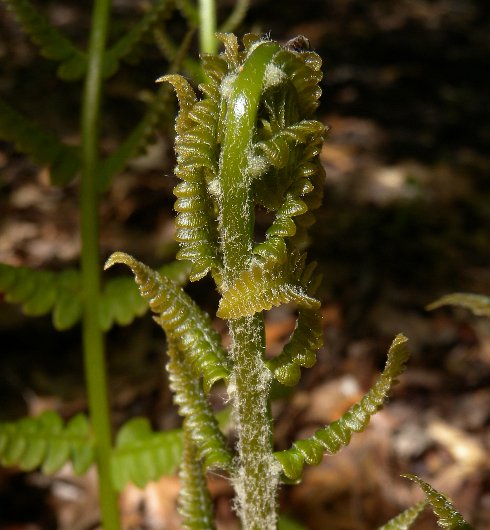
The leaflets of sterile leaves are light to medium green or yellowish green; these leaflets are initially pubescent, although they soon become glabrous. The rachises and petioles of sterile leaves are light green, yellowish green, or silvery white; these rachises and petioles are more or less covered with brown woolly hairs, especially while they are young. The rachises and petioles are flat along their upper sides and strongly convex along their lower sides. The petioles are about one-fourth of the length of the leaves. The fertile leaves have the same pinnate-pinnatifid structure as the sterile leaves, but their contracted leaflets are held erect and they are covered with reddish brown sporangia and reddish brown woolly hairs. These small sporangia are globoid in shape and split open to release their spores during the summer. These tiny spores are distributed by the wind. The root system consists of a crown of fibrous roots, from which spreading rhizomes are occasionally produced.
Cultivation:
The preference is dappled sunlight to light shade, consistently wet to
moist
conditions, and an acidic soil with some sand and organic matter. This
fern likes sheltered locations with high humidity.
Range & Habitat:
The native Cinnamon Fern is occasional in southern and northern
Illinois, uncommon in west-central Illinois, and absent from the
central and east-central sections of the state (see Distribution
Map). This fern has a wide distribution in North America; it
also occurs in South America and Asia. Habitats include low sandy
woodlands, borders of low sandy woodlands, wet sand prairies, sandy
swamps, peaty bogs, seeps and
springs in wooded areas, moist sandstone ledges in partially shaded
areas, and sandstone ravines. This fern is found in high quality
natural areas. It is occasionally cultivated in moist shade gardens.
Faunal
Associations:
The following insects feed on the Cinnamon Fern and other Osmunda
spp.: larvae of the moth Olethreutes osmundana,
larvae of Papaipema speciosissima (Osmunda Borer
Moth), the sporangia-feeding plant bug Monalocoris americanus,
and Zonothrips osmundae (Osmunda Thrips); see
Covell,
1986/2005; Knight, 1941;
Vance, 1974; Stannard, 1968. The thrips was originally found on
Cinnamon Fern at Volo Bog in NE Illinois. Cinnamon Fern is not a
significant source of food to vertebrate animals, although when large
colonies of this fern occur, its large leaves can provide protective
cover.
Photographic Location: Along the border of a low
sandy woodland at the Indiana Dunes National Lakeshore in NW Indiana,
and a moist sandy woodland at the Oak Openings Nature Preserve in NW
Ohio.
Comments: This large fern has fertile leaves that are unusually showy; they become reddish brown at maturity. The large sterile leaves are equally attractive. When the fertile leaves are present, Cinnamon Fern (Osmunda cinnamomea) is easy to identify. When fertile leaves are absent, it is difficult to distinguish this fern from Osmunda claytoniana (Interrupted Fern). On sterile leaves, the Cinnamon Fern has persistent tufts of woolly brown hair at the leaflet bases (on their undersides), whereas the leaflet bases of Interrupted Fern lack such tufts of hair. The lobes of Cinnamon Fern's leaflets have a tendency to be slightly more pointed than the lobes of Interrupted Fern, although this distinction is not always reliable. Ferns in the Osmunda genus have forked lateral veins on the leaflet undersides (where the lobes occur) of their sterile leaves; these lateral veins are shaped like tuning forks. Other ferns usually lack such veins. Fossil records indicate that ferns in the Osmundaceae (Royal Fern family) are among the oldest ferns; today's survivors can be regarded as living fossils.