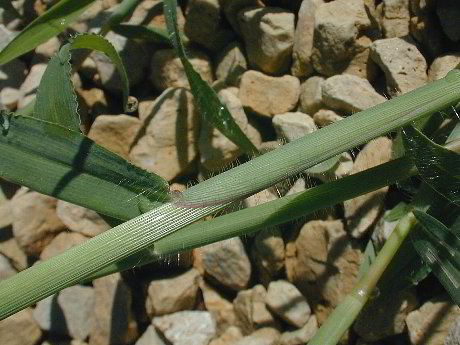
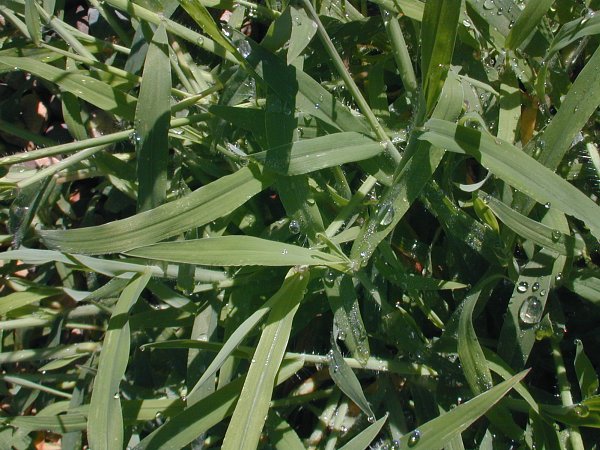
Description: This grass is a summer annual about 1-3' long. It develops several branching culms at the base; the lower branches of the culms tend to sprawl across the ground, while their upper branches are more erect. The culms are light green, terete, and glabrous, although they are mostly covered by the sheaths. The blades of the alternate leaves are up to 6" long and nearly ½" across; they are dull light green, entire or slightly curly along the margins, and often hairy toward the base. The sheaths are light green, finely ribbed, shiny or dull, and hairy.
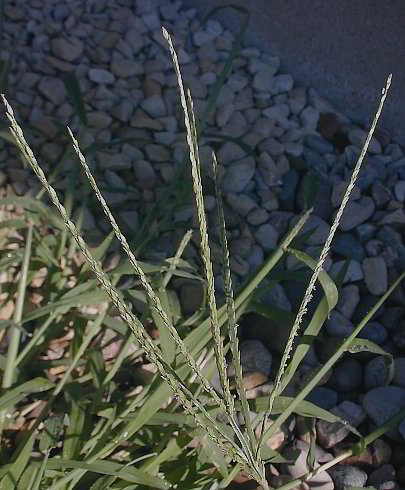
Each upper culm
terminates in 2-10 finger-like racemes up to 8" long; these racemes
spread outward from a short stalk and they are narrow and straight. The
central stalk (rachis) of each raceme is light green, flattened, and
about 1 mm. across. There are many pairs of one-flowered spikelets
along the length of each raceme; they occur along only one side of the
flattened stalk. Each ovoid spikelet is light green to brownish green,
flattened, and about 3 mm. long. It consists of 2 lemmas about 3 mm.
long and 2 glumes; one glume is about 1/3 to 1/2 as long as the lemmas,
while the other glume is tiny and insignificant. The lemmas enclose a
single developing grain. The blooming period occurs from mid-summer to
early fall. Each grain is ovoid and flattened like the lemmas. The root
system is fibrous; sometimes the nodes of the lower culms will form new
fibrous roots. Common Crabgrass often forms colonies.
Cultivation:
The preference is full or partial sun, moist to slightly dry
conditions, and a heavy clay-loam soil. This weedy grass can spread
aggressively. Most growth occurs during the hot weather of summer
because of its C4 metabolism.
Range & Habitat:
The adventive Common Crabgrass is quite common and occurs in every
county of Illinois
(see Distribution
Map). It is native to Eurasia. Habitats include
disturbed areas of prairies, weedy meadows, edges of degraded wetlands,
areas along roads and railroads, lawns and gardens, vacant lots,
fields, grassy paths, and miscellaneous waste areas. This species
prefers highly disturbed areas.
Faunal Associations: Various insects feed on the foliage, seeds, root crown, and other parts of Common Crabgrass (Digitaria sanguinalis). Such insects as Anisodactylus sanctaecrucis (a ground beetle), Harpalus pensylvanicus (Pennsylvania Ground Beetle), and Gryllus pennsylvanicus (Fall Field Cricket) eat the seeds of this grass in fields (Lundgren & Rosentrater, 2007). Other insect feeders include both larvae and adults of Chaetocnema denticulata (Toothed Flea Beetle) and Chaetocnema pulicaria (Corn Flea Beetle), larvae of Sphenophorus maidis (Maize Billbug), larvae of such leafminer flies as Agromyza parvicornis (Corn Leafminer) and Cerodontha dorsalis (Grass Sheath Miner), gall-forming larvae of Homaluroides gramineus (False Spike Grass Fly), Hysteroneura setariae (Rusty Plum Aphid) and other aphids, larvae of a moth, Mocis texana (Texas Mocis), and larvae of the skippers, Atalopedes campestris (Sachem) and Hylephila phyleus (Fiery Skipper); see Clark et al. (2004), Vaurie (1983), Needham et al. (1928), Felt (1917), Blackman & Eastop (2013), Covell (1984/2005), and Bouseman et al. (2006). The seeds of crabgrasses (Digitaria spp.) are an important source of food to many upland gamebirds and granivorous songbirds, especially sparrows (see Bird Table). The seeds are also eaten by some rodents, including the Prairie Deer Mouse and wild House Mouse (Whitaker, 1966). Occasionally, the foliage is browsed by the Cottontail Rabbit (Martin et al., 1951/1961).
Photographic
Location:
The edge of a lawn at an apartment complex in Urbana, Illinois.
Comments:
This is the most common Digitaria sp. (Crabgrass)
in Illinois. It is often found in lawns to the vexation of many
homeowners. Another introduced grass that invades lawns, Digitaria
ischaemum (Smooth Crabgrass), is a little less common. Smooth
Crabgrass has hairless sheaths and spikelets/lemmas about 2 mm. in
length, while Common Crabgrass has hairy sheaths and spikelets/lemmas
about 3 mm. in length. There are also native perennial species of
Crabgrass that occur in sandy areas of Illinois. They are more erect,
have more slender leaves, and the stalks of their finger-like racemes
are terete, rather than flattened. Another common name for Digitaria
sanguinalis is Hairy Crabgrass.