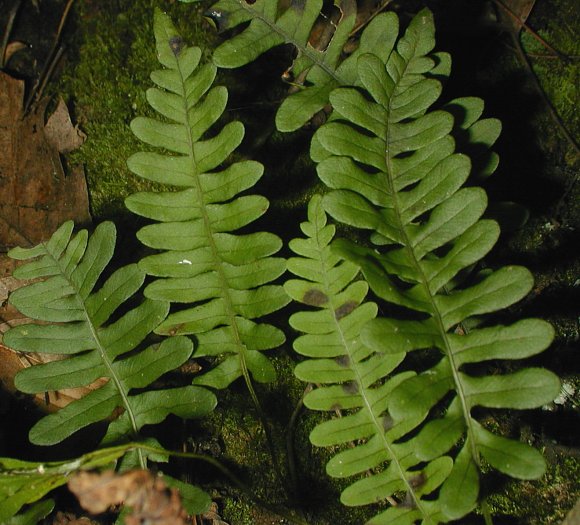
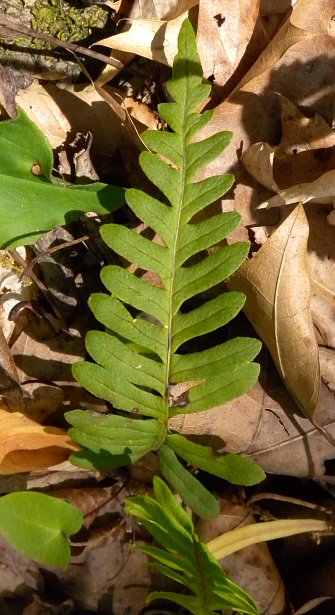
Description: This perennial fern produces evergreen leaves that are erect, ascending, or arching. The leaf blades are up to 10" long and 2½" across, although they are more typically 5-6" long and 1½" across. The leaf blades are broadly oblong, lanceolate-oblong, or elliptic-oblong in outline; they are deeply pinnatifid with 8-20 pairs of lobes along the rachis (central stalk). These lobes are longest toward the middle or lower middle of each leaf, becoming gradually smaller until they merge into a terminal lobe that is triangular-shaped. The non-terminal lobes are more or less oblong in shape, and they are smooth, slightly undulate, or minutely and sparingly toothed along their margins. The sinuses (or cavities) between pairs of adjacent lobes are acute, rather than concave; the lobes are cleft. Pairs of opposite lobes are asymmetrically aligned, rather than directly opposite from each other. The upper blade surface is yellowish green to dark green and hairless (sometimes with a lustrous appearance), while the lower surface is light green and hairless. Venation of each leaf lobe is pinnate with a prominent central vein and obscure lateral veins.
The
petioles are typically about one-fourth to one-half of the length of
the leaf blades; they are light green, glabrous
to sparsely scaly, and jointed toward their bases. The rachises of the
leaf blades are similar to the petioles; they are typically glabrous
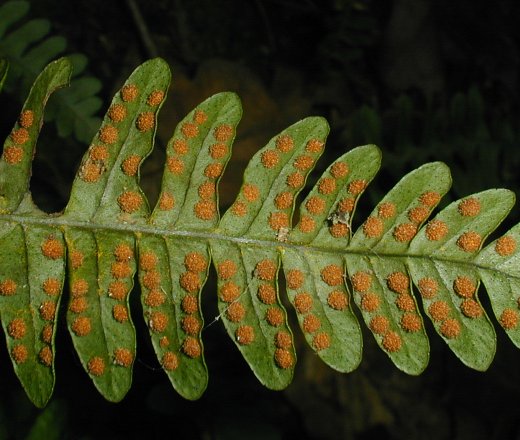
above and more scaly below. The sori (or spore-bearing
structures) are located on the underside of some leaf blades. There are
about 2-12 pairs of small sori on either side of the central vein of
each lobe; the sori are located about half-way between the central vein
and
each margin, or they are located closer to the margins. Only the upper
to middle lobes have sori. The sori are
round in shape, becoming orange-brown to brown and
hairy-looking when they are mature. Unlike many other species of ferns,
the
sori of Common Polypody lack indusia (protective membranes). The spores
are released during the autumn. The root system consists of long scaly
rhizomes and fibrous roots; these rhizomes branch occasionally. Clonal
colonies of leaves are produced from the rhizomes at favorable sites.
Cultivation:
This fern prefers medium to light shade, thin rocky soil with an acid
pH, and moist to mesic conditions with high humidity levels. It also
prefers sheltered areas where there is some protection from the wind.
Some desiccation of leaf tissue as the result of dry conditions is
tolerated, which will cause the leaf blades to roll upward toward
their rachises (central stalks). When moist conditions return, the leaf
blades will resume their normal state.
Range &
Habitat:
The native Common Polypody is occasional in southern Illinois, uncommon
in northern Illinois, and largely absent from the central portion of
the state (see Distribution
Map).
Habitats include shaded cliffs, rocky wooded bluffs, shaded sandstone
ravines, mossy boulders, and rocky ledges along streams. In Illinois,
this fern is usually found in sandstone-related habitats that are
moist, shaded, and protected. It almost always grows on various rock
formations that are coated with moss and organic debris, and rarely on
the ground, unless it is thin and rocky.
Faunal Associations:
Common Polypody is a possible host plant of a recently discovered
aphid, Macrosiphum miho,
that has been found in Illinois. Another aphid, Amphorophora ampulata,
feeds on this fern and other ferns. Common Polypody is a possible host
plant for the stalk-boring larvae of a sawfly, Heptamelus ochroleucus.
This sawfly was accidentally introduced into North America from
Europe. In Europe, fern species in the Polypodium genus are considered
host plants of this sawfly. Vertebrate animals rarely consume the
leaves of this small and inaccessible fern.
Photographic
Location:
A sandstone ravine at the Fall Creek Gorge (aka "The Potholes") in
west-central Indiana.
Comments:
The evergreen
leaves of this fern are quite attractive. Common Polypody (Polypodium virginianum)
can be distinguished from other ferns by its pinnatifid leaves with
oblong lobes and its round sori without indusia (spore-bearing
structures that lack protective membranes). Another fern species in the
Polypody family, Gray Polypody or the Resurrection Fern (Pleopeltis
polypodioides), is found in southern Illinois.
Unlike Common Polypody, this latter fern has scaly leaf
undersides. Furthermore, its pinnatifid leaves have sinuses that are
concave, rather than acute. This latter fern is occasionally epiphytic
(grows in trees), and it is able to withstand considerable desiccation
of its leaves. Sometimes Common Polypody is considered a variety of the
European species, Polypodium vulgare. Another
common name of
Polypodium virginianum
is the Rockcap Fern.