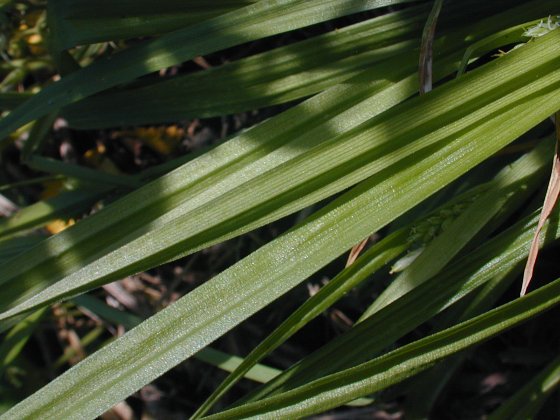
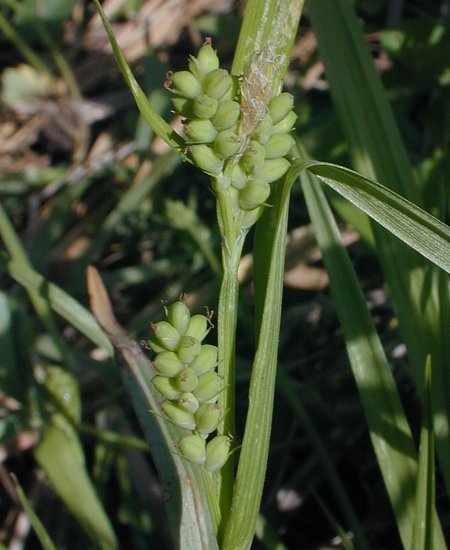
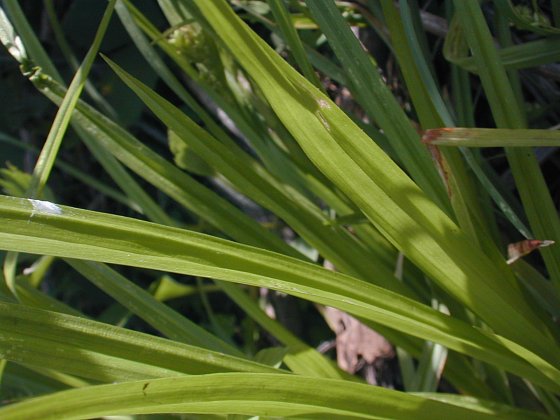
Description: This perennial sedge forms a tuft of ascending to sprawling leafy culms about 1' tall and 1½' across; both fertile and infertile shoots are present. The unbranched culms are ½–2' long, light green, glabrous, sharply triangular, and slightly winged; there are 2-3 alternate leaves along the lower half of each culm. The leaf blades of fertile shoots are up to 8" long and 8 mm. across; they are usually widely spreading. The leaf blades of infertile shoots tend to be slightly more long and wide. The leaf blades are light to medium green, glabrous, and longitudinally furrowed. The inner side of each leaf sheath is membranous, while the 2 outer sides are light green, glabrous, and longitudinally veined. The sheaths adhere rather loosely to the culms. The ligules at the junctions of sheaths and blades are longer than wide, torpedo-shaped, and short-membranous. Each fertile culm terminates in an inflorescence about 6" long (excluding the leafy bracts). This inflorescence consists of a terminal staminate spikelet, 2-4 pistillate spikelets, and their bracts. The upper 1-2 pistillate spikelets are widely separated from the lower 1-2 pistillate spikelets on the rachis (central stalk) of the inflorescence. The rachis is light green, glabrous, sharply 3-angled, and slightly winged.
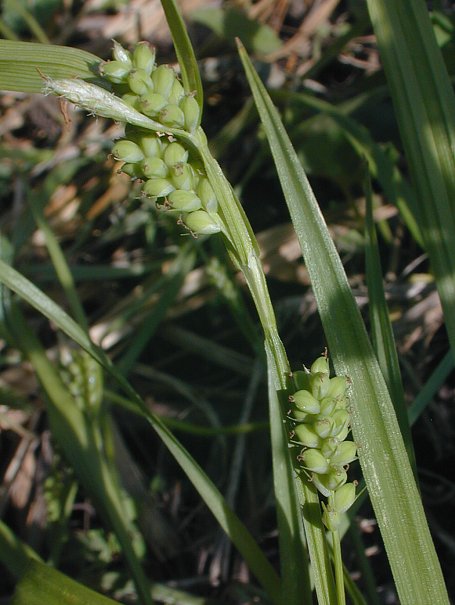
The narrow staminate spikelet is 6-12 mm. long; it has a short peduncle about 3-6 mm. in length. The staminate spikelet is initially silvery white, but it later becomes brown. The pistillate spikelets are 8-18 mm. long, 5 mm. across, and cylindrical in shape; they are packed with 10-30 perigynia and their scales. The perigynia are 2.8–3.5 mm. long and about half as much across; they are obovoid, very pale green (while immature), and hairless. The apex of each perigynium has a very short curved beak, while its bottom is wedge-shaped. The pistillate scales are a little shorter than their perigynia; they are 2.2–3.0 mm. in length, ovate in shape, and softly awned. Each of these scales is green-veined in the center, while its broad margins are membranous. The uppermost pistillate spikelet is nearly sessile, while the remaining 1-3 spikelets have slender peduncles about ¼–2½" long (lower pistillate spikelets have longer peduncles). At the base of each pistillate spikelet (or its peduncle), there is a leafy bract about 1½–8" long and 1-7 mm. across; the lower bracts are larger in size than the upper bracts. The blooming period occurs during the late spring; the florets are cross-pollinated by the wind. The achenes are 2.0–2.5 mm. long and 1.2–1.5 mm. across; they are obovoid and 3-angled. The root system is fibrous and short-rhizomatous.
Cultivation:
This
sedge prefers partial sun to medium shade and moist to mesic
conditions; it tolerates a wide range of soil types, include those
containing loam, clay-loam, or rocky material. Somewhat dry locations
are tolerated if there is sufficient shade. In disturbed areas with
exposed ground, this sedge can spread aggressively.
Range & Habitat:
This native sedge has been found in nearly every county of Illinois,
where it is common in most areas of the state (see Distribution
Map). Habitats include upland woodlands, bottomland
woodlands, woodland openings, powerline clearances in wooded areas,
savannas, thickets, degraded prairies, weedy meadows, lawns and gardens
(particularly in shaded areas), vacant lots, and waste areas.
Common Woodland Sedge has been found in both deciduous and
deciduous/coniferous woodlands (or mixed woodlands). This sedge can be
found in high quality woodlands, but it is also common in degraded
woodlands and other habitats with a history of disturbance. In
tallgrass prairies, Common Woodland Sedge functions as a shade-tolerant
understory plant.
Faunal
Associations:
Collectively, sedges (Carex spp.) are an important
source of food to many kinds of insects, birds, and other animals. The
caterpillars of the butterflies Satyrodes appalachia
(Appalachian Brown) and Satyrodes eurydice (Eyed
Brown) feed on their foliage. Various leafhoppers suck juices on the
foliage, especially Cosmotettix spp. The stink bug Mormidea
lugens has been observed to feed on the Common Woodland Sedge
(Carex blanda)
specifically. In woodlands, various upland gamebirds feed on the seeds
of sedges. These include the Woodcock, Wild Turkey, and chicks of the
Ruffed Grouse. Granivorous songbirds eat the seeds occasionally,
including various sparrows, towhees, cardinals, and others. The Gray
Squirrel and Fox Squirrel also eat the seeds.
Photographic Location:
The webmaster's wildflower garden in Urbana, Illinois, where this sedge
spontaneously introduced itself.
Comments: In open areas, this common sedge forms tufts of pale green leafy culms that have a tendency to sprawl across the ground; it is often somewhat weedy in both appearance and behavior. Where there is significant competition from adjacent ground vegetation, however, it can assume a more ascending habit and dignified appearance. Common Woodland Sedge (Carex blanda) resembles several other woodland sedges to a greater or lesser degree (e.g., Carex laxiflora, Carex striatula, & Carex gracilescens). It can be distinguished by its staminate spikelets on short peduncles (6 mm. or less) and obovoid perigynia with very short curved beaks. The other sedges tend to have ellipsoid to ovoid perigynia with beaks that are longer and more straight. The species Carex striatula and Carex gracilescens have terminal staminate spikelets on long peduncles (12 mm. or more), while Carex laxiflora has wider leaf blades (up to 2 cm. across). Like the Common Woodland Sedge, all of these species have rather large leafy bracts underneath their pistillate spikelets.