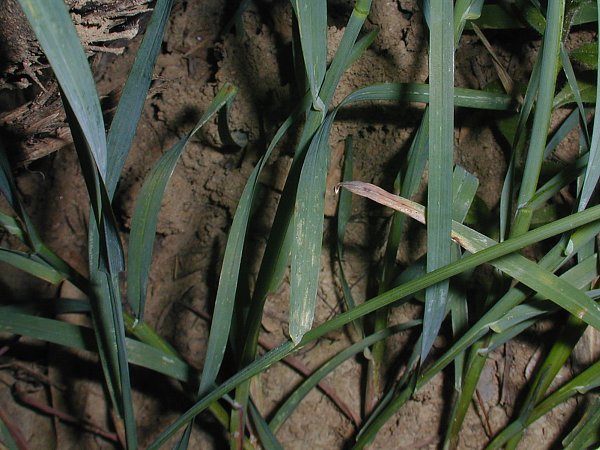
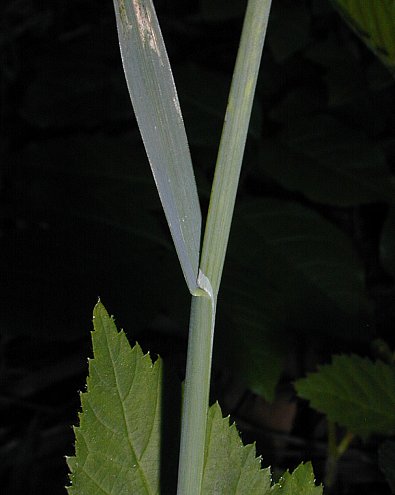
Description: This perennial grass is about ¾–2' tall, producing both fertile and infertile shoots. Infertile shoots are lower than fertile shoots. The culms are either solitary or tufted; there are 4-6 alternate leaves along each fertile culm. The culms are green or grayish blue, hairless, somewhat flattened, and unbranched. The leaf blades are up to 4" long, 4.5 mm. across, and rather stiff; they are dull green or grayish blue, hairless or sparsely canescent, and flat or slightly twisted. The blade tips are hull-shaped. The leaf sheaths are grayish blue or dull green, somewhat flattened, hairless or sparsely canescent, and shorter than the internodes (the length between adjacent nodes on the culm). The ligules are white-membranous, while the nodes are light to medium green and slightly swollen. Each fertile culm terminates in an open panicle of spikelets about 1½–5" long and ¾–2" across. Both solitary branches and whorls of 2-3 lateral branches occur along the rachis (central stalk) of the panicle; these branches are more or less ascending and tend to be longest toward the middle of the panicle. The lateral branches divide into branchlets and/or pedicels with spikelets. Some spikelets are located near the rachis (central stalk). The pedicels are up to 2 mm. long. The rachis, branches, branchelets, and pedicels of the inflorescence are slender and wiry; they are dull green or grayish blue, and hairless or sparsely canescent.
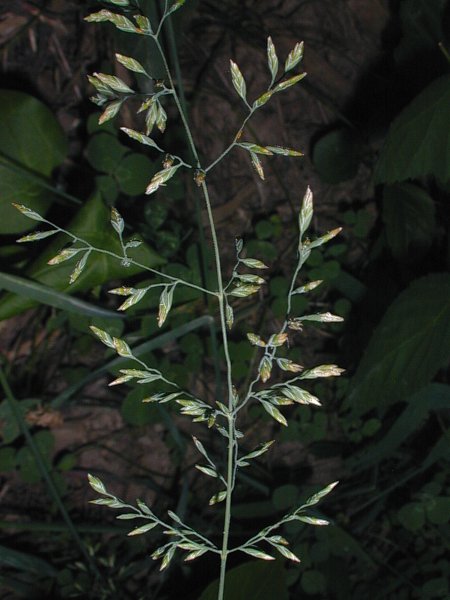
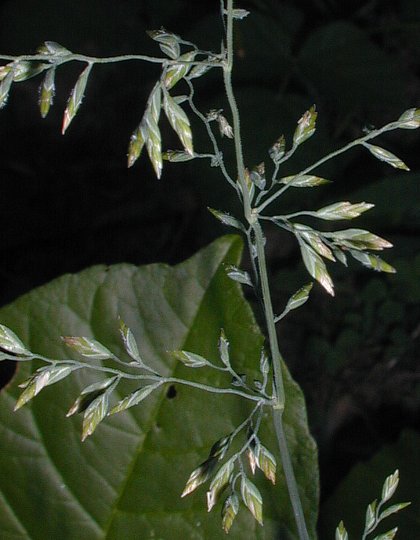
The spikelets are 4-6 mm. long, 1.5 mm. across, somewhat flattened, and mostly grayish blue; each spikelet consists of a pair of glumes at the bottom and 3-7 lemmas above that are organized into 2 overlapping ranks. The glumes are 1.5–2.5 mm. in length (one glume is slightly longer than the other); they are oblong-lanceolate, curved along their keels, grayish blue, longitudinally veined, and narrowly membranous along their margins. The lemmas are 2-3 mm. long, oblong-lanceolate, curved along their keels, light to medium green, 3- or 5-veined, and narrowly membranous along their margins. The lemmas are finely hairy along the lower half of their midveins and marginal veins; when intermediate veins are visible, they are hairless. At the base of each lemma, there is a tuft of fine webby hairs (these hairs are sometimes absent or difficult to see). The florets of the lemmas are perfect, consisting of 2 stigmata, 3 stamens, and an ovary. The blooming period occurs during the summer, lasting about 1-2 weeks for a colony of plants. The florets are cross-pollinated by the wind. The entire inflorescence becomes tan as the grains become mature. Disarticulation of the spikelets is above the glumes. Mature grains are about 1.5 mm. long, ellipsoid in shape, grooved along one side, and light tan to brown. The root system is fibrous and long-rhizomatous. Clonal colonies of plants sometimes develop from the rhizomes.
Cultivation:
The preference is full or partial sun, mesic to dry conditions, and a
slightly acidic soil containing sand, rocky material, or clay.
Range & Habitat:
Canada Bluegrass occurs in every county of Illinois (see Distribution
Map),
where it is common. In spite of its common name, this grass species is
native to
Eurasia. Habitats include dry rocky woodlands, openings in upland
woodlands, upland prairies, upland sand prairies, upland
savannas, sandy
savannas, areas along railroads, roadsides, sandy camping sites,
weedy meadows, pastures,
and waste areas. Canada Bluegrass is usually found in habitats that are
somewhat disturbed or degraded. This grass was originally introduced
into North America as a source
of forage for dry pastures with poor soil. It has since spread into
other areas.
Faunal Associations: Many insects feed on various parts of Canada Bluegrass and other bluegrasses (Poa spp.). These species include leaf beetles, the Bluegrass Billbug (Sphenophorus parvulus), larvae of the Green June Beetle (Cotinis nitida) and Japanese Beetle (Popillia japonica), the Meadow Plant Bug (Leptoterna dolobrata) and other plant bugs, stink bugs, the Rusty Plum Aphid (Hysteroneura setariae) and other aphids, larvae of moths, larvae of skippers, larvae of butterflies, the Sulphur-winged Grasshopper (Arphia sulphurea) and other grasshoppers, and the Straight-lanced Meadow Katydid (Conocephalus strictus); see Insect Table for a more complete listing of these species). Both upland gamebirds and granivorous songbirds eat the seeds of bluegrasses, including the Greater Prairie Chicken, Wild Turkey, Ring-necked Pheasant, Mourning Dove, House Sparrow, Field Sparrow, Savannah Sparrow, Chipping Sparrow, Vesper Sparrow, and White-crowned Sparrow. The foliage is a source of food for the Ruffed Grouse, Wild Turkey, Cottontail Rabbit, Elk, and voles. It is also palatable to horses, cattle, and other kinds of livestock.
Photographic
Location:
An upland woodland opening at Busey Woods in Urbana, Illinois.
Comments:
Canada Bluegrass can be distinguished from other bluegrasses (Poa
spp.) by its flattened culms and grayish blue or grayish
green
foliage. Also, its panicle of spikelets has a more narrow shape than
those of
many other bluegrasses. Another common species, Kentucky Bluegrass (Poa
pratensis),
prefers ground that is more moist, loamy, and
fertile. Unlike Canada Bluegrass, this latter species has terete culms
(round in cross-section) and foliage that is more green. Both Canada
Bluegrass and Kentucky Bluegrass differ from some bluegrass species by
the characteristics of their lemmas: both the marginal veins and
midveins
of their lemmas are finely hairy from the middle downward, while their
intermediate veins are hairless (sometimes the intermediate veins are
too obscure to be readily visible). To make such distinctions, it is
useful to have a 10x hand lens or a 30x field microscope.