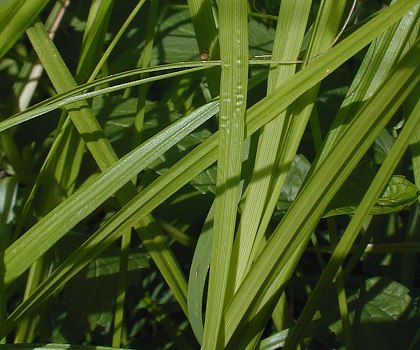
Description: This perennial sedge is about 1½–2½' tall. Infertile shoots produce rosette-like clusters of arching leaves, while fertile shoots produce culms (stems) with alternate leaves; culms of the latter terminate in narrow inflorescences. The culms are light green, 3-angled, and glabrous. The leaf blades are up to 14" long and 8 mm. (1/3") across; they are light green, glabrous, and longitudinally furrowed. These leaf blades are ascending or arching. The outer 2 sides of each leaf sheath are light green and glabrous, while its inner side is light green to membranous and glabrous. These sheaths are wrapped tightly around their culms.
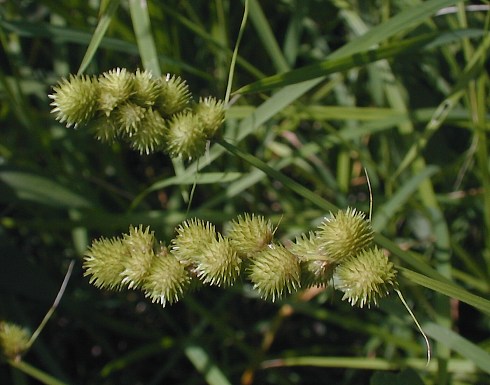
The inflorescence
of each fertile shoot consists of 5-14 sessile spikelets along a rachis
(central stalk) up to
2" in length. The culm underneath this inflorescence is devoid of
leaves for several inches below. At the base of the lowest spikelet,
there is usually a slender
bract that is narrowly linear and up to 16 mm. (2/3") long; there may
be one or
more smaller bracts that are partially hidden by other spikelets. The
spikelets are densely distributed along each rachis and they are
partially overlapping. Each spikelet is 6-8 mm. (1/4–1/3") across,
light green while immature, globoid in shape, and prickly in
appearance because
of the beaks of the perigynia. The staminate florets, if present, are
located at the bottom of the spikelet underneath the pistillate florets
and their perigynia. In each spikelet, the perigynia of the pistillate
florets are densely packed
together and widely spreading to ascending. The perigynia are about
3.0–4.5 mm.
long and 1.5 mm. across, flattened ovoid-lanceoloid in shape,
and narrowly winged along the middle of their margins; they taper
gradually to long narrow beaks at their apices, while their bottoms are
wedge-shaped and somewhat truncate. Both the inner and outer sides of
these perigynia have several fine longitudinal veins. Pistillate scales
originate from the bases of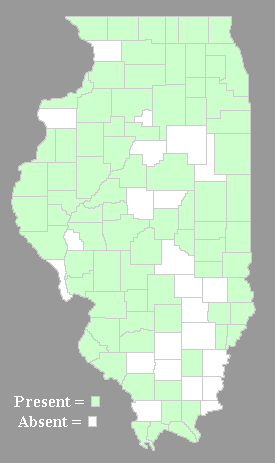 perigynia and they partially
cover their outer surfaces. These scales are lanceolate in shape and
2-3 mm. long; immature scales have green-veined centers, while their
margins are membranous. With age, the pistillate scales become more
brown. The blooming period occurs from late spring to early summer,
lasting about 1-2 weeks. The florets are cross-pollinated by wind.
About a month later, mature perigynia become brown and fall to the
ground; they are sometimes blown about by the wind. Each perigynium
contains a single achene. Mature achenes are 1.0-1.5 mm. in length,
oblongoid-ovoid in shape, and rather flattened. The root system
produces white fibrous roots and short rhizomes. This sedge forms tufts
of leaves and culms from its rhizomes, while spreading to new areas by
reseeding itself.
perigynia and they partially
cover their outer surfaces. These scales are lanceolate in shape and
2-3 mm. long; immature scales have green-veined centers, while their
margins are membranous. With age, the pistillate scales become more
brown. The blooming period occurs from late spring to early summer,
lasting about 1-2 weeks. The florets are cross-pollinated by wind.
About a month later, mature perigynia become brown and fall to the
ground; they are sometimes blown about by the wind. Each perigynium
contains a single achene. Mature achenes are 1.0-1.5 mm. in length,
oblongoid-ovoid in shape, and rather flattened. The root system
produces white fibrous roots and short rhizomes. This sedge forms tufts
of leaves and culms from its rhizomes, while spreading to new areas by
reseeding itself.
Cultivation:
The preference is full sun to light shade, wet to moist conditions,
and soil containing loam or silt-loam with decaying organic
material. Most vegetative
growth occurs during the spring and early summer. Occasional standing
water is tolerated.
Range & Habitat:
The native Crested Sedge is occasional in most areas of Illinois; in
the SE area
of the state, it is less common than elsewhere. Habitats include
openings in moist woodlands, swamps, soggy thickets, wet prairies,
sedge meadows, sloughs, low-lying areas along streams, powerline
clearances in woodlands, and ditches. This sedge occurs in both
degraded and higher quality habitats.
Faunal Associations:
The caterpillars of various butterflies, skippers, and moths feed on
wetland sedges (Carex
spp.); see the Lepidoptera Table
for a listing
of these species. Other insects that prefer such sedges as a food
source include sedge grasshoppers (Stethophyma
spp.), semi-aquatic leaf
beetles (Donacia spp.,
Plateumaris spp.),
billbugs
(Sphenophorus spp.),
larvae of miscellaneous flies, seed bugs, plant
bugs, aphids, and leafhoppers (especially Cosmotettix
spp.). The seeds and seedheads of wetland sedges are an
important source of food to various wetland birds, including
ducks, rails, and granivorous songbirds (see Bird
Table).
Most mammalian herbivores feed on the foliage
sparingly; meadow voles feed on both the foliage and rootstocks.
During the ice age, preserved dung in caves of the western United
States reveals that the Imperial Mammoth consumed the foliage of
wetland sedges and other kinds of grassy vegetation (Martin, 2007).
This finding
probably generalizes to the Columbian Mammoth as well. The range of
this latter mammoth extended into eastern United States; it occupied
savanna and grassland habitats.
Photographic Location:
A powerline clearance in Busey Woods, Urbana, Illinois.
Comments: This sedge has foliage that is quite similar to other sedges (Carex spp.). However, its spikelets are quite distinctive because of their globoid shape and prickly appearance. Whether they are immature and green, or mature and brown, the spikelets of Crested Sedge (Carex cristatella) are attractive; the mature perigynia persist on their rachises longer than those of most sedges, or so it seems to me. Similar sedges usually have spikelets that are more ovoid (longer than they are broad) and/or their spikelets are more distant from each other along their rachises. One species that Crested Sedge can be confused with is the common Troublesome Sedge (Carex molesta). However, the latter species has only 2-5 spikelets per inflorescence and the bottoms of its perigynia are more rounded, rather than wedge-shaped and somewhat truncate.