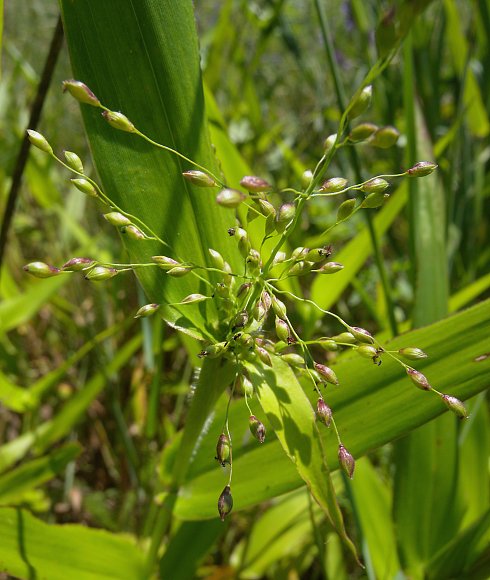
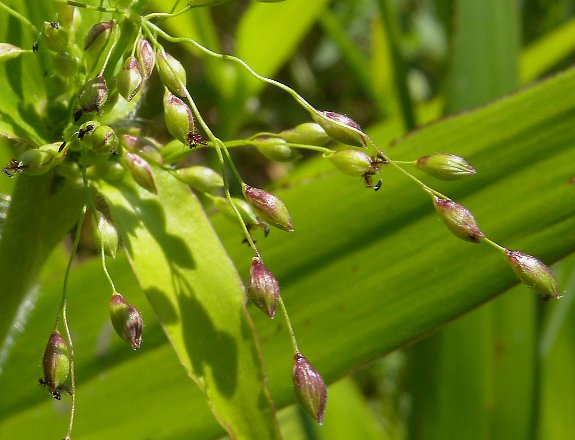
Each vernal culm terminates in a panicle of spikelets about 2½-6" long that is exerted from the uppermost sheath; this panicle has a pyramidal shape with a central rachis and ascending to widely spreading lateral branches. At intervals along the rachis, these lateral branches are whorled. The branches divide into branchlets or pedicels that terminate in solitary spikelets. The rachis, branches, branchlets, and pedicels of the panicle are light green, slender, and slightly wiry. Individual spikelets are 2.5-3.0 mm. long, about one-half as much across, ovoid or broadly ellipsoid in shape, hairless to sparsely pubescent, and light green to greenish purple. Each spikelet consists of 2 glumes, 2 lemmas (one fertile and the other sterile), and a perfect floret with 2 feathery stigmata and 3 stamens. The smaller glume is only one-third the length of the spikelet, while the larger glume and sterile lemma are the same length as the spikelet. Both outer sides of each spikelet, consisting of the larger glume and sterile lemma, have about 7 longitudinal nerves.
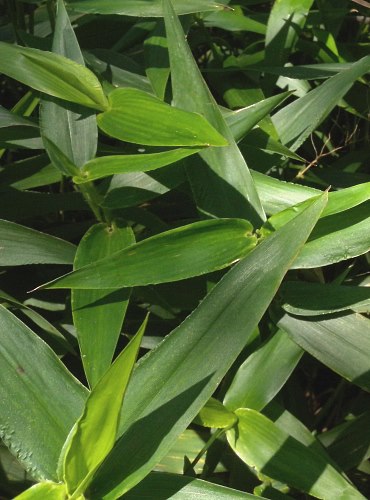
For the vernal culm, the blooming period occurs from early to mid-summer for about 1-2 weeks. The florets are cross-pollinated by the wind. Afterwards, each culm continues to branch, developing secondary culms in its autumnal form. This causes each plant to become taller. The autumnal culms and their leaves have the same characteristics as the vernal culm and its leaves, except several panicles of spikelets are produced that remain inserted within their sheaths (and thus they are hidden from view). Compared to the vernal panicle, these autumnal panicles are reduced in size and they are cleistogamous (self-pollinating). Both vernal and autumnal spikelets produce grains about 2.0-2.5 mm. long that are ovoid and slightly flattened. After hard frost kills the autumnal culms and their leaves, they are replaced by low winter rosettes of basal leaves. The root system is fibrous and rhizomatous. Colonies of clonal plants are often produced from the rhizomes.
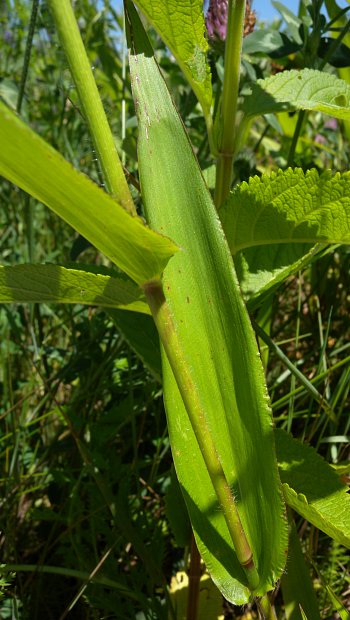
Cultivation: The preference is partial sun, moist conditions, and sandy soil. In some situations, this grass can spread aggressively via its rhizomes.
Range & Habitat: The native Deer-Tongue Grass is common in southern Illinois, while in the rest of the state it is occasional (see Distribution Map). Habitats include moist depressions in rocky upland woodlands, sandy woodlands, sandy savannas, sand prairies, acidic gravelly seeps, sandy swamps, low areas along streams and ponds, and abandoned sandy fields. This grass is more common in moist sandy habitats than elsewhere and it tolerates some disturbance.
Faunal Associations: Insects that feed on Deer-tongue Grass and other panic grasses (Dichanthelium spp., Panicum spp.) include the caterpillars of Polites themistocles (Tawny-edged Skipper) and other skippers, the larvae of such moths as Idioglossa miraculosa and Cycloplasis panicifoliella, the leaf beetle Chalepus bicolor, Sphenophorus callosus (Southern Corn Billbug), Oebalus pugnax (Rice Stink Bug), the stilt bug Jalysus spinosus, the plant bugs Collaria meilleurii and Collaria oculata, Anoecia cornicola (White-banded Dogwood Aphid) and other aphids, the leafhoppers Polyamia herbida and Polyamia rossi, and Arphia sulfurea (Sulfur-winged Grasshopper). The Insect Table provides more information about these species. Among vertebrate animals, the seeds of panic grasses are an important source of food to many birds, especially sparrows (see the Bird Table for a listing of these species). The seeds are also consumed by some small rodents, such as the wild House Mouse and Prairie Deer Mouse (Whitaker, 1966). The young foliage is palatable to many mammalian herbivores, including cattle, horses, sheep, deer, and rabbits.
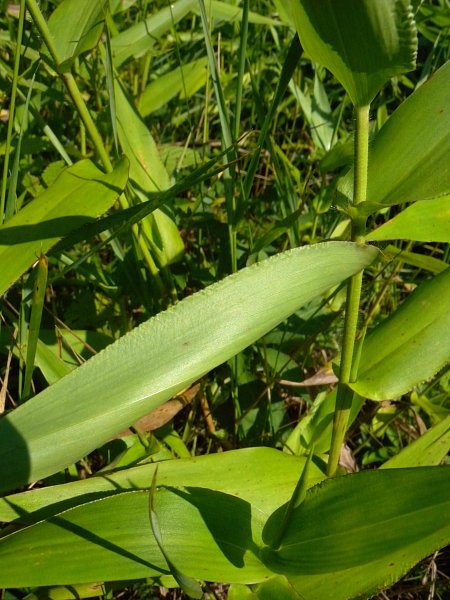
Photographic Location: A moist sandy woodland and mesic sand prairie at the Indiana Dunes National Lakeshore in NW Indiana; a sandy swamp at the Heron Boardwalk in Vermilion County, Illinois.
Comments: Deer-Tongue Grass (Dichanthelium clandestinum) is one of a small number of cool-season panic grasses (Dichanthelium spp.) with leaf blades that can exceed 1" (25 mm.) in width. It starts off life as a normal cool-season panic grass, producing an exerted inflorescence during early summer when it is about 1½-2' tall. At this stage, it closely resembles Broad-leaved Panic Grass (Dichanthelium latifolium) and similar species. However, after producing this early inflorescence, it continues to grow during the rest of the summer by forming branching culms, becoming 3-4½' tall by autumn. This additional growth makes Deer-Tongue Grass the tallest species of the numerous cool-season panic grasses that occur in Illinois. Like many other species in this genus, Deer-Tongue Grass often blooms again later in the year by producing inflorescences that remain hidden, or at least partially hidden, in its autumnal sheaths. This unusual characteristic sets them apart from many other grasses.