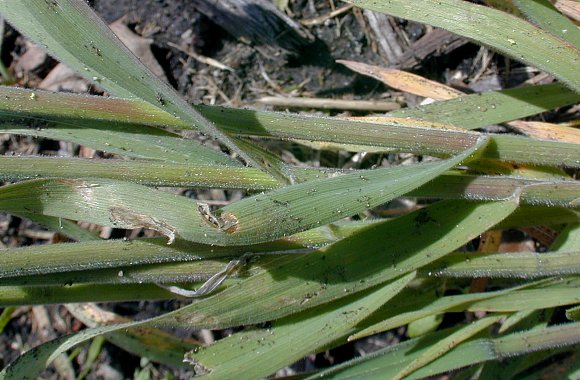
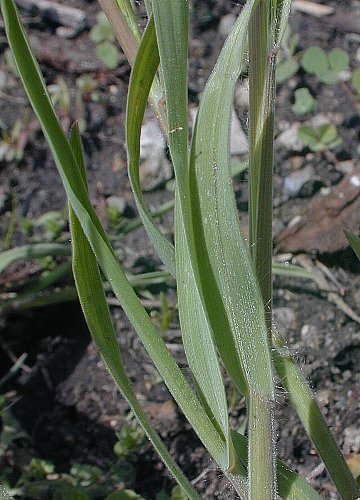
Description: This grass is a winter or spring annual of variable size. On dry barren ground, it is typically ¾–1½' tall, while on moist fertile ground it can become 2-3' tall. Individual plants are tufted at the base, sending up multiple unbranched culms. These culms are terete, green, and canescent; they are largely hidden by the sheaths. The blades of the leaves are up to 6" long and 1/3" (8 mm.) across; they are whitish green or grayish green, short-pubescent on both the upper and lower sides, and either flat or involute (rolled upward). The sheaths of the leaves are whitish green to reddish green, densely pubescent, longitudinally veined, and rather loose. Each culm terminates in a panicle of spikelets about 2-6" long. Both the central stalk (or rachis) and lateral branches of this panicle are strongly inclined to droop. An immature panicle is barely exerted from the sheath of the uppermost leaf, while a mature panicle is more exerted and more widely spreading. The individual spikelets are about ¾–1½" long (including their awns). While immature, they are whitish green to reddish green and frequently shiny in appearance.
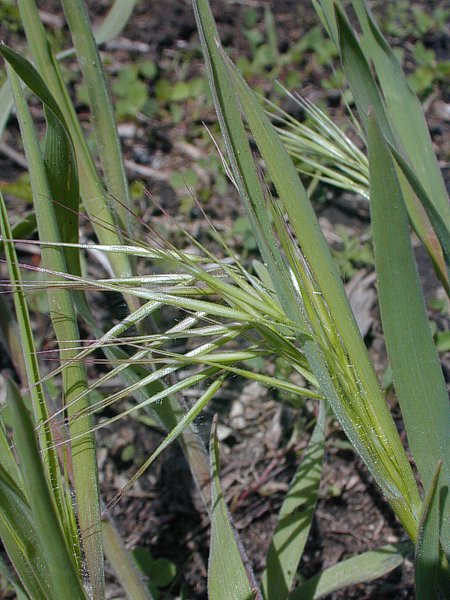
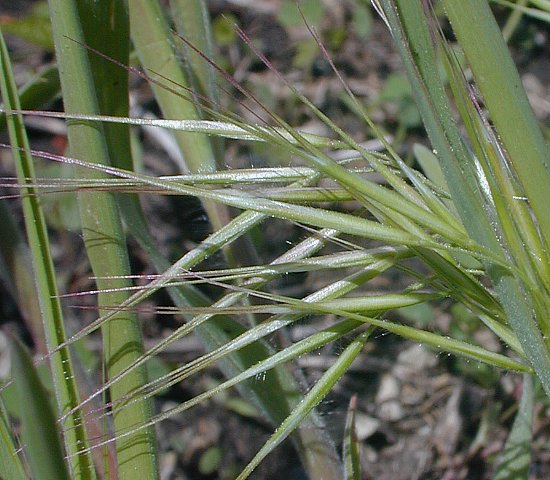
Each spikelet consists of a pair of glumes and 5-9 lemmas that are arranged in two overlapping ranks. These lemmas are appressed together in young spikelets, but they become more widely spreading in older spikelets. The first glume is 5-7 mm. long, linear, and glabrous to finely short-pubescent; it has a single prominent vein. The second glume is 8-10 mm. long, linear, and glabrous to finely short-pubescent; it has 1-3 prominent veins. The lemmas are 10-12 mm. long (excluding their awns), linear-lanceolate, and finely short-pubescent to hairy (rarely glabrous); they have 5-7 veins that are more difficult to discern. The slender awns of the lemmas are about 12-16 mm. long and more or less straight. The blooming period occurs from mid-spring to early summer, lasting about 1-2 weeks for a colony of plants. The florets are usually self-pollinating. Shortly afterwards, the entire plant becomes light tan. Disarticulation of the spikelets is above the glumes. At maturity, each awned lemma encloses a single slender grain that is 7-8 mm. long. The root system is fibrous. This grass spreads by reseeding itself. Colonies of plants are often formed at favorable sites.
Cultivation:
This
weedy grass adapts to a wide range of conditions, although it is
typically found at sites that are dry, barren, and sunny. Sites with
sandy or gravelly soil are particularly preferred. Where the soil is
more moist and fertile, this grass becomes taller and more erect. It
can reseed itself aggressively.
Range & Habitat:
The adventive Downy Brome is found in every county of Illinois, where
it is quite common
(see Distribution
Map).
This grass is native to Eurasia. The first specimen of this
species was collected in Illinois during the 1890's. Habitats include
barren savannas, sand prairies, fields, pastures, vacant lots,
landfills, areas along railroads, roadsides, and waste areas. This is a
pioneer species that prefers open areas with a history of disturbance.
The dead foliage during the summer is an important cause of wildfires
in the Western states, but this is less of a problem in Illinois and
other Eastern states.
Faunal Associations: Several species of grasshoppers (primarily their nymphs) feed on the foliage of Downy Brome (see Grasshopper Table). Among these species, Downy Brome is a preferred host plant for Melanoplus sanguinipes (Migratory Grasshopper). Other insects that feed on this grass include Oulema melanopus (Cereal Leaf Beetle) and the larvae of two leaf-mining flies, Cerodontha incisa and Cerodontha muscina (Clark et al., 2004; Spencer & Steyskal, 1986). Hoofed mammalian herbivores will feed on this grass while it is immature during the spring. However, the awns of the spikelets on mature plants can cause mechanical injury to their mouth parts and digestive tracts. The leaves, stems, and seeds of this grass are eaten by the Prairie Vole; the House Mouse (outdoor population) also eats the seeds. Some upland gamebirds and granivorous songbirds probably eat the seeds, although information about this in the Midwest is scant. The long awns of mature spikelets cling readily to the fur of mammals and the clothing of humans, by which means the seeds are distributed into new areas.
Photographic
Location:
Along a railroad in Urbana, Illinois.
Comments:
Downy Brome develops very quickly during the spring; it is one of the
first grasses to bloom in the state. This characteristic is useful in
the identification of this species. At this time of year, Downy Brome
has a silky inflorescence that is rather attractive. There are many Bromus
spp. (Brome Grasses) in Illinois, both native and non-native.
The native species are often perennials that are found around
woodlands, while the non-native species are usually weedy annuals that
are found in sunny disturbed areas. In addition to its early maturity,
Downy Brome can be distinguished from other Brome grasses by the long
awns of its lemmas (about ½–¾" in length), its pubescent sheaths and
leaves, and strongly drooping inflorescence. Other technical
characteristics that are useful in its identification include the
length of the lemmas, the pubescence of the lemmas, and the number of
veins in the glumes and lemmas, as described above.