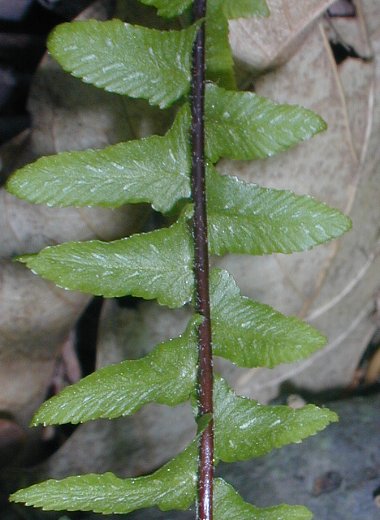
Description: This perennial fern consists of either individual leaves or small tufts of simple-pinnate leaves. Individual leaves are ½–1½' long and 1-2" across; the semi-evergreen fertile leaves are longer and more erect than the evergreen sterile leaves. Each compound leaf has 10-40 pairs of leaflets along its rachis (or central stalk); these leaflets are usually arranged alternately along the rachis, rather than in opposite pairs. The leaflets toward the top and the bottom of each leaf are smaller in size than those toward the middle. Both the rachis and petiole of mature leaves are terete and dark purplish brown; usually they are glabrous, but sometimes sparse white hairs are present. For very young leaves emerging from the ground, the rachis and petiole can be light green. Individual petioles (about 1-4" long) are much shorter than the leaf blades.
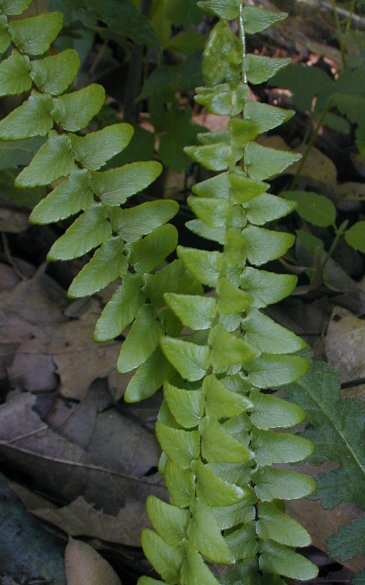
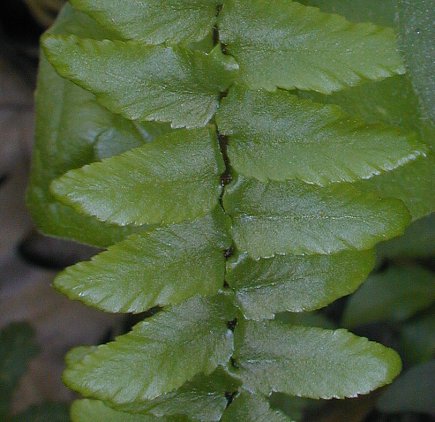
The medium to dark green leaflets are deltate-oblong or deltate-elliptic in shape, crenate or crenate-serrate along their margins, and glabrous; young leaflets often have a lustrous quality. The leaflets are basally auricled (with eared lobes) on their upper sides, providing them with an asymmetrical appearance; these narrowly deltate auricles overlap the rachis. The leaflets are pinnately veined; each one has a central vein and several lateral veins. The lateral veins are forked. On mature fertile leaves, the leaflets develop two columns of elongated sori (spore-bearing structures) on their undersides; these sori are oriented diagonally to the central veins of the leaflets. Attached along one side of each sorus, there is an elongated indusium (protective membrane) that eventually withers away. The spores are released to the wind during the summer or early fall. The root system consists of a short rhizome with fibrous roots; relative to the ground surface, the position of this rhizome is often vertical or diagonal in its orientation.
Cultivation:
This fern prefers partial sun or dappled sunlight, moist to slightly
dry conditions, and soil that is loamy, rocky, or sandy.
Unlike many other spleenworts (Asplenium spp.),
which are
restricted to very rocky habitats (e.g., mossy boulders and crevices of
cliffs), Ebony Spleenwort adapts to terrestrial conditions. Thus, it is
more likely to thrive in gardens.
Range & Habitat:
The native Ebony Spleenwort is occasional in the southern half
of Illinois, while in the northern half of the state it is uncommon or
absent (see Distribution
Map).
However, this fern has been spreading into new locations northward,
even reaching the upper Great Lakes region. Habitats include thin
upland woodlands, sandy woodlands, sandy savannas, rocky wooded slopes,
rocky cliffs and ledges (if not too sunny and dry), small meadows in
upland wooded areas, sandy meadows, sandstone and limestone glades, and
rocky banks along roads. In the rocky habitats where this fern occurs,
there may be some seepage of ground water. Ebony Spleenwort is found in
both higher quality natural areas and more disturbed habitats (e.g.,
where there has been some removal of trees or brush in wooded
areas by fire or other means).
Faunal
Associations:
Information about floral-faunal relationships is limited. Two
aphids, Amphorophora
ampullata and Idiopterus
nephrelepidis, feed on the plant juices of spleenworts (Asplenium spp.);
see Hottes & Frison (1931) and Blackman & Eastop
(2013). Frond
fragments of these ferns have been found in the gullets of Woodland
Jumping Mice (Napaeozapus
insignis insignis); see Hamilton (1941) in New York.
Photographic Location:
Edge of a small meadow in an upland woodland in Vermilion
County, Illinois, and a wooded bank along a path in Pope County,
Illinois. The use of a camera flash has caused the color of
the leaves to wash out in some photos.
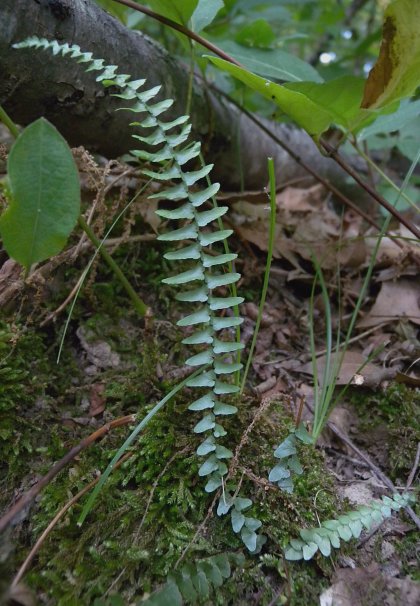
Comments: This is the largest and most adaptable spleenwort in Illinois; the attractive leaves have a delicate appearance. It superficially resembles a small narrow Christmas Fern (Polystichum acrostichoides), but the rachis and petiole of the latter fern are light-colored and very scaly. Among the various spleenworts (Asplenium spp.) in Illinois, the most similar species is Black Spleenwort (Asplenium resiliens), which has been called "Little Ebony Spleenwort." Both Ebony Spleenwort (Asplenium platyneuron) and Black Spleenwort have rachises and petioles that are black or nearly so. The latter fern has smaller leaves (about 3-9" long & ½–1" across) and the basal auricles (eared lobes) of its leaflets don't overlap or hide the rachis to the same extent as those of Ebony Spleenwort. Other similar spleenworts in Illinois have leaflets that lack basal auricles and their leaflets are often as wide as they are long. Furthermore, the mature petioles and rachises of such spleenworts are light-colored (green or yellowish tan) in whole or part. Ebony Spleenwort occasionally hybridizes with other spleenworts when they occur together in the same area.