Description: This perennial fern consists of several ascending leaves about 4-12" tall; the leaves are usually organized together in a loose tuft; they are deciduous. The leaf blades are 4-10" long and about one-half to one-third as much across; they are light green or yellowish green, hairless, and slightly membranous. The leaf blades are ovate to deltate-ovate in outline and broadest toward the middle or near their bases. The structure of each leaf blade is bipinnate-pinnatifid to pinnate-bipinnatid – the leaflets and their lobes tend to be less differentiated toward the tip of the leaf blade than at its base. There are about 8-12 pairs of leaflets along the rachis (central stalk) of each leaf; the leaflets are not necessarily opposite from each other. The leaflets are lanceolate or deltate-lanceolate in outline and their structure is simple-pinnate to pinnatifid, dividing into either subleaflets and/or lobes. The subleaflets are ovate to oval in shape and their margins are shallowly cleft and/or crenate; they are often abruptly contracted at their bases, forming distinct petiolules (basal stalklets). These subleaflets occur primarily along the lower to middle rachis (central stalk) of the leaf blade. Elsewhere, the leaflets are divided into lobes that are broadly oblong to ovate in shape and the margins of these lobes are cleft and/or crenate.
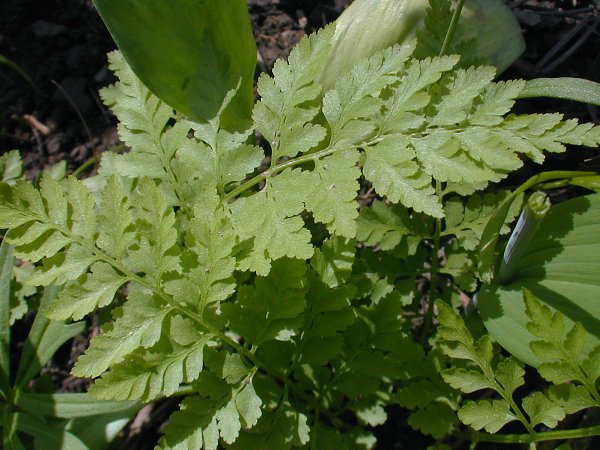
The slender petioles are shorter
than the leaf blades; they are light green to yellowish green and
glabrous. The rachises (central stalks) of the leaf blades are similar
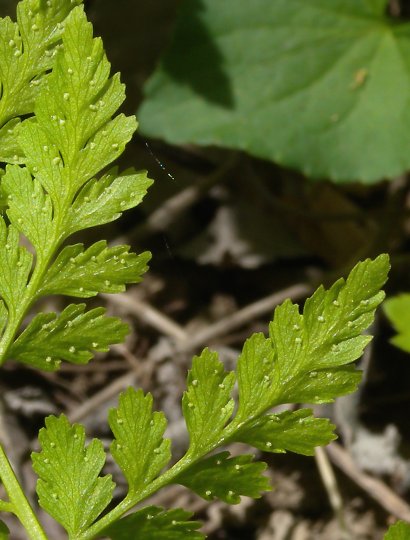
to the petioles. The sori (spore-bearing structures) are located on the
leaf undersides; they occur near the sinuses of the subleaflets and
leaflet lobes. The sori are orbicular in shape; each sorus is partially
covered by an indusium (pale protective membrane) that is 0.5 mm.
across. The indusia soon fade away and they are replaced by the
brownish sporangia containing the spores. These spores usually are
released during the summer; they are distributed by the wind. Each
spore is about 30 micrometers across; it is brown, globoid, and
prickly. The root system consists of long hairy rhizomes, from which
the leaves develop.
Cultivation:
The preference is light shade, moist to mesic conditions, and soil
containing loam or rocky material with decaying leaf
litter. This fern is easy to grow in shaded situations
if it is protected from the wind and taller ground vegetation
is kept away from it.
Range &
Habitat:
The native Southern Fragile Fern occurs in every county of Illinois,
where it is
common (see Distribution
Map).
Habitats include moist to mesic deciduous
woodlands, edges of wooded bluffs, shaded banks of rivers, wooded areas
along rocky streams, upper slopes of ravines, and shaded areas along
cliffs. This fern can be found in both Maple-Basswood and Oak-Hickory
woodlands, surviving in natural areas that are mildly to moderately
degraded, although it also occurs in high quality natural
areas. Because of its small size and habitat preferences,
populations of Southern Fragile Fern are threatened by the invasion of
Garlic Mustard (Alliaria
petiolata) and some non-native shrubs.
Faunal Associations:
Fragile ferns (Cystopteris
spp.) are host plants of the aphid Amphophora ampullata;
this aphid also feeds on other ferns. The foliage of this small
deciduous fern has limited value to wildlife. Some upland gamebirds
(Wild Turkey, Ruffed Grouse) and the White-Tailed Deer may eat the
fronds sparingly.
Photographic Location:
A deciduous woodland at Busey Woods in Urbana, Illinois.
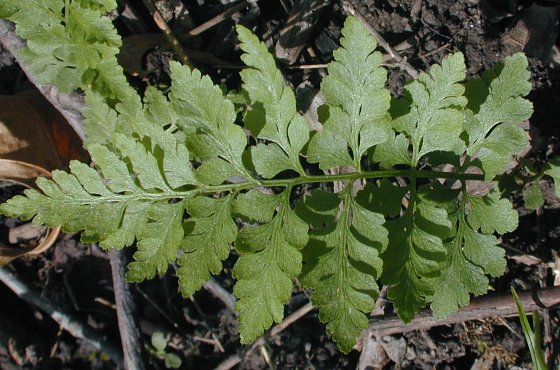
Comments: The Southern Fragile Fern (Cystopteris protrusa) is probably the most common fern in Illinois. This fern is still referred to as Cystopteris fragilis var. protrusa in many older texts, but it is now considered a separate species. Other closely related ferns in this genus are Cystopteris fragilis (Northern Fragile Fern) and Cystopteris tenuis (MacKay's Fragile Fern); these two ferns were formerly classified as Cystopteris fragilis var. fragilis and Cystopteris fragilis var. mackayi respectively. They are both uncommon in Illinois. The latter two ferns have rhizomes that are short and scaly, while those of Southern Fragile Fern are longer and more hairy-looking. They are also more likely to have lower petioles that are brown or red, while the petioles of Southern Fragile Fern are usually yellowish green throughout. The subleaflets along the lower rachis of Southern Fragile Fern are usually ovate to oval in shape, while the corresponding subleaflets of the Northern Fragile Fern and MacKay's Fragile Fern are broadly oblong to ovate in shape and they tend to be less abruptly contracted at their bases. The habitat preferences of these ferns also vary: Southern Fragile Fern is primarily terrestrial, while Northern Fragile Fern and MacKay's Fragile Fern are more likely to be found growing on or around mossy boulders and rocky cliffs.