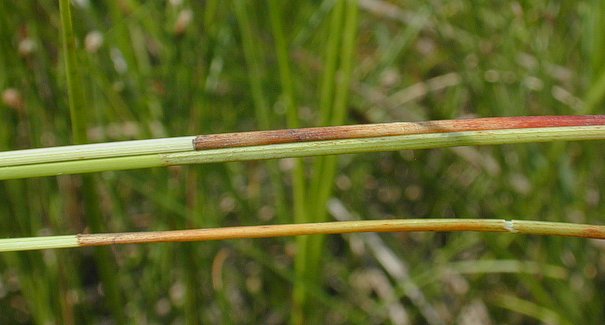
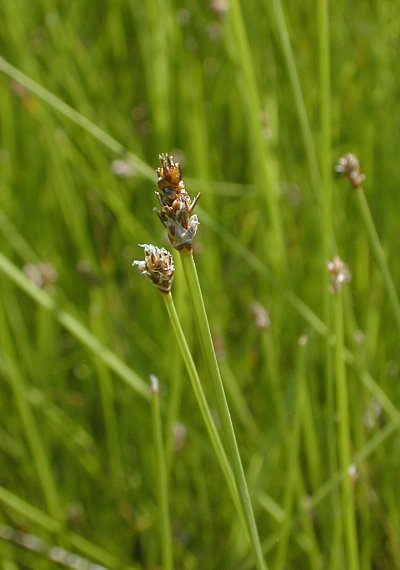
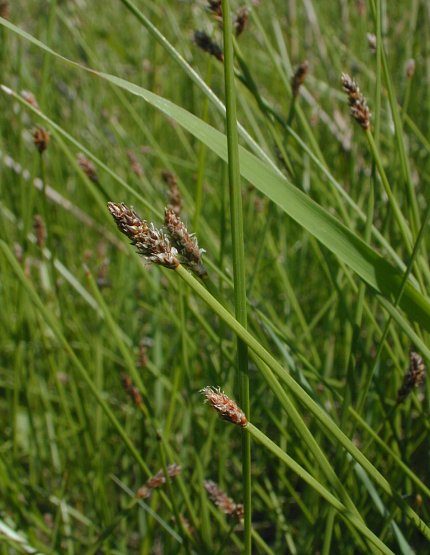
Description: This perennial spikerush forms an unbranched culm that is about ½–1¼' tall. The stiff culm is 0.5-1.5 mm. in diameter, medium green, and hairless; it is nearly terete below, becoming increasingly flattened above. A basal sheath surrounds the base of the culm; this sheath becomes light brown to reddish brown with age and it is truncate at the apex. There is no leaf blade. The culm terminates in a single spikelet. A mature spikelet is lanceoloid to ellipsoid in shape, medium to dark brown, and about 4-8 mm. long; it consists of a dense head of minute florets and their scales. The florets are perfect with 3 stamens and a tripartite style. The floral scales are 2-3 mm. long and ovate in shape; their margins are membranous.

The blooming period occurs during the summer; the florets are wind-pollinated. Fertile florets are replaced by tiny achenes, which can float on water or blow about in the wind. These achenes are about 1 mm. in length, light brown to dark brown, and obovoid in shape; each achene has a tubercle at its apex and 0-5 bristles that originate from its base (the bristles are usually absent). When they are present, the bristles are variable in length, but never longer than the achene. The tubercle usually has a somewhat flattened conical shape with a tiny point in its middle (apiculate); other tubercular shapes have been reported as well. The root system is fibrous and strongly rhizomatous. This spikerush often forms dense mats of culms from the rhizomes.
Cultivation:
The preference is full sun and wet conditions; shallow standing water
is tolerated. The soil can be mucky, sandy, peaty, gravelly,
or rocky.
Range & Habitat:
The native Flat-stemmed Spikerush is occasional in central and northern
Illinois, while in the southern section of the state it is uncommon or
absent (see Distribution
Map). Habitats include damp depressions in
rocky woodlands and
limestone glades, prairie swales, wet dolomite prairies, sedge meadows,
borders of ponds and streams, and roadside ditches. This species is
usually found in higher quality wetlands, although it also occurs at
degraded sites.
Faunal Associations: Several kinds of insects use spikerushes (Eleocharis spp.) as host plants. These species include semi-aquatic leaf beetles (Donacia spp., Plateumaris spp.), semi-aquatic weevils, an aphid (Rhopalosiphum cerasifoliae), leafhoppers (especially Limotettix spp.), larvae of Crambid moths, larvae of the Yellow-Collared Scape Moth (Cisseps fulvicollis), and the Gladiator Meadow Katydid (Orchelium gladiator). Larvae of a rare skipper, the Poweshiek Skipperling (Oarisma poweshiek), supposedly feed on the Slender Spikerush (Eleocharis elliptica) in prairie swales. This spikerush is closely related to the Flat-stemmed Spikerush (Eleocharis compressa) that is described here. The Insect Table provides a more complete list of these species. Among vertebrate animals, the seedheads of spikerushes are a source of food to ducks, geese, and rails during the summer (see Bird Table). The Mallard and Canada Goose are typical examples of such birds in Illinois. These birds probably help to spread spikerushes to new wetlands because the tiny seeds can cling to their damp weathers and muddy feet. The dense vegetation of spikerush colonies provides protective cover for semi-aquatic insects, frogs, and other small animals.
Photographic
Location:
A roadside ditch along the Red Bison Railroad Prairie in Savoy,
Illinois, and a roadside ditch in Urbana, Illinois.
Comments:
This medium-sized spikerush is fairly easy to identify because of its
flat culms and the appearance of its achenes (which usually lack
bristles). The small seedheads are often a darker shade of brown than
those of other spikerushes (Eleocharis spp.), and
they often develop a chaffy appearance because of the wide transparent
margins of
the floral scales. Because there is some variability across local
populations,
some specimens may be more difficult to identify than others;
hybridization across
different species of spikerush may be responsible for some of these
anomalies. Flat-stemmed Spikerush has been regarded as a variety of
Slender
Spikerush (Eleocharis
elliptica) by Mohlenbrock (1976, p. 82), where
it is listed as Eleocharis
elliptica compressa. Under this taxonomic treatment, the
typical variety of this spikerush has less flattened stems than var.
compressa,
otherwise they are very similar to each other.