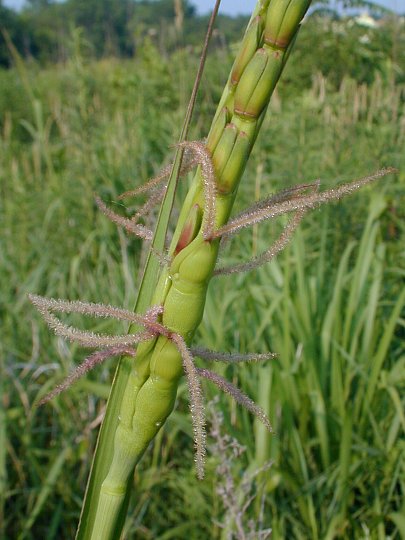
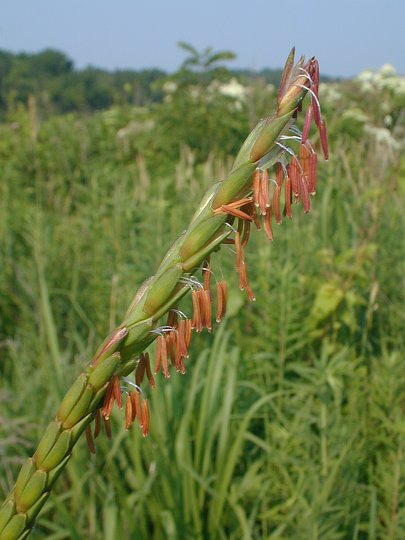
Description: This perennial grass is about 3-7' tall; it forms a large tuft of leafy culms. The culms are light green to pale reddish green, glabrous, terete, and usually unbranched. Alternate leaves are located primarily along the lower one-half of each culm. The leaf blades are up to 2½' long and 1½" across; their upper sides are medium green and glabrous, while their lower sides are light green and glabrous. Most leaf blades are arching and rather floppy; larger leaf blades usually have white central veins that are conspicuous. The leaf sheaths are light green to reddish green, glabrous, longitudinally veined, and open. The ligules consist of short white hairs. Each culm terminates in 1-3 floral spikes (rarely up to 5 floral spikes) that are erect to ascending. These spikes are narrowly cylindrical and 4-12" long; their spikelets are sessile or nearly so. Gama Grass is monoecious, producing separate male (staminate) and female (pistillate) florets on the same inflorescence. Spikelets of male florets occur in pairs along the upper three-fourths of each spike, while spikelets of female florets occur individually along the bottom one-fourth of each spike.
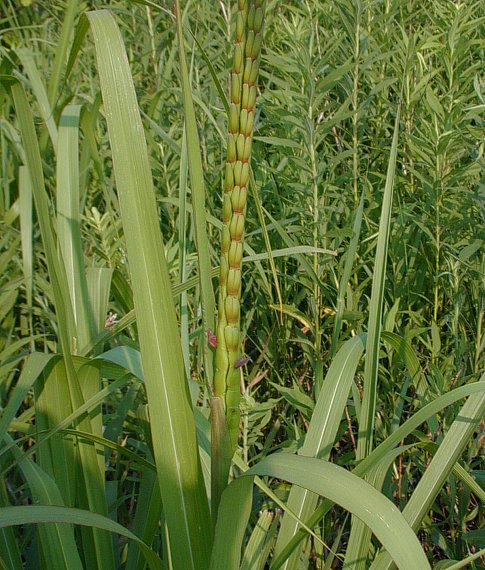
The male spikelets have outer glumes that are 6-10 mm. long and oblong-lanceolate in shape. Each male floret has 3 stamens consisting of slender white filaments and orange-red anthers. The female spikelets are sunken into the central axis (rachis) of the spike; they have hard outer glumes that are 7-11 mm. long, ovate in shape, and convex on the outside. Each female floret produces 2 slender plumose stigmata that are purplish pink to white. The outer glumes of both male and female florets are green to reddish green and glabrous. The blooming period occurs during the summer (in Illinois), lasting about 1-2 weeks. The florets are cross-pollinated by the wind. Afterwards, the female florets are replaced by large hard-coated grains (one grain per floret). These grains are brown, short-cylindrical in shape, and truncated, sometimes obliquely, at their tops and bottoms. The root system is fibrous and short-rhizomatous; clonal offsets are often produced at the base of each plant.
Cultivation:
The preference is full to partial sun, moist to mesic conditions, and a
fertile loam or clay-loam to sustain its robust growth.
This grass can become quite large, although it is not particularly
aggressive. The seeds require moist stratification (exposure to
moisture and cool temperatures) in order to germinate; their hard coats
can delay germination. It is easier to propagate new plants by dividing
the root mass of larger plants. In spite of its preference for moist
conditions, Gama Grass is able to tolerate hot dry weather because of
its C4 metabolism and deep root system.
Range & Habitat:
The native Gama Grass occurs occasionally in the southern half of
Illinois; it is absent from northern Illinois (see Distribution
Map). Illinois lies along the northern range-limit
of this species. Habitats include wet to mesic prairies, prairie
swales, thickets, woodland borders, savannas, limestone glades,
abandoned fields, low areas along railroads, and roadside ditches.
While this grass normally occurs in moist open areas,
sometimes it colonizes drier areas that are rocky or gravelly. At one
time, large colonies of Gama Grass could be found in the moist prairies
of Illinois and many southern states, but it has since declined in
abundance as a result of habitat destruction.
Faunal
Associations:
Insects that feed on the foliage and other parts of Gama Grass include
the caterpillars of Problema byssus (Byssus
Skipper), leaf-mining larvae of the beetles Anisostena bicolor
and Anisostena kansana,
Sphenophorus maidis
(Maize Billbug), and larvae of the gall fly Chilophaga tripsaci
(Bouseman et al., 2006; Clark et al., 2004; Vaurie, 1983; Felt,
1917). The nutritious foliage is readily eaten by livestock.
Probably bison, elk, and other large herbivores grazed on the foliage
before they were extirpated within the state. This large grass also
provides protective cover for various kinds of wildlife, especially in
prairies.
Photographic Location:
A restored prairie at Meadowbrook Park in Urbana, Illinois.
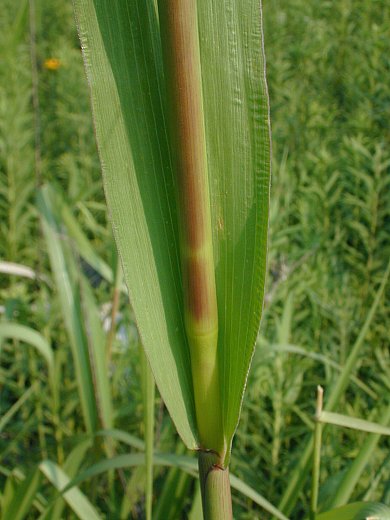
Comments: Gama Grass is an interesting plant with an unusual appearance that shares some similarities to its distant relative, Zea mays (Cultivated Corn). Both of these species resemble each other as follows: 1) they are large-sized grasses, 2) their larger leaf blades have conspicuous white midveins, 3) their sessile spikelets occur in floral spikes, and 4) male and female florets occur in separate locations on the same plant (i.e., they are monoecious). However, the male and female florets of Gama Grass occur in different locations of the same terminal spikes, while the male and female florets of Cultivated Corn occur on separate spikes. While Cultivated Corn is a summer annual, Gama Grass is a perennial. They are both warm-season grasses with a C4 metabolism, and they are both members of the same tribe of grasses that occurs mainly in subtropical or tropical America. Another common name of Tripsacum dactyloides is Eastern Gama Grass.