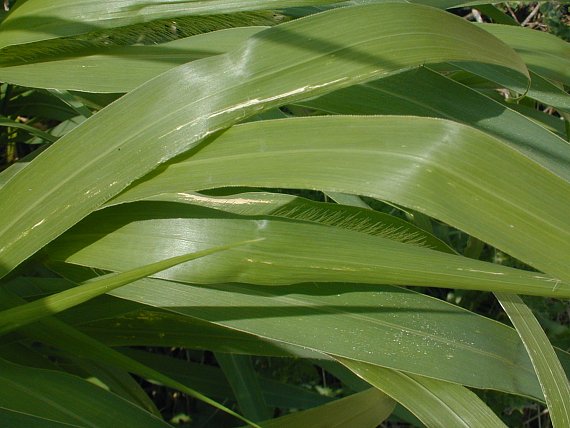
Description: This grass is a summer annual about 2-4' tall. It often branches near the base, sending up multiple culms that are erect to ascending. The culms are light green, glabrous, and terete; several alternate leaves occur along the length of each culm. The leaf blades are up to 15" long and ¾" (20 mm.) across; they are light to medium green, linear in shape, and rather floppy. The upper surface of each leaf blade often has scattered fine hairs that are stiff, appressed, and bristly; sometimes the upper surface is shiny and nearly hairless. The margins of the leaf blades are rough-textured from minute teeth. The leaf sheaths are light green, fine pubescent to hairless, and open; they are often ciliate along their margins. Each ligule at the junction of sheath and blade consists of a ring-like tuft of white hairs up to 3 mm. long. Each stem terminates in a spike-like panicle of florets about 3-6" long. These spike-like panicles are nodding and very bristly in appearance; they are initially light green, but later become light brown to straw-colored. The lateral branchs of each panicle are very short and inconspicuous; each branch ultimately terminates in a few ovoid spikelets on short pedicels. Each spikelet has a pair of glumes, a fertile lemma with a floret, and 1-3 bristly hairs that originate from the base of the spikelet. The first glume is about 1 mm. long, the second glume is about 2 mm. long, the fertile lemma is about 3 mm. long, and the bristly hairs are up to ½" (12 mm.) long. The floret of each spikelet has an ovary, 3 stamens, and a pair of feathery stigmas. The blooming period occurs from mid-summer to autumn; the florets are wind-pollinated. Afterwards, the florets are replaced by grains that are about 2.75 mm. long, 1.75 mm. across, and 1.00 mm. thick; these grains are ovoid in shape, flattened along one side, and pale-colored. The root system consists of a shallow tuft of fibrous roots. This grass reproduces by reseeding itself. It often forms colonies of varying size.

Cultivation:
This
grass is typically found in sunny areas that are moist to dry. It
adapts to many kinds of soil, including those that contain loam, clay,
silt, or gravel. The seeds don't germinate until the weather becomes
warm during the late spring or early summer. Most vegetative growth
occurs during the summer. In spite of its shallow root system, Giant
Foxtail is able to withstand considerable drought because of its C4
metabolism. This grass can reseed itself aggressively and become a pest
where the ground is cultivated.
Range & Habitat:
The non-native Giant Foxtail is a common grass that occurs in every
county of Illinois (see Distribution
Map). It was introduced into the
United States from East Asia during the 1920's, probably in
contaminated shipments of grain. This grass soon appeared in Illinois,
where it has spread relentlessly ever since. Habitats include weedy
meadows, degraded savannas, gravel bars in rivers, banks of drainage
canals, fallow fields, cropland, landfills, mined land, construction
sites, vacant lots, junk yards, sunny fence rows, edges of yards,
gardens, areas along railroads, roadsides, and waste land. Areas with a
history of disturbance are strongly preferred.
Faunal Associations:
Various insects feed on Giant Foxtail and other Setaria spp. For
example, the Rusty Plum Aphid (Hysteroneura setaria)
sucks juices near the seedheads of these grasses during the summer,
while larvae of the Northern Corn Rootworm (Diabrotica barberi)
feed on their roots. Other insect feeders include flea beetles, larvae
of gall flies, stink bugs, grasshoppers, meadow katydids, mealybugs,
army worms, and other insects (see
Insect Table). Rabbits,
voles, and livestock occasionally eat the foliage of these grasses.
However, the bristly seedheads of mature plants can damage the
mouth parts of horses and cattle. The seeds are eaten by the
Thirteen-Lined Ground Squirrel and many kinds of birds (see Bird Table).
Because of the abundance of these weedy grasses and the popularity of
their seeds, Setaria
spp. are one of the most important sources of food for
birds.
Photographic
Location:
Along a railroad in Champaign, Illinois. The photographed grasses are
leaning sideways to a greater extent than usual.
Comments:
Because of its large size and long nodding seedheads, mature plants of
Giant Foxtail (Setaria
faberi) are quite conspicuous. It is one of
several foxtail grasses (Setaria spp.)
that are weedy summer annuals. Giant
Foxtail is larger in size than most foxtail grasses that occur in
Illinois, and its seedheads are long and conspicuously nodding. Most
foxtail grasses in the state have seedheads that are straight or nod
slightly. The bristly hairs of Giant Foxtail's seedheads are always
green before they become light brown or straw-colored. In contrast,
young bristly hairs of Yellow Foxtail's seedheads (Setaria
glauca) are always yellow and those of Green Foxtail (Setaria
viridis) are sometimes purple. Foxtail Millet (Setaria italica),
in contrast, is very similar to Giant Foxtail in most of these
characteristics,
except it is somewhat larger in size. Foxtail Millet tends to have
longer seedheads (up to 12" in length), longer culms (up to 6' in
length), and wider leaf blades (up to 1¼" or 30 mm. across). While its
seedheads often nod like those of Giant Foxtail, they are more stout in
appearance because their lateral branches are longer. Sometimes, this
provides them with a lumpy or lobed appearance that the
seedheads of Giant Foxtail don't possess.