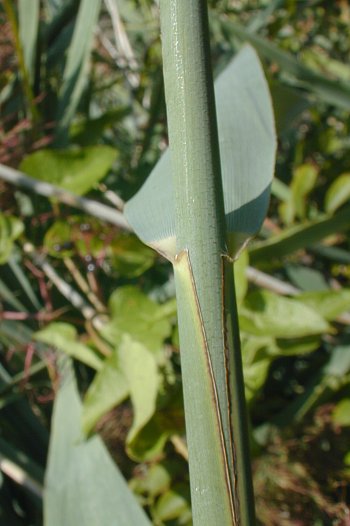
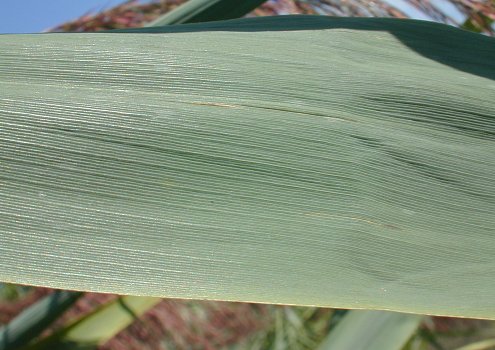
Description: This perennial grass is 4-16' tall and unbranched; individual plants are erect or they may lean over with age. The culm is light green or grayish blue, glabrous, and rather stout (up to 15 mm. across); it has small rectangular impressions across its surface. The alternate leaves are abundant along the culm and they are ascending to arching. The leaf blades are up to 2' long and 2" across; they are light green or grayish blue, linear-lanceolate, and glabrous. The upper leaf surface has conspicuous parallel veins. The open leaf sheaths are the same color as the blades and they are glabrous. The ligules have short white hairs. The culm terminates in a panicle of spikelets up to 1½' long and one-half as much across. This panicle is densely branched and its branchlets are ascending or drooping. While the florets are in bloom, the panicle has a silky reddish appearance, although it becomes light tan to dark brown later in the year.
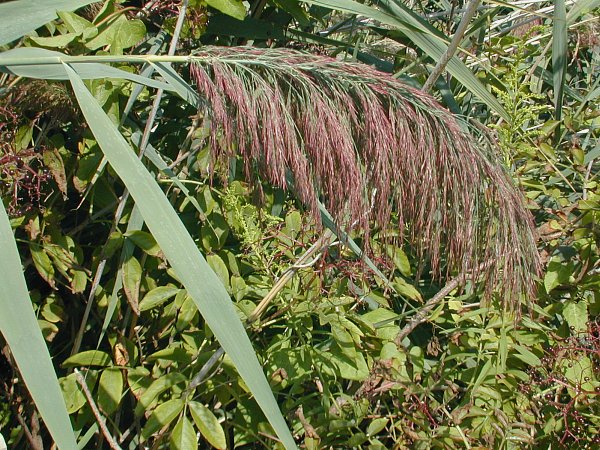
Each spikelet is
12-17 mm. (1/2–2/3") long and it has 3-7 florets; the
lowest floret is sterile or staminate, while the remaining florets are
usually
perfect. At the bottom of this spikelet, there is a pair of
linear-lanceolate glumes about 6 mm. (¼") long. The lemmas above the
glumes are
linear in shape and up to 12 mm. (½") long, becoming smaller as they
ascend the
rachilla (central stalklet of the spikelet). Along the rachilla, there
are
tufts of long silky hairs. The blooming period occurs during mid- to
late summer, lasting about 2-3 weeks for a colony of plants. The
florets are wind-pollinated. Upon maturity, the perfect florets are
replaced by grains, but the latter are often abortive or sterile.
The root system consists of stout rhizomes and coarse fibrous roots.
This grass often forms clonal colonies that are sometimes quite large
in size.
Cultivation:
The preference is full sun, wet conditions (including shallow water),
and a rich fertile soil to sustain the prodigious growth of this grass.
Propagation is easiest by division of the rhizomes, as most seeds are
infertile. This grass also tolerates partial sun and soil that is
consistently moist, rather than wet. It can spread aggressively through
its rhizomes, becoming a pest.
Range &
Habitat:
Giant Reed occurs occasionally in central and northern Illinois, while
in the southern part of the state it is uncommon (see Distribution
Map).
This species is
native to Illinois and other parts of North America; it also occurs in
Eurasia, Africa, and Australia. Habitats include swamps, wet
prairies, marshes, margins of ponds and rivers, large drainage ditches,
edges of poorly drained fields, and sandy lagoons along beaches. In
some of these habitats, Giant Reed can become the dominant wetland
plant.
Faunal Associations:
Larvae of the Broad-winged Skipper (Poanes viator)
feed on Giant Reed (Phragmites
australis), as do the larvae of such moths as the
Phragmites Wainscot (Leucania
phragmitidicola) and Large Wainscot (Rhizedra lutosa).
Other insect feeders include the leaf beetle Donaciella
pubicollis, Southern Corn Leaf Beetle (Myochrous denticollis),
Corn Flea Beetle (Chaetocnema
pulicaria), larvae of the gall fly Calamomyia phragmites,
and the Mealy
Plum Aphid (Hyalopterus
pruni); Giant Reed is the preferred summer host plant of
this aphid. Among vertebrate animals, cattle and horses readily browse
on the foliage of immature plants, while muskrats feed on the
rhizomes and stems. The dense clonal colonies that this grass often
forms and its tall coarse foliage provide protective cover for deer,
rabbits, birds, and other animals. It also provides excellent nesting
habitat for ducks, rails, and other wetland birds.
Photographic Location:
A drainage ditch along a railroad in Champaign, Illinois.
Comments: Giant Reed (Phragmites australis) is a very imposing species that dwarfs most other grasses. In spite of its common name, the Giant Reed is a grass (a member of the Grass family), rather than a reed (whatever that means). With the exception of Giant Cane (Arundinaria gigantea), a species that occurs only in southern Illinois, Giant Reed is the tallest native grass species in Illinois (there are probably non-native Eurasian strains of this grass within the state as well). The Giant Cane is a native bamboo species that flowers only once in about 50 years, while mature specimens of Giant Reed bloom every year. Another grass species that can become quite tall, Arundo donax, is also called 'Giant Reed.' This latter species is cultivated as an ornamental grass; it is native to the Mediterranean area. So far it has naturalized only rarely in southern Illinois. The species Arundo donax is tall and columnar; it has leaves that are shorter than those of Giant Reed. In Illinois, Arundo donax is usually not as tall as the Giant Reed, but in warmer climates it can become taller. There is a less robust form of Arundo donax with variegated leaves that is often cultivated. A scientific synonym of Giant Reed is Phragmites communis, while 'Common Reed' is another common name that is often applied to this species.