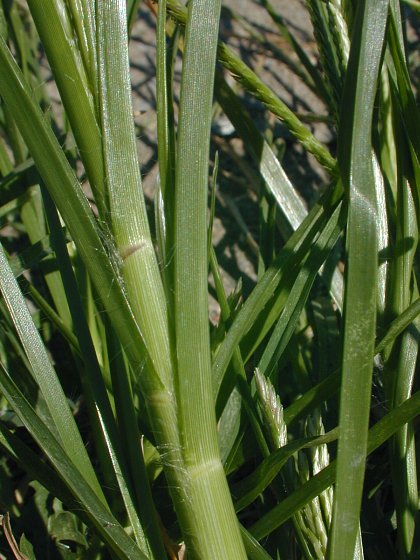
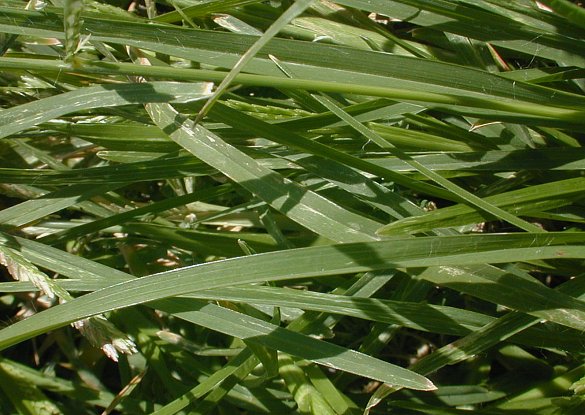
Description: Goose Grass is a summer annual about ½–2' tall that is tufted at the base, sending up multiple ascending culms with alternate leaves. Most of the leaves are located toward the base of the culms. The culms are green, glabrous, and somewhat flattened; they are mostly hidden by the sheaths. The leaf blades are up to 10" long and 8 mm. across; they are medium to dark green, mostly glabrous, keeled, and hull-shaped at their tips. The margins of leaf blades are sparsely ciliate with long crooked hairs. The leaf sheaths wrap loosely around the culms and they are somewhat flattened (elliptic in cross-section) and overlapping. The leaf sheath surface is whitish to medium green, longitudinally veined, and mostly glabrous. However, the margins of the leaf sheaths are somewhat ciliate with long crooked hairs, particularly near their apices. The ligules are white-membranous. Each culm produces a whorl of 2-8 floral spikes at the apex of a long peduncle (basal stalk); there are often 1-2 individual spikes that are located a little lower on the peduncle. The floral spikes are 2-6" long, straight or slightly curved, and ascending to widely spreading (relative to the orientation of the peduncle).
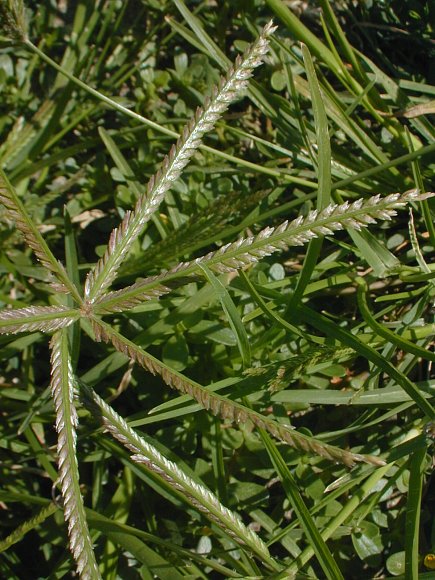
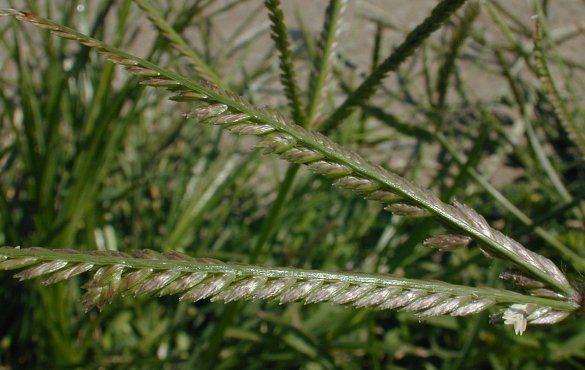
Each floral spike consists of 2 dense rows of sessile spikelets along one side of its rachis (central stalk); the rachis is green, glabrous, and flattened along its exposed side. Immature spikelets are light green, but they become silvery white to silvery red during the blooming period. Each spikelet has a pair of glumes at the bottom and 3-7 lemmas above. The lemmas are arranged in 2 overlapping ranks that are appressed together. Both glumes and lemmas are elliptic or lanceolate, keeled, and thin-textured. The lower glume is 1.5-2.5 mm. in length, while the upper glume is 2-3 mm. in length. The lemmas are 2-3.5 in length; the lower lemmas in a spikelet tend to be larger in size than the upper lemmas. The florets of fertile lemmas are perfect; some upper lemmas may be sterile. The blooming period occurs primarily during the summer, although some plants may bloom during early autumn. Afterwards, the spikelets turn brown; the lemmas disarticulate individually above the glumes. The small grains of fertile lemmas are 1.0–1.5 mm. long, ovoid in shape, somewhat flattened along one side, dark brown, and rough-textured. Each grain has several fine ridges along one side that radiate from the center toward its margins. The root system is fibrous. This grass spreads by reseeding itself.
Cultivation:
Typical growing conditions are full to partial sun and moist to
slightly dry soil that contains loam, clay-loam, or gravelly
material. Goose Grass is often found in heavy compacted soil. Because
of its C4 metabolism, this grass is able to tolerate hot weather and
occasional periods of drought.
Range & Habitat:
Goose Grass is common in most areas of Illinois, although it is
apparently less common or absent in rural areas in the northern half of
the state (see Distribution
Map). This grass was accidentally introduced into North
America from Eurasia and
it tends to be more common in areas with warm climates. Habitats
include lawns and gardens, cracks in city sidewalks and pavement,
margins of building foundations, vacant lots, construction sites, areas
along railroads and roadsides, fields, and waste areas. Less often,
Goose Grass is found in very degraded floodplain areas where there is
scant ground vegetation. It is a typical weed of disturbed urban areas.
Faunal Associations: The caterpillars of a skipper, Atalopedes campestris (Sachem), feed on the foliage (Opler & Krizek, 1984). Other insect feeders of Goose Grass (Eleusine indica) include Chaetocnema denticulata (Toothed Flea Beetle), Chaetocnema pulicaria (Corn Flea Beetle), larvae of the fly Cerodontha dorsalis (Grass Sheath Miner), Anoecia cornicola (White-banded Dogwood Aphid), and Hysteroneura setariae (Rusty Plum Aphid); this grass is the summer host of the latter two aphids (Clark et al., 2004; Needham et al., 1928; Blackman & Eastop, 2013). Mammalian herbivores can eat this grass in limited amounts without ill-effects. Because the seeds are able to pass through the digestive tracts of cattle and horses while remaining viable, such herbivores help to spread the seeds to new locations (Rodriguez et al. 1983). Birds apparently make little use of the seeds, at least in the Midwestern areas of the United States.
Photographic
Location:
A crack in a city sidewalk in Urbana, Illinois.
Comments:
Goose Grass (Eleusine
indica) superficially resembles one of the crabgrasses (Digitaria
spp.)
because of the finger-like spikes of its inflorescence and its habit of
growth, but it is actually quite different. The foliage of Goose Grass
is rather shiny, while the foliage of crabgrass is more
dull-colored. The spikelets of Goose Grass, if they are examined
carefully, will be found to have multiple overlapping lemmas (typically
3-7 lemmas per spikelet). These spikelets are initially shiny and
silvery, but they later turn brown. In contrast, each spikelet of
crabgrass has only a pair of lemmas. The finger-like spikes of
crabgrass are more narrow than those of Goose Grass, and they are
usually green or reddish green and less shiny.