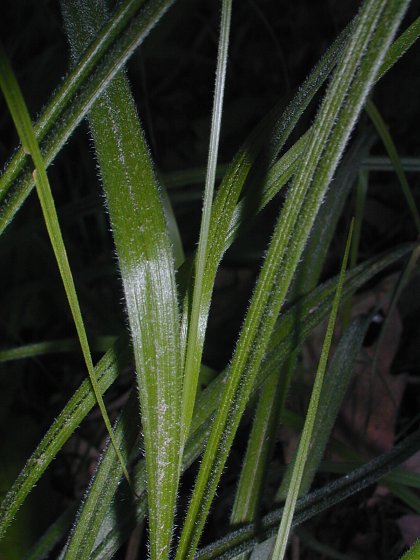
Description: This perennial sedge forms a loose tuft of leafy culms about 1-2' tall. Each culm has 4-6 alternate leaves, which are located mostly along the lower half of its length. Each slender culm is light to medium green, stiff, triangular in cross-section, and slightly pubescent to glabrous; the texture of the culm is rough underneath the inflorescence, otherwise it is smooth. The leaf blades are up 11" long and 5 mm. across; they are medium green, widely spreading, and rather floppy. Both the upper and lower surfaces of these blades are conspicuously pubescent. The outer two sides of the leaf sheaths are medium green and very pubescent, while their inner sides are membranous and less pubescent. The apices of inner sheaths have upper margins that are concave or truncate. At the junctions of sheaths and blades, the ligules are short-membranous; each ligule forms an upside-down V-shape. Each culm terminates in an inflorescence of 2-4 cylindrical spikelets and their bracts. The uppermost spikelet is gynecandrous (pistillate florets & their scales above, staminate florets & their scales below), while the lower spikelets are pistillate.
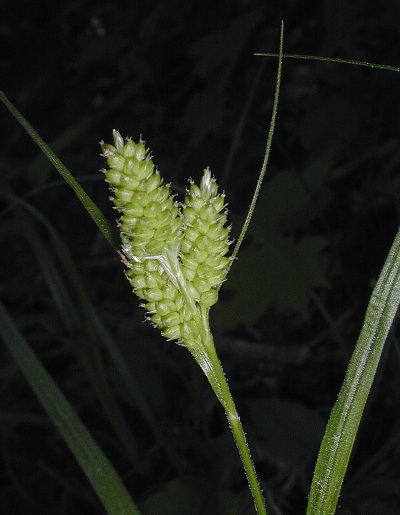
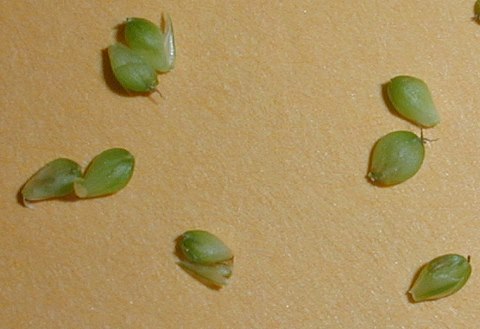
The spikelets are 10-12 mm. long and about 5 mm. across; the uppermost spikelet is a little longer than the lower spikelets. The spikelets are densely packed with the perigynia of pistillate florets; these perigynia are spreading to ascending. There are about 20–40 perigynia per spikelet. The spikelets are held more or less erect on short slender peduncles; at the bases of these peduncles, there are green linear bracts up to 1½" long; the bract of the lowest spikelet overtops the inflorescence. The perigynia are 2.5–3.0 mm. long, about 1.5 mm. across, and obovoid in shape; their outer surfaces are pale green (while immature), glabrous, and only faintly nerved. Each perigynium is well-rounded on its 2 outer sides and somewhat flat on its inner side; the beak of each perigynium is very short and insignificant, while its base is bluntly wedge-shaped. The pistillate scales are 2.0–2.5 mm. long and ovate in shape; they are shorter than the perigynia. The pistillate scales have wide membranous margins (later turning brown), otherwise they are green-veined. The blooming period occurs from late spring to early summer, lasting about 1-2 weeks. The florets are wind-pollinated. The achenes are obovoid, glabrous, and somewhat 3-angled; they are about 1.5–2.0 mm. in length. The root system is fibrous and short-rhizomatous.
Cultivation:
This
sedge is typically found in partial sun to light shade, mesic to
slightly dry
conditions, and somewhat sterile soil containing sand, rocky
material, or clay. Like many other sedges, it will form small tufts of
leaves and culms.
Range & Habitat:
The native Hairy-leaved Sedge is fairly common in the southern half of
Illinois,
becoming occasional to absent in the northern half of the state (see Distribution
Map). Habitats include upland woodlands, thinly wooded
bluffs, wooded slopes, typical savannas and sandy savannas, rocky
glades, sandy
meadows, and abandoned fields. In wooded habitats, this sedge often
occurs where oaks (Quercus
spp.) are the dominant canopy trees.
Faunal Associations:
Insects that feed on woodland sedges (Carex spp.) include
caterpillars of the butterfly Satyrodes appalachia
(Appalachian Brown), leaf-mining larvae of the moths Elachista argentosa
and Elachista madarella,
larvae of the moth Apamea
indocilis (Ignorant Apamea), the stink bug Mormidea lugens,
and the aphids Carolinaia
caricis and Iziphya
flabella. Among
vertebrate animals, the seeds are eaten by such birds as the Wild
Turkey, Cardinal, Eastern Towhee, Song Sparrow, Lincoln Sparrow, Tree
Sparrow (winter only), Common Redpoll (winter only), and Slate-colored
Junco (winter only). Some
mammals use woodland sedges as a source of food to a minor extent;
these species include the White-Tailed Deer (foliage), Black Bear
(foliage), Gray Squirrel (seedheads), and Fox
Squirrel (seedheads).
Photographic
Location:
Edge of a wooded bluff in Vermilion County, Illinois.
Comments:
This sedge is usually found in rather dry open woodlands. It resembles
many other Carex spp. (sedges), but its leaf blades
and sheaths are conspicuously pubescent. Unlike Carex
hirtifolia (Hairy Sedge) and some other hairy sedges (Carex spp.), the
perigynia of Hairy-leaved Sedge are glabrous, rather than pubescent.
Hairy-leaved Sedge could be confused with Carex bushii
(Bush's Sedge), but the pistillate scales of the latter are longer than
the perigynia. Another common name of Carex hirsutella
is Downy Sedge.