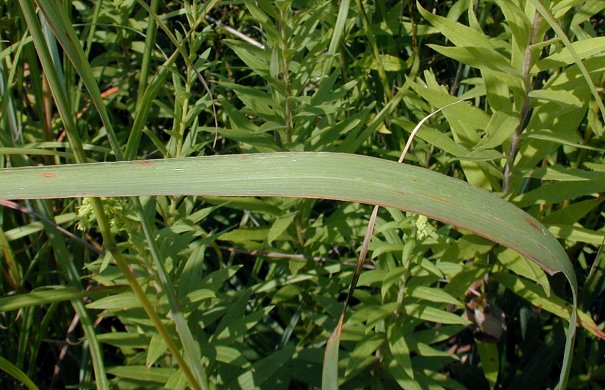
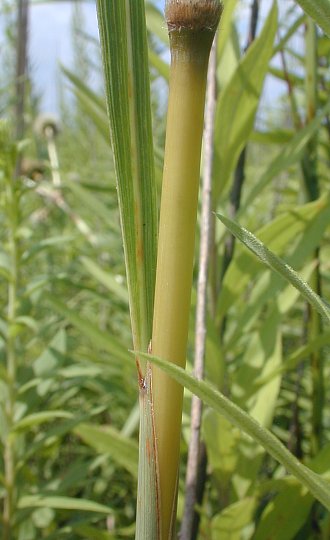
Description: This perennial grass is 3-7' tall. It typically consists of a dense tuft of flowering culms and their deciduous leaves. The culms are terete, glabrous, pale green or pale yellow, and unbranched. Alternate leaves occur primarily along the lower one-half of each culm. The leaf blades are up to 2' long and 6 mm. across; they are pale green to dark green, flat, and hairless (rarely short-pubescent). The leaf blades are ascending to widely spreading, and often arched. The leaf sheaths are pale to medium green, open, and hairless (rarely short-pubescent). The nodes of the culms are slightly swollen, dark-colored, and covered with short fine hairs (at least when they are young). The ligules are white-membranous. Each fertile culm terminates in a narrow panicle of spikelets. Each panicle is 4-14" long and ellipsoid to lanceoloid in outline, becoming broader with age. The panicle has a rachis with several ascending branches; the latter are up to 4" long. The rachis and branches are yellowish tan to golden brown, mostly glabrous, and terete. Small tufts of hair may occur where the branches diverge from the rachis. The branches divide into branchlets that terminate in clusters of 2-3 spikelets. In each cluster, the sessile spikelet is fertile, while the remaining 1-2 pedicellate spikelets are either sterile or fertile. Sterile spikelets have hairy pedicels that are 5-8 mm. long; these pedicels are empty, lacking either glumes or lemmas at their apices.
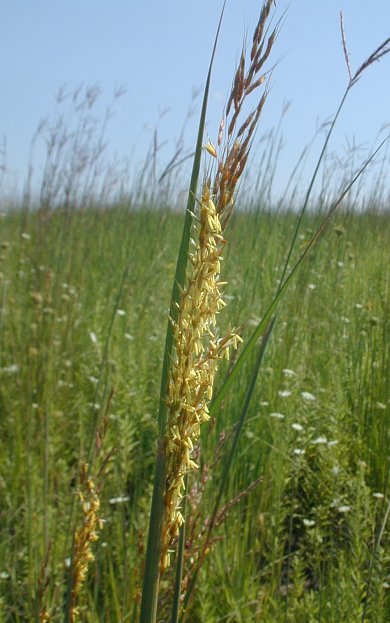
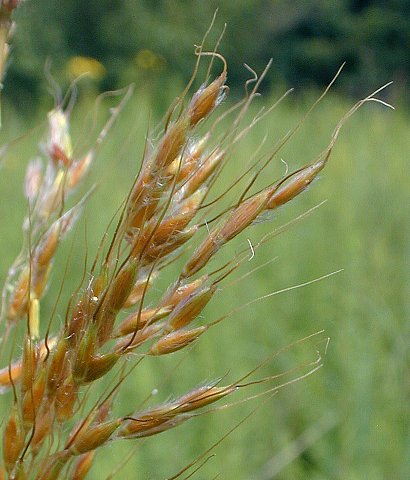
Fertile spikelets, whether they are sessile or pedicellate, are 5-8 mm. long (excluding their awns) and lanceoloid in shape; they are typically golden brown during the blooming period. Each fertile spikelet consists of a pair of glumes, a sterile lemma, an awned fertile lemma, and a perfect floret. The glumes are the same length as the spikelet; they are lanceolate, convex along their outer surfaces, longitudinally veined, and somewhat shiny. One glume is covered with silky white hairs, particularly along the lower length of its length, while the other glume is mostly hairless. The sterile and fertile lemmas are 3-6 mm. long, lanceolate, membranous, and enclosed by the glumes. The fertile lemma has a long awn at its tip that is often bent, gently curved, or twisted; this awn is about 12-20 mm. (½–¾") in length. Each perfect floret has 3 yellow stamens, 2 white plumose stigmas, and an ovary; the stamens are rather large (3-5 mm. long) and showy. The blooming period occurs from late summer to early autumn, lasting about 1-2 weeks for a colony of plants. The florets are cross-pollinated by the wind. At this time, the panicle branches spread outward slightly, while later they become more appressed and ascending. At maturity, the spikelets disarticulate below the glumes, falling to the ground in their entirety. The narrow grains are about 2-2.5 mm. in length. The root system is fibrous and short-rhizomatous.
Cultivation:
The preference is full to partial sun and moist to dry-mesic
conditions. Various kinds of soil are tolerated, including those that
contain loam, clay-loam, sand, and gravel. Most growth and development
occurs during the warm weather of summer because of the C4 metabolism
of this grass. It can spread aggressively in some situations (e.g.,
prairie restorations).
Range & Habitat:
Indian Grass can be found in every county of Illinois (see Distribution
Map), where it is native. This was one of the dominant
grasses of the prairies that covered much of Illinois during historical
times. Habitats include typical savannas and sandy savannas, black soil
prairies, clay prairies, sand prairies, gravel prairies, dolomite
prairies, hill prairies, cemetery prairies, barrens with scrubby
vegetation, limestone glades, grassy fens, fallow fields, roadsides,
and areas along railroads (particularly where prairie remnants occur).
Indian Grass is often used in tallgrass prairie restorations.
Faunal
Associations:
Several species of grasshoppers feed on the foliage of Indian Grass
(see Grasshopper
Table); this grass is a preferred host plant of Eritettix simplex
(Velvet-striped Grasshopper), Melanoplus
confusus (Little Pasture Grasshopper), and Syrbula admirabilis
(Handsome Grasshopper). These grasshoppers are an important source of
food to many insectivorous songbirds and upland gamebirds. Other
insects that feed on Indian Grass include the leafhopper Flexamia
reflexa, the Issid planthopper Bruchomorpha
extensa, and the caterpillars of Amblyscirtes hegon
(Pepper-and-Salt Skipper); see Panzer et al. (2006) and Bouseman et al.
(2006). The foliage is also palatable to hoofed mammalian herbivores,
including bison and cattle. Because of its height and tendency to
remain erect, it provides nesting habitat and protective cover for many
kinds of birds, including the Ring-necked Pheasant, Greater Prairie
Chicken, Northern Bobwhite, Mourning Dove, and Field Sparrow (see
Walkup, 1991; Best, 1978).
Photographic Location:
A restored prairie at Meadowbrook Park in Urbana, Illinois.
Comments: This tall prairie grass is attractive, particularly while the florets are blooming. Indian Grass (Sorghastrum nutans) remains erect throughout the summer and sometimes throughout the winter. Another dominant prairie grass, Big Bluestem (Andropogon gerardii), is more likely to lean in the direction of the prevailing winds, and its culms topple over during the winter to smother surrounding vegetation. Indian Grass is easy to identify because of its height and its distinctive golden inflorescence. This grass is distantly related to sorghum grasses (Sorghum spp.) of the Old World, including the introduced Johnson Grass (Sorghum halepense). Like Indian Grass, the spikelets of sorghum grasses usually occur in pairs (one sessile spikelet and one pedicellate spikelet). However, the pedicellate spikelets of sorghum grasses always have glumes and lemmas, even when they are sterile. In contrast, the pedicellate spikelets of Indian Grass lack glumes and lemmas when they are sterile; they consist of empty pedicels. Outside of Illinois, there are other species in the Sorghastrum genus that occur primarily in the southeastern United States; they can be distinguished from Indian Grass by their longer awns (at least 20 mm. or ¾" long).