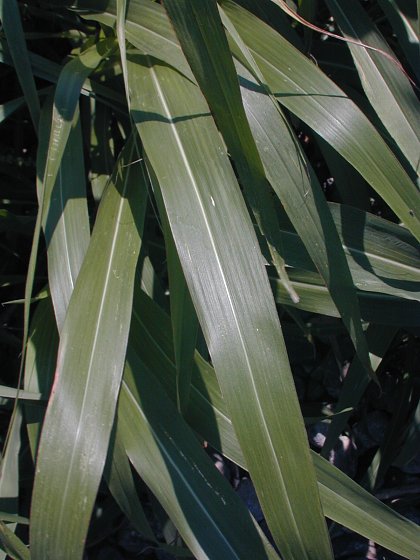
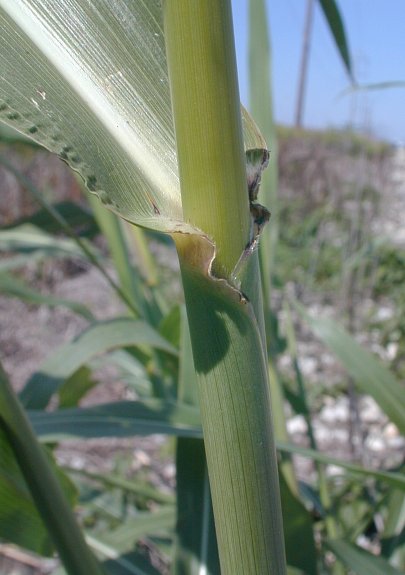
Description: This perennial grass is about 2½–7' tall and more or less erect. The culms are light green, terete, and glabrous. The alternate leaves occur primarily along the lower half of each culm. The leaf blades are up to 2½' long and 1¼" across; they are widely spreading, arching, or ascending. The upper blade surface is medium to dark green and glabrous, while the lower blade surface is more pale than the upper surface and glabrous. The larger leaf blades have prominent central veins that are pale-colored near their bases. The leaf sheaths are light green to green, glabrous (or nearly so), and open. The ligules at the junctions of leaf blades and sheaths have narrow strips of fine white hairs. Each culm terminates in a panicle of spikelets. Each panicle is up to 1½' long and less than one-half as much across; it is broader toward the bottom than the top and somewhat airy in appearance when it is fully open. The rachis (central stalk) of each panicle is green, glabrous, terete, and slightly wiry. At intervals along this rachis, there are whorls of 2-3 lateral branches or single lateral branches that are ascending to widely spreading. The lateral branches divide into branchlets and spikelets with pedicels. The spikelets occur from the middle of these branches to their tips, but they are absent near the rachis. The lateral branches, branchlets, and pedicels are green, slender, glabrous or scabrous, and slightly wiry.
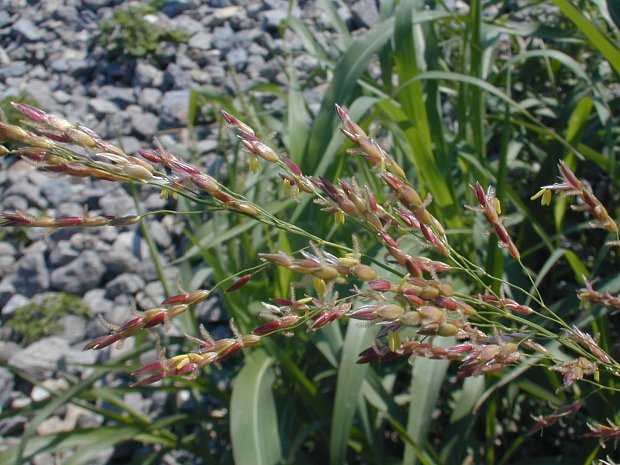
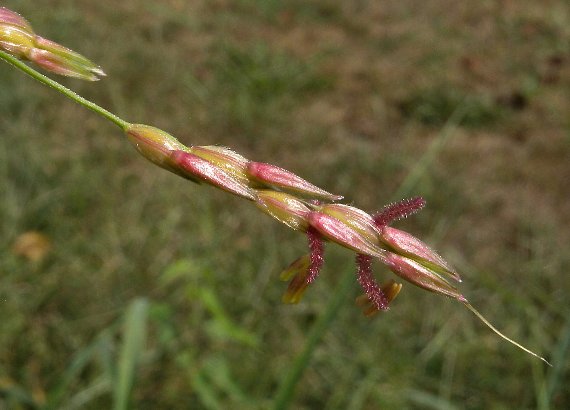
The spikelets occur in pairs (rarely in trios), consisting of a sessile spikelet and a pedicellate spikelet (rarely 2 pedicellate spikelets). The sessile spikelets are 4.5-5 mm. long and perfect, while the pedicellate spikelets are 4.5-6 mm. long and either staminate or sterile. Both kinds of spikelets have a pair of glumes that enclose the lemmas; these glumes are the same length as the spikelets. While the florets are in bloom, the glumes of the sessile spikelets are lanceolate, glabrous to appressed-hairy, and often light tan with reddish central veins. At the same time, the glumes of pedicellate spikelets are narrowly lanceolate, glabrous or nearly so, and often metallic red; their pedicels are up to 6 mm. long and glabrous to softly hairy. The fertile lemmas of the sessile spikelets have awns at their tips. These awns are 10-15 mm. long, slightly crooked or twisted, and early-deciduous. Perfect florets have a pair of plumose stigmas that are white to mauve; both perfect florets and staminate florets have anthers that are pale yellow to brown. The blooming period occurs during mid-summer to autumn, lasting 1-2 weeks for a colony of plants. Each spikelet with perfect florets produces a single grain. The grains are 2-3 mm. long, ovoid in shape, and reddish brown. The root system is fibrous and long-rhizomatous. This grass often forms clonal colonies from the rhizomes.
Cultivation:
The preference is full sun, moist to mesic conditions, and fertile
loamy soil. However, this robust grass will tolerate drier locations
and less productive soil containing gravel or clay. Because this grass
has a C4 photosynthetic metabolism, most growth and development occurs
during the summer and episodes of hot dry weather are tolerated.
This grass has a tendency to spread aggressively.
Range & Habitat:
Johnson Grass is occasional to locally common in the southern half of
Illinois, while in the northern half of the state it is uncommon or
absent (see Distribution
Map).
This grass was introduced from the eastern Mediterranean area or the
Middle East as a pasture grass in southeastern United States, and
it has since spread across a large area of the United States. In some
states, Johnson Grass is considered a noxious weed. Habitats include
thickets, moist meadows, fallow fields, areas along railroads and
roadsides, construction sites, and waste areas. Sometimes this
grass invades gardens and prairie restorations. Both the seeds and
rhizomes can be transported and introduced into new areas by means of
contaminated bags of topsoil.
Faunal Associations: Insects that feed on Johnson Grass (Sorghum halepense) and other Sorghum spp. include the caterpillars of Lerodea eufala (Eufala Skipper), Chaetocnema denticulata (Toothed Flea Beetle), Chaetocnema pulicaria (Corn Flea Beetle), Oulema melanopus (Corn Leaf Beetle), Sphenophorus maidis (Maize Billbug), seed-eating larvae of Contarinia sorghicola (Sorghum Midge), Euschistus servus (Brown Stink Bug), Euschistus tristigmus (Dusky Stink Bug), Oebalus pugnax (Rice Stink Bug), Blissus leucopterus leucopterus (Common Chinch Bug), Rhopalosiphum maidis (Corn Leaf Aphid), Sipha flava (Yellow Sugar Cane Aphid), and Chortophaga viridifasciata (Northern Green-striped Grasshopper); see Bouseman et al. (2006), Clark et al. (2004), Vaurie (1983), Felt (1917), Rider (2009), Cranshaw (2004), Blackman & Eastop (2013), and Brust et al. (2008) for more information. The Canada Goose, Mourning Dove, and probably other birds eat the seeds of Johnson Grass (Havera, 1999; Lewis, 1993), as does the wild House Mouse (Whitaker, 1966). Foliage that becomes wilted from frost or hot dry weather can contain sufficient amounts of hydrocyanic acid to kill cattle and horses if it is eaten in quantity. Also, the foliage can cause 'bloat' in such herbivores from the accumulation of excessive nitrates. Otherwise, it is edible (Georgia, 1913).
Photographic
Location:
A gravelly area along a railroad in Savoy, Illinois, and the lawn of an
apartment complex in Urbana, Illinois.
Comments:
In Illinois, Johnson Grass (Sorghum
halepense) can become quite large in size and it has a
tendency to stand out from the surrounding vegetation. In spite of its
weedy character, this grass is rather attractive while it is in bloom.
The foliage of Johnson Grass has a similar appearance to the foliage of
native Gama Grass (Tripsacum dactyloides). For
example, their leaf blades are quite long and broad, shiny green, and
pale-striped from their prominent central veins. However, the
inflorescence of Johnson Grass is quite different from the
inflorescence of Gama Grass. The latter species has either individual
or clusters of stout
floral spikes, while Johnson Grass has a spreading panicle of florets
with slender branches and branchlets. Another species, Sorghum (Sorghum
bicolor), is occasionally cultivated as an agricultural crop.
Sorghum is an annual and its inflorescence is more dense and upright in
appearance than the inflorescence of Johnson Grass.
Another species, Columbus Grass (Sorghum × almum),
has been introduced into the United States from Argentina. This species
resembles Johnson Grass, but it is even larger in size with leaf blades
typically 1-2" across. Because Columbus Grass has difficulty surviving
cold winters, it is restricted to southern Illinois, where it is rare.