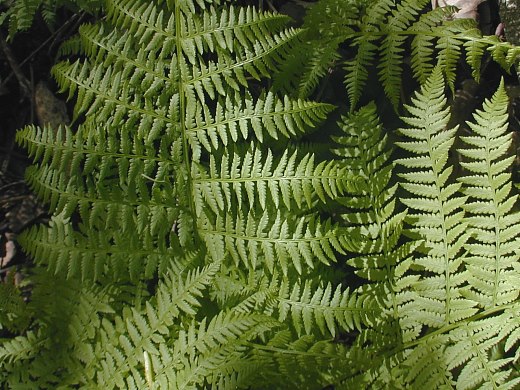
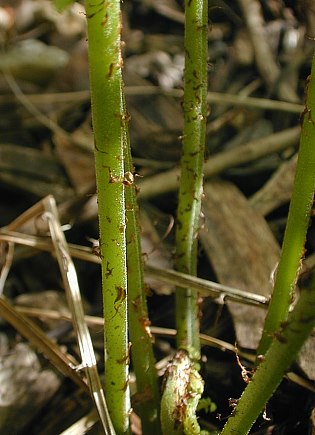
Description: This perennial fern has deciduous leaves about 2–3½' long that are arranged in loose tufts. The petioles are usually light green or yellowish green, sometimes becoming reddish brown late in the season; they have chaffy scales that are light to dark brown. These scales are less than 1 cm. (1/3") in length for var. angustum, while for var. asplenioides they are greater than 1 cm. (1/3") in length. The compound leaves are 2-3 times longer than their petioles and lanceolate-ovate in outline; they are widest below the middle and up to 10" across. Both surfaces of the compound leaf are light to medium green (or yellowish green during spring) and glabrous. Each compound leaf is bipinnate-pinnatifid with 12-24 pairs of leaflets (not necessarily opposite from each other); these leaflets are linear-lanceolate in outline and pinnate-pinnatifid in structure. The larger leaflets have 15 or more pairs of subleaflets. The subleaflets are oblong-lanceolate, pinnatifid (shallowly to moderately cleft), and either sessile or short-stalked; their margins are slightly to moderately serrated and flat to revolute (rolled downward). The veins of the subleaflets are pinnate. Both the rachis (central stalk) of the compound leaf and the lateral stalks of the leaflets are light green and glabrous (or nearly so); they are grooved along their upper surfaces and convex along their lower surfaces.
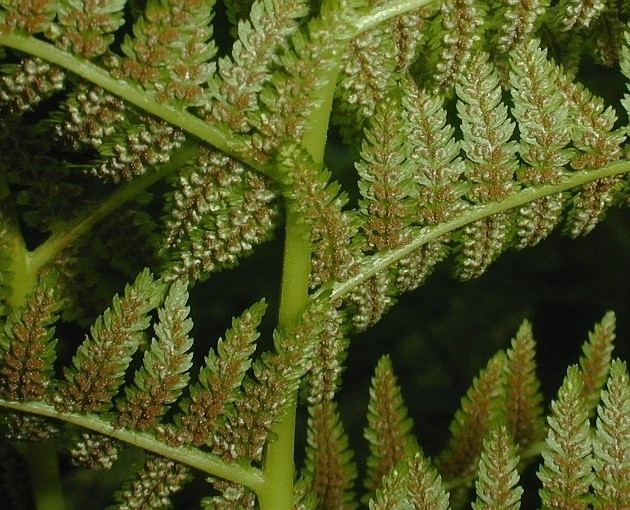
The reproductive
structures (sori & indusia) are located on the undersides of
the
subleaflets. There are several pairs of sori/indusia on either side of
the central vein of each subleaflet. Usually, the narrow sori
(spore-bearing structures) are slightly to moderated curved (like a
crescent moon or sickle); less often, they are either straight
or strongly curved (like a horse-shoe). The indusia (protective
membranes) are the same
shape as their sori; each indusium is attached to one side of its
sorus.
The brownish spores of the sori are usually released to the wind during
the summer or early fall. The root system is fibrous and rhizomatous.
Clonal offsets are often formed from the rhizomes, creating small
colonies of plants.
Cultivation:
The preference is dappled sunlight to moderate shade, moist to mesic
conditions,
and a loose loamy soil that is slightly acidic. This fern likes high
humidity and some protection from the wind. Problems with disease
organisms and
pests are uncommon.
Range & Habitat: The native Lady Fern is occasional in most areas of Illinois; it is uncommon or absent in parts of south-central and east-central Illinois (see Distribution Map). This circumboreal species is widely distributed in North America and Eurasia. Across this range, several varieties of Lady Fern have been identified. In Illinois, Athyrium filix-femina angustum (Northern Lady Fern) is the most common variety throughout the state. In southern Illinois, Athyrium filix-femina asplenioides (Southern Lady Fern) has been found in a few counties. Habitats include moist to mesic woodlands, rocky ravines, shaded seeps, and edges of swamps. In Illinois, Lady Fern is typically found in deciduous woodlands (e.g., Maple-Basswood), although it is also occurs in coniferous or mixed woodlands in areas north of the state. Occasionally, this fern is cultivated in woodland gardens because of its ornamental foliage.
Faunal
Associations:
Information about floral-faunal relationships for this fern is limited.
Insects that feed on the Lady Fern include the aphid, Macrosiphum lambi,
and larvae of the moth, Stathmopoda
aenea. Larvae of this moth feed on spores of the leaf
undersides. White-Tailed Deer browse sparingly on the leaves
of this fern during the summer. Because this fern is fairly large in
size and sometimes forms colonies, it can provide significant cover for
wildlife in those few areas where it is locally common. However, the
value of this fern to wildlife appears to be low overall.
Photographic Location:
A woodland garden near Busey Woods in Urbana, Illinois.
Comments:
The Lady Fern is an ornamental foliage plant that adapts readily to
cultivation. Like Dryopteris felix-mas (Male Fern),
the rhizomes of Lady Fern contain an oil that has been used to expel
intestinal worms (particularly tapeworms). An overdose of this oil is
toxic and potentially fatal to humans, however.
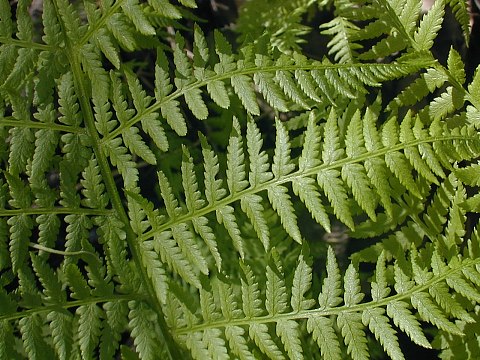
In many ways, the compound leaves of Lady Fern resemble those of several Dryopteris spp. (Wood Ferns), particularly Dryopteris carthusiana (Spinulose Wood Fern) and Dryopteris intermedia (Common Wood Fern). In addition to having similar leaf blades, the latter two ferns also have scaly petioles. The Lady Fern differs from these 2 species as follows: 1) Its leaves are usually more broad, 2) its leaves are deciduous, while the leaves of the preceding Dryopteris spp. are semi-evergreen to evergreen, and 3) its spore-bearing structures are slender (whether straight or curved), while the spore-bearing structures of the latter ferns are circular in shape. For a more detailed description of the differences between the varieties Athyrium filix-femina angustum (Northern Lady Fern) and Athyrium filix-femina asplenioides (Southern Lady Fern), see The Illustrated Flora of Illinois: Ferns (1967/1999) by Robert Mohlenbrock, or the website of Efloras (www.efloras.org). Some authorities consider these two varieties to be separate species, in which case Northern Lady Fern is referred to as Athyrium angustum and Southern Lady Fern is referred to as Athyrium asplenioides.