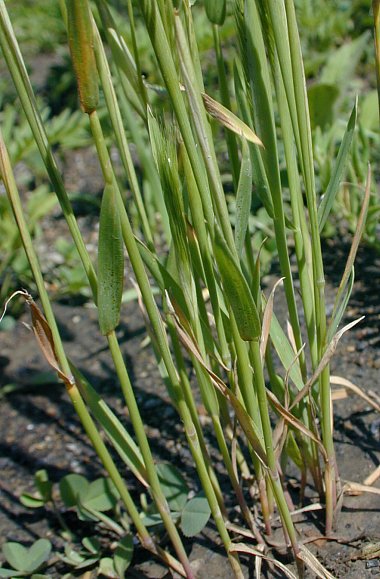
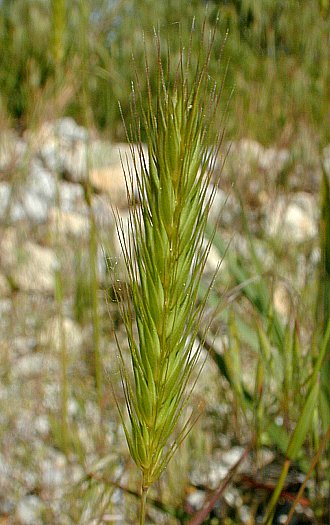
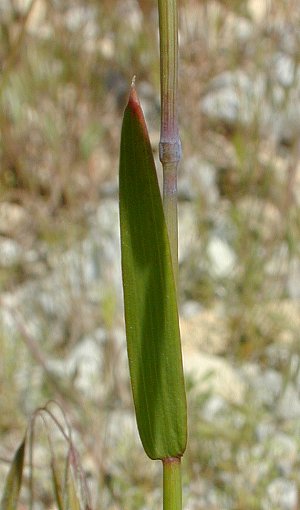
Description: This grass is ¾–1½' tall and often tufted at the base, sending up multiple unbranched culms. It is a winter or spring annual. The culms are erect to ascending and sometimes decumbent at the base; they are terete, light green, and slender. Each culm has 1-3 alternate leaves along the lower half of its length. The leaf blades are ¾–2½" long and about 1/8" (3 mm.) across; they are dull pale green, hairless, and flat. Along the culm, these blades are erect to ascending, rather than widely spreading. The leaf sheaths are pale green to pale purplish green, finely veined, and hairless. The nodes are dark-colored and swollen. Each culm terminates in a spike-like inflorescence about 1½–3" long and ½" across; this stiff and erect inflorescence consists of 2 overlapping ranks of spikelets.
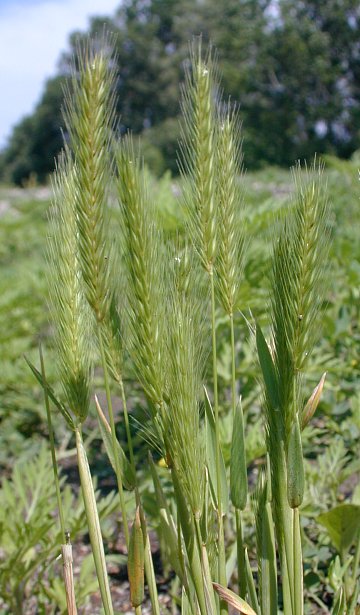
Each spikelet consists of a central lemma, 2 lateral lemmas, and their glumes; each lemma has 2 glumes. The central lemma is sessile, while the lateral lemmas are short-stalked. The central lemma is 12-15 mm. long (including its awn), linear-lanceolate in shape, and fertile; its glumes are 10-15 mm. long (including their awns) and linear-lanceolate in shape. The lateral lemmas are about 5 mm. long (including their awns, if any) and infertile; their glumes are 10-15 mm. long (including their awns). One of the glumes of each lateral lemma is linear-lanceolate, while the other glume is slender and bristle-like. The awns of the glumes and central lemmas are about 5-6 mm. long. Immature lemmas and glumes are light green; the wider glumes have narrow cream margins. The blooming period occurs from late spring to mid-summer. The florets of the fertile lemmas are cross-pollinated by the wind. The grain of each fertile lemma is ovoid-oblongloid in shape, light-colored, and about 3 mm. in length. The root system is shallow and fibrous. This grass reproduces by reseeding itself. It occasionally forms small loose colonies in favorable habitats.
Cultivation:
The preference is full sun, dry conditions, and a sterile soil
containing an abundance of gravel, sand, or clay. Alkaline soil is
readily tolerated, if not preferred. Growth and development occurs
rather quickly during the spring and early summer.
Range & Habitat:
The native Little Barley is common in southern Illinois, occasional in
central Illinois, and uncommon to absent in the northern section of the
state (see Distribution
Map). This species has a wide distribution in the southern
two-thirds of the continental United States; northern Illinois is
located along its northern range limit. Habitats include dry dolomite
prairies, gravelly areas along railroads, roadsides, pastures, fallow
fields, and sterile waste areas. This species is somewhat
weedy and commonly found in areas with a history of disturbance.
Faunal
Associations:
Insects that feed on Little Barley (Hordeum
pusillum) and other barley grasses (Hordeum spp.)
include the Large-headed Grasshopper (Phoetaliotes nebrascensis),
the Brown Stink Bug (Euschistus
servus), and several species of aphids, including Metopolophium dirhodum
(Rose-Grass Aphid), Rhopalosiphum
maidis (Corn Leaf Aphid), Sipha flava (Yellow
Sugar Cane Aphid), and Tetraneura
ulmi (Elm & Grass Root Aphid). It also seems
likely that some species of mice and ground squirrels eat the seeds
occasionally, as this has been observed for wild barley grasses in the
Great Plains and western states.
Photographic Location:
A dry gravelly area along a railroad near Champaign, Illinois, and
along a gravel road at Judge Webber Park in Urbana, Illinois.
Comments: Little Barley (Hordeum pusillum) is related to the Eurasian species, Cultivated Barley (Hordeum vulgare). Its appearance is somewhat similar to the awned variety of Cultivated Barley, except that Little Barley is smaller in size and it has shorter awns. Both of these species can be found in similar habitats (e.g., fallow fields and gravelly areas along railroads). The spike-like inflorescence of another species, Foxtail Barley (Hordeum jubatum), has a nodding habit and its silky awns are much longer than those of Little Barley. Another species in the state, the non-native Meadow Barley (Hordeum brachyantherum), is very rare in Illinois. It is a taller grass (up to 3' tall) with wider leaf blades (up to 9 mm. across), and its awned lemmas are usually longer in length. Little Barley is one of the native plants that was cultivated by Amerindians in Illinois and other Midwestern states. Some of its seeds were stored during the fall and winter, planted during the spring, and harvested during the summer as a grain crop. However, when the squash-bean-corn complex of crops arrived in this area from Mexico, its cultivation was abandoned as the latter was more productive.