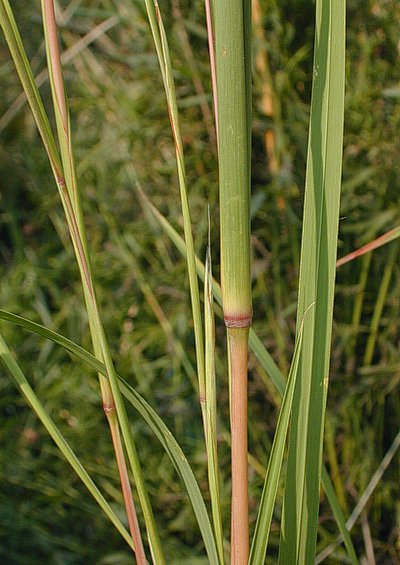
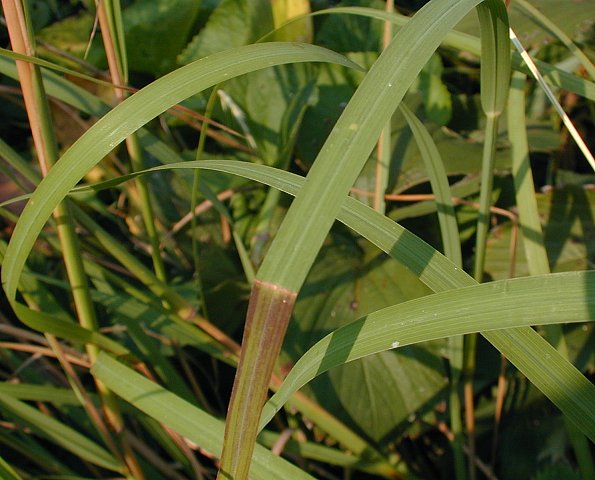
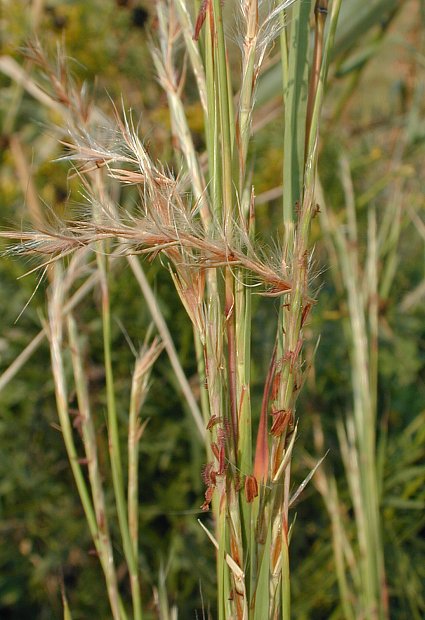
Description: This perennial grass is 2-3' tall and densely tufted at the base. The culms are tan or reddish brown, hairless, and terete; the base of each culm is erect, rather than decumbent across the ground. Alternate leaves are produced primarily along the lower half of each culm. The leaf blades are up to 10" long and 6 mm. (¼") across; they are light green or light blue, hairless or slightly pubescent, and either flat or curving upward along their margins. The leaf sheaths are light green or light blue, hairless or slightly pubescent, finely veined, relatively tight or swollen along the culms, and open toward their apices. The nodes are swollen, hairless, and reddish, while the ligules are white-membranous. Each fertile culm terminates in an inflorescence consisting of several ascending racemes of spikelets. The racemes are about 1½–3" long; they have peduncles (or basal stalks) of variable length underneath. Several pairs of spikelets occur on opposite sides of each raceme's rachis (central stalk); this rachis is covered with long white hairs and it tends to zigzag between the spikelets as they become mature. For each pair of spikelets, there is a fertile spikelet that is sessile and a sterile spikelet on a slender pedicel.
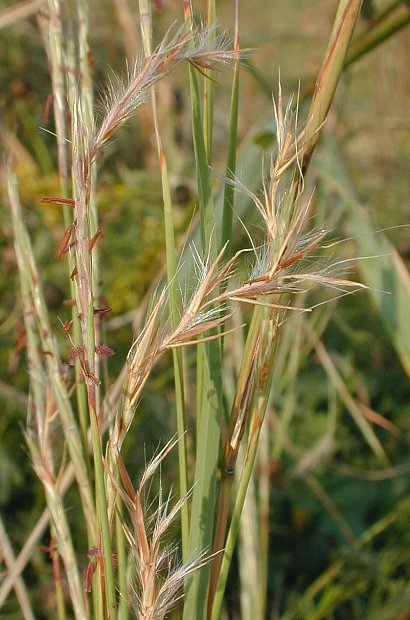
The fertile spikelet is 6-8 mm. in length (excluding any awns); it consists of a pair of outer glumes and a pair of inner lemmas (one lemma is fertile, the other is sterile). The glumes are light green to tan, lanceolate, keeled along their outer surfaces, and hairless to slightly hairy. The fertile lemma is tan to reddish brown, oblong, convex along its outer surface, and long-awned; this awn is 8-15 mm. long and it is often curved or twisted. The sterile spikelet is smaller than the fertile spikelet; it consists of a single glume, a pair of glumes, or a pair of glumes with 1-2 empty lemmas (rarely, one of these lemmas will have male florets). One of the glumes of the sterile spikelet has a short awn (1.5-3 mm. in length). The perfect florets of fertile lemmas have brown to reddish brown anthers and stigmas that are pale purple and plumose. The blooming period occurs from late summer into the autumn, lasting about 1-2 weeks. The florets are cross-pollinated by the wind. Afterwards, the spikelets disarticulate from the racemes; there is a single grain per fertile spikelet. To some extent, these spikelets are blown about by the wind. The root system is fibrous and short-rhizomatous. The deciduous culms and leaves become various shades of tan, brown, or wine-red during the autumn and winter.
Cultivation:
The
preference is full sun and mesic to dry conditions. Different kinds of
soil are tolerated, including those that contain clay-loam, gravel, or
sand. Less fertile soil is preferred because of the reduced competition
from taller vegetation. Because of its C4 metabolism, Little Bluestem
develops primarily during the warm weather of summer and early fall,
and it has excellent drought resistance.
Range & Habitat:
The native Little Bluestem is occasional to locally common in most
areas of Illinois, although voucher specimens haven't been collected in
some counties (see Distribution
Map). Habitats include hill prairies, gravel prairies, sand
prairies, black soil prairies, clay prairies, scrubby barrens, rocky
slopes of thinly wooded bluffs, sandy savannas, hilltop glades
(limestone, sandstone, or shale), sand dunes, gravelly areas along
railroads, and abandoned fields. Little Bluestem is often used in
prairie restorations and it is occasionally found in gardens as an
ornamental grass. In Illinois, this is one of the dominant grasses of
hill prairies.
Faunal Associations: The caterpillars of several skippers feed on the foliage of Little Bluestem, including Atrytonopsis hianna (Dusted Skipper), Hesperia metea (Cobweb Skipper), Hesperia ottoe (Ottoe Skipper), Hesperia sassacus (Indian Skipper), Nastra lherminier (Swarthy Skipper), and Polites origenes (Crossline Skipper); see Bouman et al. (2006). A skipper looks like a cross between a small moth and a small butterfly. Skippers are common in prairies and other open areas where Little Bluestem and other grasses occur. Many grasshoppers also feed on the foliage (see Grasshopper Table); grasshoppers are common in the same habitats as skippers and they are an important source of food for many insectivorous birds. Other insects that feed on Little Bluestem include Diapheromera velii (Prairie Walkingstick), the leaf-mining beetle Anisostena nigrita, the thrips Illinothrips rossi, Prosapia ignipectus (Black Spittlebug), the Delphacid planthopper Delphacodes parvula, and such leafhoppers as Flexamia albida, Flexamia clayi, Flexamia delongi, Flexamia graminea, Flexamia prairiana, Athysanella incongrua, and Laevicephalus unicoloratus (Arment, 2006; Clark et al., 2004; Hamilton, 1982; Stannard, 1968; Panzer et al., 2006; Haarstad, 2002; FLOW, 2014; Hicks, 2014). The Field Sparrow, Tree Sparrow, Slate-Colored Junco, and other small songbirds eat the seeds, particularly during the winter. The foliage of Little Bluestem is quite palatable to bison, cattle, and other hoofed mammalian herbivores.
Photographic
Location:
The wildflower garden of the webmaster in Urbana, Illinois.
Comments:
Little Bluestem is an attractive prairie grass, particularly during the
autumn. While the stems of other grasses become matted during the
winter,
the stems of Little Bluestem remain conspicuously upright. This species
is somewhat variable in the appearance of its foliage and the hairiness
of its floral racemes. Glaucous forms with blue summer foliage can be
found in dry gravelly areas along railroads, while forms with reddish
autumn foliage are often cultivated. An older scientific name for this
species is Andropogon scoparius. However, the
floral racemes of Little Bluestem occur individually on slender stalks,
while the floral racemes of Andropogon spp. (Beard
Grasses) occur in groups (often in finger-like clusters from the same
stalk). This is the only Schizachyrium sp. in
Illinois, although other species in this genus can be found in
southeastern or southwestern areas of the United States. They differ
from Little Bluestem in having racemes with longer hairs (at least ½"
in length) and culms that are partially decumbent on the ground.