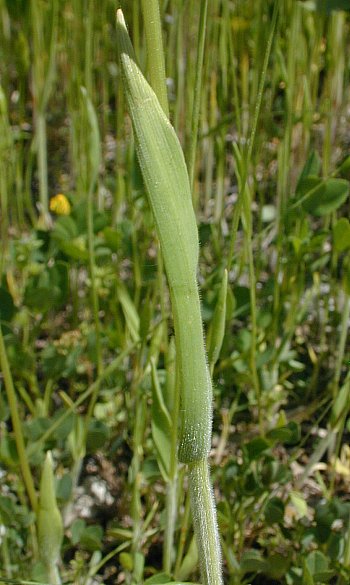
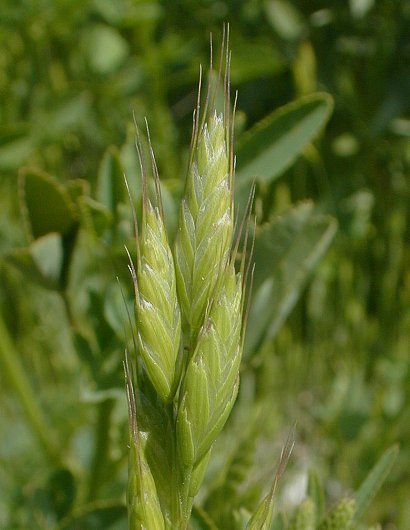
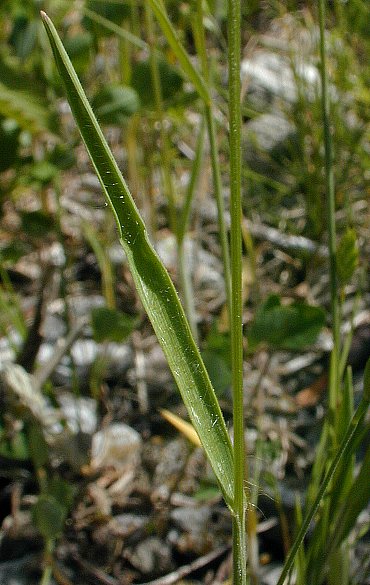
Description: This annual grass is ¾–2' tall and unbranched. The erect culm is light green, terete, and finely pubescent (clearly visible with 10x magnification). Along the lower half of the culm, there are about 3 alternate leaves. The erect to ascending leaf blades are 1-6 mm. across, 2-6 cm. long, and soft-textured; their upper sides are medium green and sparsely pubescent, while their lower sides (often facing outward) are light green and densely pubescent. The leaf sheaths are light green, densely pubescent, and open at their apices. The nodes along each culm are swollen, dark-colored, and finely pubescent. The ligules are short-membranous. Each culm terminates in a compact panicle about 4-8 cm. in length that consists of 6-12 spikelets. The spikelets are more or less erect on pedicels up to 1 cm. in length; each compressed spikelet is about 15 mm. long and 4-5 mm. across with a pair of glumes at the bottom and 2 overlapping ranks of 6-12 lemmas above.
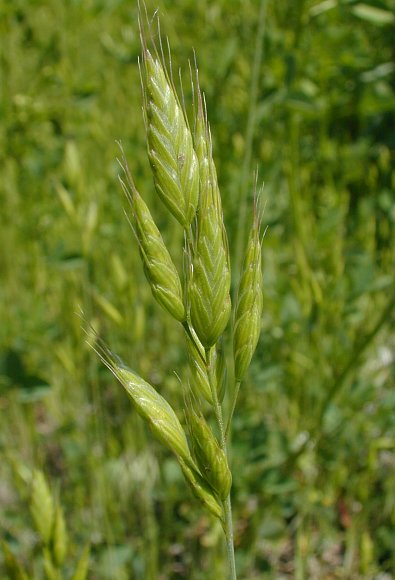
The glumes are convex to slightly keeled on the outside, green, glabrous, and awnless; each glume has about 5 longitudinal veins that are pale green. On each spikelet, the first glume is about 5 mm. long, while the second glume is about 7 mm. long. The lemmas are convex on the outside, green, glabrous, and white-membranous along their margins; each lemma has about 5-7 longitudinal veins that are pale green. The lemmas are 7-9 mm. long, while their straight awns are 4-7 mm. long. Enclosed within each lemma, there is a white membranous palea with a hairy margin that surrounds the developing grain; this palea is about 5 mm. long and linear-oblong in shape. The blooming period is late spring to mid-summer. The perfect florets of the lemmas are wind-pollinated. Afterwards, the spikelets become light tan and this grass begins to die down. The grains are narrowly oblongoid and up to 5 mm. long. The root system is shallow and fibrous. This grass reproduces by reseeding itself. It often forms loose colonies of small erect plants.
Cultivation:
The
preference is full sun in a dry open area. This grass is
typically found in
poor soil containing clay, gravel, and possibly sand.
Range & Habitat:
This non-native grass has been collected from DuPage County and the
webmaster has observed this species along a railroad in Champaign
County, Illinois (see Distribution
Map). Lesser Soft Brome is probably more common than these
records
indicate because the various Bromus spp. (Brome
grasses), particularly those from Europe, are difficult to identify and
their taxonomic history has been unstable. Look for
this grass in such disturbed habitats as roadsides, gravelly areas
along railroads, and sterile waste areas. Lesser Soft Brome appears to
be less invasive than other Brome grasses from Europe, although it
could conceivably invade dry gravel prairies and sand prairies.
Faunal
Associations:
Various short-horned grasshoppers eat the foliage of Bromus
spp. (Brome grasses), including Camnula pellucida
(Clear-winged Grasshopper), Melanoplus packardii
(Packard Grasshopper), and Phoetaliotes nebrascensis
(Large-headed Grasshopper). Other insects that feed on these grasses
include caterpillars of the moth Leucania
multilinea (Many-lined Wainscot), Oulema
melanopus (Cereal Leaf Beetle), larvae of Cephus cinctus
(Grass-stem Sawfly), larvae of Tetramesa
bromicola (Brome Gall Wasp), and several aphids (Forda spp., etc.)
that feed on the roots. Among vertebrate animals, the Prairie
Vole and probably other small
rodents eat the foliage and seeds of various Brome grasses in open
areas. Some upland gamebirds and granivorous songbirds also eat the
seeds, but most observations derive from records in Western states.
During the spring, immature Brome grasses are palatable to hoofed
mammalian herbivores, but mature plants are less palatable because of
the awned spikelets, which can irritate the gastrointestinal tract and
mouth parts of these animals.
Photographic Location:
A gravelly area along a railroad in Savoy, Illinois.
Comments: This European grass can be identified by its compact erect inflorescence and its soft-textured pubescent leaves. It is one of several European Bromus spp. (Brome grasses) that have been introduced into the United States. Lesser Smooth Brome and other annual Brome grasses usually prefer dry open areas with a history of disturbance. Many of these grasses are regarded as weeds, although some species are cultivated as forage plants during the spring. Lesser Smooth Brome is a subspecies of Soft Brome, Bromus hordeaceus. It differs from the typical subspecies by its glabrous spikelets, slightly shorter lemmas, and smaller stature. The typical subspecies, Bromus hordeaceus hordeaceus (Soft Brome), has pubescent spikelets. In the past, Soft Brome has been classified as Bromus mollis, while Lesser Smooth Brome was regarded as the hybrid Bromus × pseudothominei. Another European species, Bromus racemosus (Bald Brome), is somewhat similar in appearance, but this species has a panicle of spikelets that is longer and less compact; furthermore, the branches of its panicle are more likely to droop. A similar species from western North America, Bromus squarrosus (Corn Brome), has curved awns that spread outward. In contrast, Lesser Smooth Brome has straight awns.