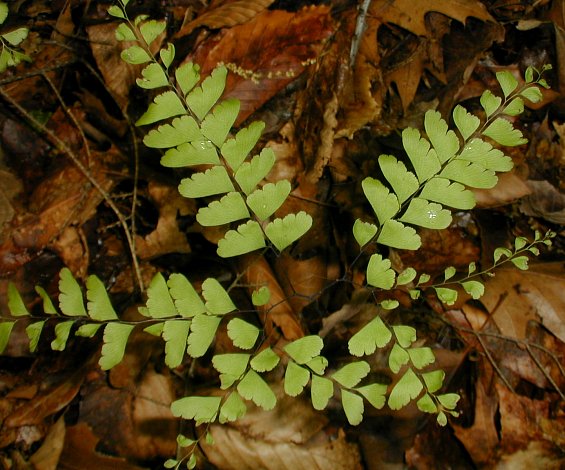
Description: A specimen of this deciduous perennial fern consists of a much-branched bipinnate leaf and its petiole. This compound leaf is 6-24" across and nearly as long; it is held more or less horizontal to the ground. In outline, this leaf is reniform (kidney-shaped) or fan-shaped in outline; it has pinnae (leafy stalks) radiating in all directions. The petiole is 6-18" tall; it is black or dark brown, wiry, glabrous, and erect. The petiole divides into two major branches that widely diverge from each other. Along one side of each branch, there are several straight pinnae; they are odd-pinnate. These pinnae are up to 12" long and 2" across; they have 4-24 pairs of leaflets and single terminal leaflets. The central stalks of the pinnae are black or dark brown, wiry, and glabrous. The non-terminal leaflets are arranged alternately to nearly opposite along each stalk on short petiolules; they are medium green and glabrous. The non-terminal leaflets are up to 1" long and ½" across; they are plume-shaped. One side of each non-terminal leaflet is smooth and slightly curved, while the other side is shallowly cleft and crenate-dentate.
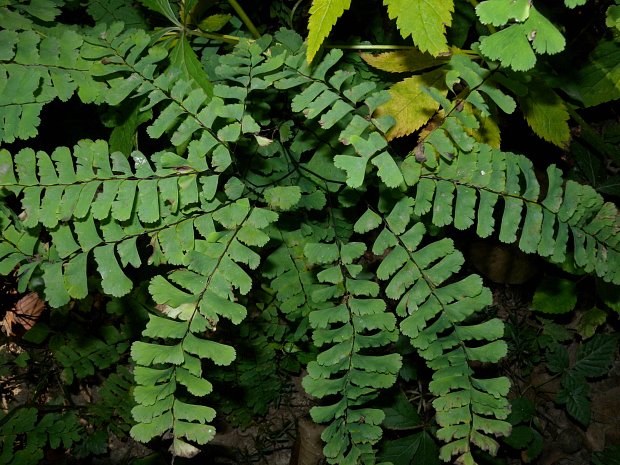
The terminal
leaflets are up to ¾" long and ¾" across; they are fan-shaped. The
lateral sides of each terminal leaflet are smooth and straight,
while the outer side is shallowly cleft and crenate-dentate. The larger
lobes of both non-terminal
and terminal leaflet have rounded or truncate tips. The sporangia
(spore-bearing
structures) are located near the lobed tips of the leaflets on their
undersides. Each of these leaflet tips folds downward and partially
covers its sporangia; these small sporangia are arranged together in a
narrow band. The spores are produced and released during the summer or
fall; they are distributed by the wind. The root system is fibrous and
rhizomatous. Small clonal colonies of plants are often produced from
the long slender rhizomes.
Cultivation:
The preference is light shade, moist to mesic conditions, and pockets
of loose fertile loam with an abundance of decaying leaf litter. This
fern likes high humidity and it should be located in a shaded area that
is protected from the wind.
Range &
Habitat:
The native Maidenhair Fern is occasional throughout Illinois; it has
been found in every county of the state (Distribution
Map). However,
this fern appears to be less abundant than it was in the past. Habitats
include rich deciduous woodlands, rocky wooded slopes, and shaded
ravines where limestone or sandstone is close to the ground surface.
This fern is found in higher quality woodlands where the
original ground flora is largely intact.
Faunal Associations:
Information about floral-faunal relationships is limited. Two aphids, Macrosiphum adianti
and Papulaphis sleesmani,
suck plant juices from this fern. It has been reported that
White-Tailed Deer don't browse on its fronds (Augustine, 1997), which
may be an indication of their toxicity.
Photographic
Location:
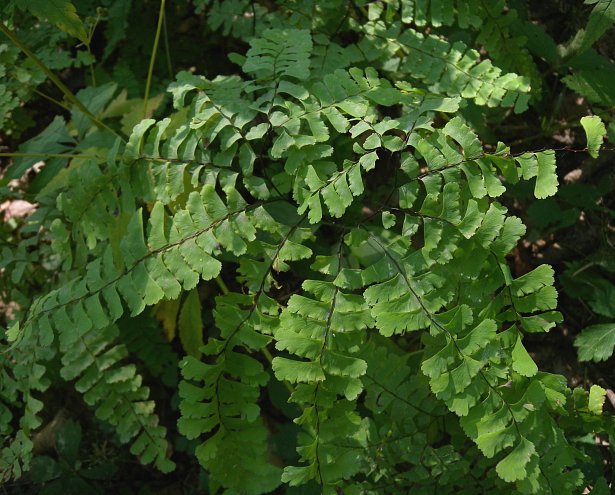
Along the wooded slope of a sandstone ravine at Shades State Park in
west-central Indiana, and a deciduous woodland at Walnut Point State
Park in east-central Illinois.
Comments:
This is one of the more distinctive and beautiful ferns in the state. A
close relative is Adiantum capillus-veneris (Venus
Hair Fern), which is located in areas south of Illinois. The central
stalk (main rachis) of this latter species is branched on both sides;
these side stalks are quite short and they have only a few leaflets
each. The leaflets of this fern are all fan-shaped, rather than
plume-shaped. Sometimes Adiantum pedatum is
referred to as
the Northern Maidenhair Fern, while Adiantum capillus-veneris
is referred to as the Southern Maidenhair Fern.