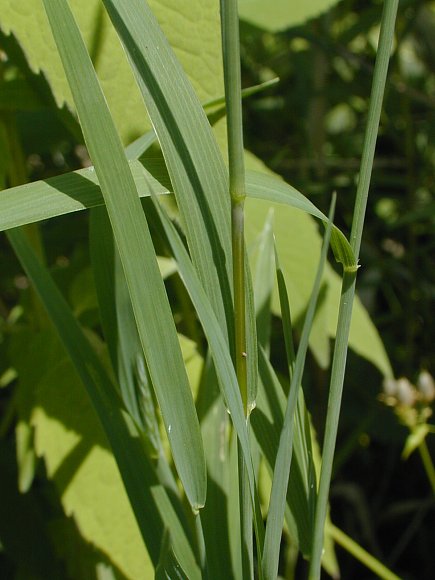
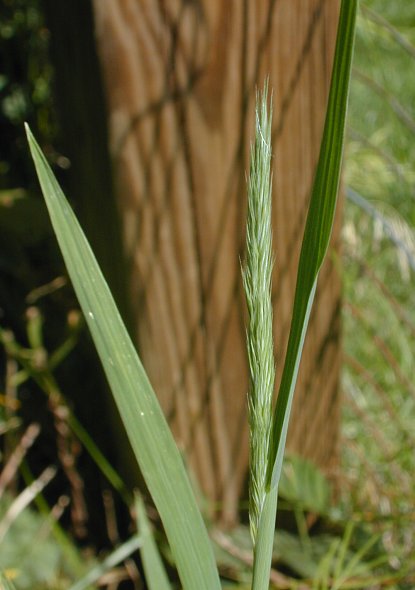
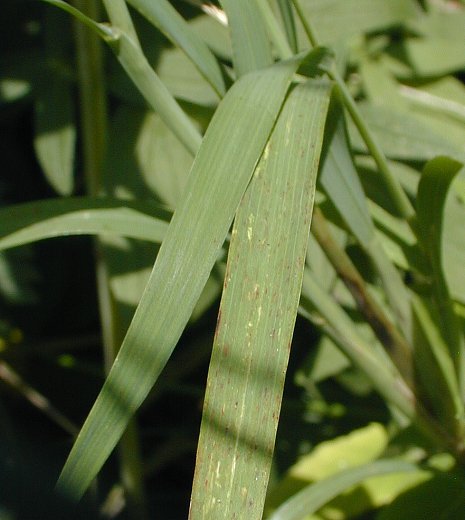
Description: This perennial grass is 1-3' long and erect to sprawling. The culms are light green, terete, and glabrous; they branch occasionally. Abundant alternate leaves occur along the entire length of each culm; lower leaves tend to wither away as the season progresses. The leaf blades are up to 4" long and 5 mm. across; they are dull gray-green, flat, and hairless. The blades are ascending to widely spreading and either floppy or somewhat stiff. The open leaf sheaths are dull gray-green, hairless, somewhat flattened (or keeled), and often coming loose from the culms. At the junctions of blades and sheaths, the ligules are white-membranous, more or less truncate, and about 1 mm. in length. The small nodes are swollen and hairless. The culm (and any upper branches) terminates in a narrow panicle of spikelets up to 5" long and ½" across. Initially, this panicle has a spike-like appearance, but it becomes a little more broad with age as its lateral branchlets become less appressed against the rachis (central axis of the inflorescence). These lateral branchlets are up to 1½" long.
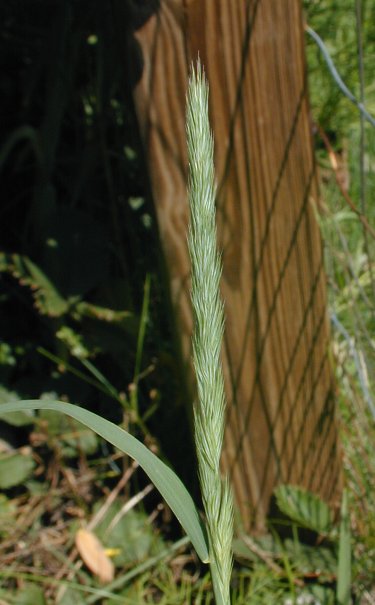
The spikelets are densely distributed along the lateral branchlets; they are light green or whitish green, becoming light brown or light tan after the blooming period. Each spikelet is 5-8 mm. long (including the awns), narrowly lanceoloid in shape, and slightly flattened, consisting of a pair of awned glumes, a fertile lemma, and a palea. Both glumes are 2-3 mm. long (excluding their awns), linear-lanceolate, keeled, and mostly membranous, except for their central veins and awns. The fine awns of these glumes are 3-5 mm. long. The lemma is 3-4 mm. long, lanceolate, and keeled; there is a tuft of fine hairs at its base. The membranous palea is almost as long as the lemma; it encloses a perfect floret with 3 anthers, 2 plumose stigmas, and an ovary. The tiny anthers are white or yellow and about 0.5 mm. long. The blooming period occurs during the late summer, lasting about 1-2 weeks for a colony of plants. The florets are cross-pollinated by the wind. Afterwards, mature spikelets disarticulate above the glumes. The narrows grains are 1.5–2 mm. long; they have adherent pericarps (persistent lemmas & paleas). The root system is fibrous, long-rhizomatous, and rather shallow. Loose colonies of plants are often formed from the rhizomes.
Cultivation:
Generally, this grass prefers full or partial sun and a moist soil
containing loam, sandy loam, or silt. However, some local ecotypes of
this species are adapted to more mesic sites; the latter tend to have a
more erect habit and stiffer leaf blades.
Range & Habitat:
The native Marsh Muhly is occasional in the northern 3 tiers of
counties and the western half of Illinois, but it is uncommon or absent
elsewhere in the state (see Distribution
Map). Illinois lies toward the eastern range-limit of this
species. Habitats are highly variable; they include moist
to mesic prairies (particularly in disturbed areas), thin
woodlands and savannas, low areas along rivers, roadside ditches,
seasonal wetlands, and edges of marshes. Usually, these habitats are
somewhat degraded from a history of disturbance.
Faunal
Associations:
Insects that feed on Marsh Muhly and other Muhly grasses (Muhlenbergia spp.)
include Anoecia
cornicola (White-banded Dogwood Aphid), Prociphilus erigeronensis
(Erigeron Root Aphid), the aphid Schizaphis
muhlenbergia, the leafhopper Flexamia imputans, Plesiommata
tripunctata
(Three-spotted Leafhopper), Eurytomocharis
muhlenbergiae
(Muhlenbergia Jointworm), larvae of the gall flies Astictoneura agrostis
and Astictoneura
muhlenbergiae, stem-gall forming larvae of the grass fly Homaluroides ingratus,
and leaf-mining larvae of the moth Elachista
brachyelytrifoliella
(see the Insect Table for
more information about these species). The foliage of these grasses is
palatable to cattle and other livestock while it is young. Because
Marsh Muhly often forms clonal colonies of plants, it can provide
significant cover for small mammals and other wildlife.
Photographic Location:
The wildflower garden of the webmaster in Urbana, Illinois.
Comments: Marsh Muhly (Muhlenbergia racemosa) is a rather ordinary-looking grass that resembles Common Satin Grass (Muhlenbergia frondosa) and several other species in this genus. It can be distinguished from them primarily by its awned glumes, which are 5-8 mm. long (including the length of their awns). Other Muhly grasses (Muhlenbergia spp.) in Illinois have glumes that lack awns, although their lemmas are sometimes awned. An exception is Wild Timothy (Muhlenbergia glomerata), which has awned glumes of the same length as Marsh Muhly; these two species are very difficult to distinguish. However, the anthers of Marsh Muhly are much smaller (about 0.5 mm. in length) than those of Wild Timothy (about 1–1.5 mm. in length), while the white-membranous ligules of Marsh Muhly are longer (about 1.0 mm. in length) than those of Wild Timothy (about 0.5 mm. in length or less). There have been some attempts to make generalizations about the differing habitats that these two species are supposed to prefer, but this is rather risky because their fidelity to any particular habitat appears to be low.