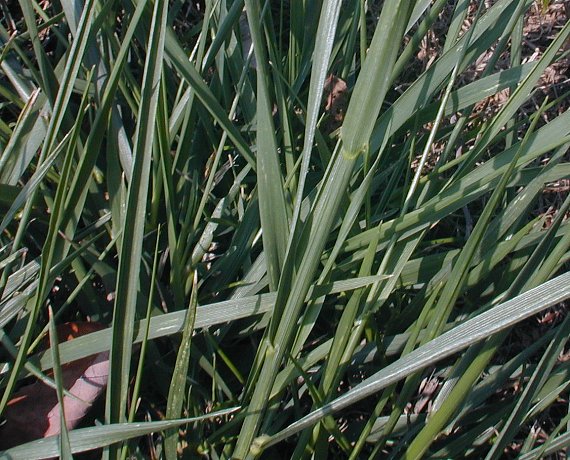
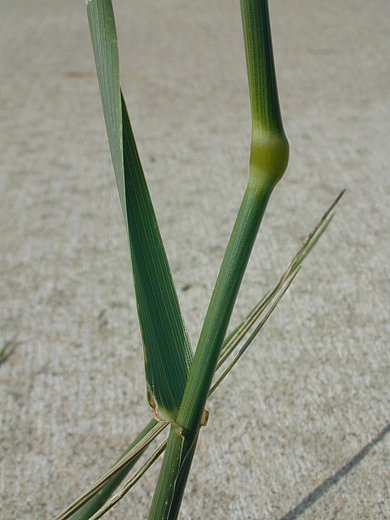
Description: This perennial grass is about 1½–4' tall, forming tufts of leafy culms that are ascending to erect. The culms are light to medium green, terete, and glabrous. Several alternate leaves occur along the length of each culm. The blades of these leaves are up 12" long and 8 mm. across; they are ascending to arching. Both the lower and upper blade surfaces are dull green or grayish blue and hairless. Individual blades are flat, rolled upward along their margins, or twisted. The base of each leaf blade has a pair of whitened auricles that clasp the culm. The leaf sheaths are dull green or grayish blue, longitudinally veined, hairless, and open. The nodes along each culm are light green, swollen, and glabrous. Each fertile culm terminates in a narrow panicle of spikelets about 4-10" long. In addition to the central rachis, the panicle has lateral branches that are longest toward its bottom; these branches are up to 4" long (although they are usually about one-half of this length). The lateral branches usually divide into two or more short pedicels with spikelets; occasionally a short lateral branch remains undivided and terminates in a single spikelet. Both before and after the blooming period, the lateral branches are stiffly erect or appressed against the rachis, but they are more spread out and ascending during the short period of bloom. The slender rachis, lateral branches, and pedicels of the panicle are green or grayish blue, terete or angular, and glabrous or nearly so.
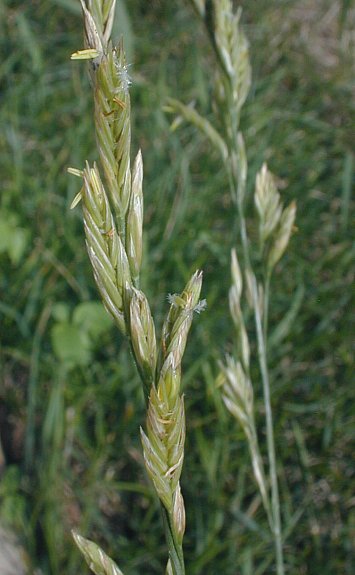
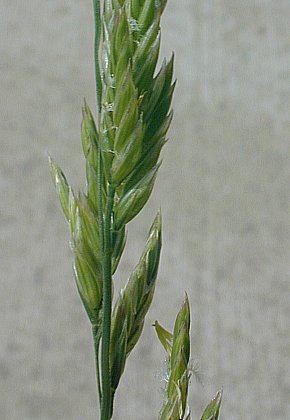
The spikelets are not confined to the tips of lateral branches, but they also occur near the rachis. Each spikelet is up to 12 mm. ( ½") long and somewhat flattened; it has 2 glumes at the bottom and 5-11 fertile lemmas that are organized into 2 overlapping ranks. The glumes are 3-5 mm. long, while the lemmas are 6-8 mm. long. Both the glumes and lemmas are lanceolate, longitudinally folded, and usually awnless. On rare occasions, the lemmas have inconspicuous awns up to 1 mm. in length. The upper margins of the lemmas are slightly membranous, becoming light tan and scarious with age. Each lemma has a perfect floret consisting of 3 stamens with pale yellow anthers, 2 feathery white stigmata, and an ovary. The blooming period usually occurs during mid- to late summer, lasting 1-2 weeks for a colony of plants. The florets are cross-pollinated by the wind. Afterwards, the entire inflorescence becomes light tan and nods towards it apex. The florets are replaced by grains (one grain per floret). These grains are 3-3.5 mm. long, narrowly ellipsoid in shape, narrowly concave along one side, and light tan. The root system is fibrous and rhizomatous. This grass has a tendency to form colonies that exclude other plants.
Cultivation:
The
preference is full to partial sunlight, moist to dry conditions, and a
loam or clay-loam soil. This introduced grass can invade lawns.
Although it survives regular mowing, this grass prefers unmowed or
little-mowed areas.
Range & Habitat:
Meadow Fescue occurs in every county of Illinois, where it is quite
common (see Distribution
Map). This grass was introduced from Eurasia as a source of
pasturage and
hay for farm animals, and it is still used for this purpose. Habitats
include prairie remnants, degraded meadows, woodland borders, thickets,
lawns, vacant lots, city parks, sunny fence rows, abandoned fields,
pastures, grassy areas along railroads and roadsides, grassy banks
along bridges and highway overpasses, banks of rivers and ditches, and
waste areas. In spite of its aggressive nature (or perhaps because of
it), Meadow Fescue has been planted by state and local highway
departments as a source of grassy cover along roads and for erosion
control along the banks of bridges and rivers. However, running water
often erodes the soil underneath the root mass of Meadow Fescue,
causing the entire bank to collapse into the river or its floodplain.
This grass is also used in athletic fields because of its resistance to
trampling and hot dry weather. Sometimes Meadow Fescue invades
prairies, where it becomes a troublesome weed to ecologists.
Faunal Associations: Insects that feed on Fescue grasses (Festuca spp.) include caterpillars of the skipper Atalopedes campestris (Sachem), larvae of the moth Pediasia trisecta (Larger Sod Webworm), Camnula pellucida (Clear-winged Grasshopper), Oulema melanopus (Cereal Leaf Beetle), Sphenophorus parvulus (Bluegrass Billbug), Blissus leucopterus hirtus (Hairy Chinch Bug), Metopolophium dirhodum (Rose-Grass Aphid), Rhopalosiphum oxyacanthae (Apple-Grass Aphid), Tetraneura ulmi (Elm & Grass Root Aphid), and other aphids (Barnes, 1999; Cranshaw, 2004; Brust et al., 2008; Clark et al., 2004; Blackman & Eastop, 2013). Horses, cattle, and other hoofed farm animals graze on the foliage of Meadow Fescue. The seeds of Meadow Fescue are eaten by the Greater Prairie Chicken (Korschgen, 1962). Meadow Fescue collapses into sprawling mats of vegetation during the winter, which probably provides good cover for voles and other small rodents.
Photographic
Location:
A lawn in Urbana, Illinois.
Comments:
There are several cultivars of this grass that vary in their leaf
width, overall size, and color of foliage. Some cultivars are marketed
as a source of forage, while other cultivars are used to create sod.
However, the sod that this Eurasian grass creates is
rather coarse and uneven. Meadow Fescue (Festuca pratensis)
is very similar
in appearance to another Eurasian species, Tall Fescue (Festuca
arundinacea). This latter species was considered a
variety of Meadow Fescue (Festuca
pratensis) in the past, rather than a distinct species.
Tall Fescue has 4-5 lemmas per spikelet and its lemmas are
7-10 mm. in length. In contrast, Meadow Fescue has 5-11 lemmas per
spikelet and its lemmas are 6-8 mm. in length. Other Fescue grasses
(Festuca spp.) in Illinois have more narrow leaf
blades (3 mm. or less across) or they have shorter lemmas (5 mm. long
or less). Unlike Meadow Fescue, some of these species have conspicuous
awns. Other scientific names that refer to Meadow Fescue include Festuca
elatior, Schedonorus
pratensis, and Lolium
pratensis. The recent taxonomic history of this grass has
been unstable.