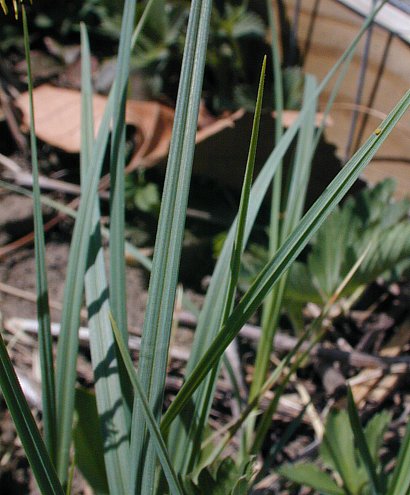
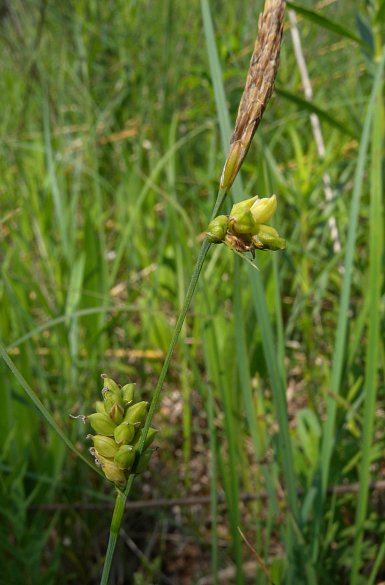
Description: This perennial sedge is about ½–1¼' tall, producing both fertile and infertile shoots that are unbranched. The culm of each plant is somewhat triangular and hairless. The blades of alternate leaves are up to 6" long and ¼" (6 mm.) across; they are grayish green or bluish green, linear in shape, and hairless, arching upward from the stem. Each fertile shoot produces a flowering stalk with 1-3 pistillate spikelets and a terminal staminate spikelet at its apex. The staminate spikelet is about 1–1½" long and very conspicuous when the golden yellow pollen is produced. However, it turns brown shortly after the pollen is shed. The peduncle of the staminate spikelet is about 1-2" long. Each pistillate spikelet is about ½–1" long and ¼" across. The uppermost pistillate spikelet is nearly sessile, while the lower pistillate spikelets (if there are any) are nearly sessile or they have peduncles up to 1" long. These pistillate spikelets are cylindrical in shape and densely packed with pistillate flowers and their perigynia; they have a coarse grainy appearance because of the inflated perigynia.
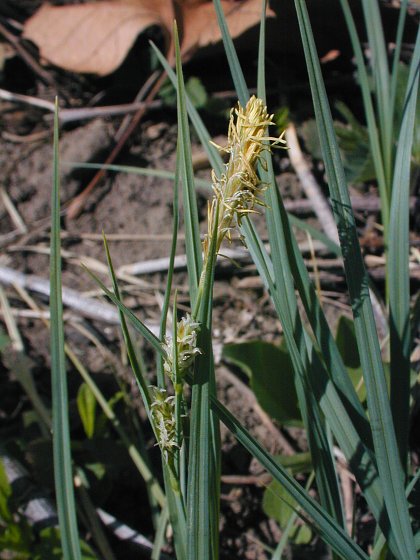
The perigynia of pistillate flowers are about 3-4 mm. in length and 2-3 mm. across; they are obovoid with short beaks that often curve outward, and they are strongly veined along their sides. The perigynia are initially pale green to pale grayish green, although they later turn brown when the achenes ripen. The pistillate scales are the same length or a little shorter than the perigynia; they are oval-shaped, but taper abruptly into short narrow tips. Immature pistillate scales have green central veins and broad translucent margins; later they become light brown. The blooming period occurs from mid- to late spring, lasting about 1-2 weeks. The florets of the spikelets are cross-pollinated by the wind. Mature achenes are about 3 mm. long and 2 mm. across; they are obovoid, bluntly 3-angled, and brown. The root system consists of long rhizomes and fibrous roots. Loose colonies of plants are often formed from these rhizomes.
Cultivation:
The
preference is full to partial sun, moist to dry conditions, and loam,
clay-loam, or rocky alkaline soil. Once it becomes established, this
sedge is adaptable and easy to grow. It is one of the earlier sedges to
bloom during the spring.
Range & Habitat:
The native Mead's Sedge occurs occasionally in central and northern
Illinois, while in the southern part of the state it is less common
(see
Distribution
Map).
Habitats include moist to dry black soil
prairies, dolomite prairies, hill prairies, savannas with sparse
ground vegetation, sedge meadows, limestone glades, and
areas along railroads. This sedge is an understory plant of
prairies and other open areas, where it adapts to the shade
of taller vegetation during the summer and fall.
Faunal
Associations:
Little information is available about floral-faunal relationships for
Mead's Sedge, although considerable information is available for Carex
spp.
(sedges) in general. Some insects that feed on sedges include various
aphids, leafhoppers (especially Cosmotettix
spp.), billbugs
(Sphenophorus spp.),
larvae of leaf-mining moths (Elachista
spp.) and
other moths, caterpillars of skippers (especially Euphyes spp.
&
Poanes spp.),
and caterpillars of butterflies (Satyrodes
spp.). The foliage of upland
sedges in open areas is especially likely to be consumed by various
grasshoppers (see Grasshopper Table).
Among vertebrate animals, the
seeds of such sedges are eaten by various upland gamebirds and
granivorous
songbirds. This includes such species as the Wild Turkey, Greater
Prairie Chicken, Ring-necked Pheasant, Mourning Dove, Horned Lark, and
Savannah Sparrow. Although it is not a preferred source of food,
White-tailed Deer and other hoofed mammalian herbivores browse on the
foliage. There is some evidence that the seeds of sedges can pass
through the digestive tracts of White-tailed Deer and remain viable,
introducing these plants into new areas (Myers et al., 2004).
Photographic Location:
The wildflower garden of the webmaster in Urbana, Illinois, and the
Coneflower Hill Prairie near Lake Shelbyville in Shelby County,
Illinois.
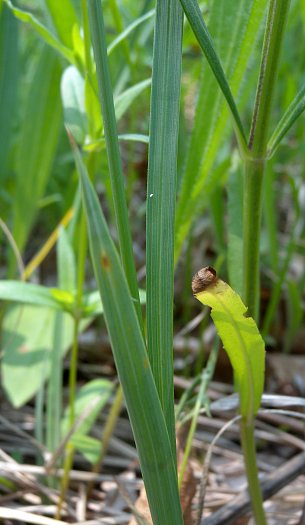
Comments: Mead's Sedge (Carex meadii) is short, slender, and upright in its growth habit, and its foliage is often a distinctive grayish green or bluish green. This sedge is also unusual in forming loose colonies of plants from long rhizomes, rather than tight tufts of leaves from short rhizomes. It is difficult to distinguish Mead's Sedge from Rigid Sedge (Carex tetanica). In the past, they were regarded as different varieties of the same species. The latter species is supposed to differ from Mead's Sedge in the following ways: 1) its foliage is green, rather than grayish green or bluish green, 2) the base of its culm is often purplish red, rather than light brown, 3) its pistillate spikelets are slightly more slender (less than ¼") than those of Mead's Sedge, and 4) its perigynia and achenes are more ellipsoid-obovoid in shape than obovoid. In the field, these two species have a tendency to intergrade, particularly in the Great Lakes area. However, Mead's Sedge usually occurs in drier habitats than Rigid Sedge; the latter is primarily a wetland species.