Description: This perennial fern produces a rosette of ascending to arching evergreen leaves from a vertical rootstock. The compound leaves are about 1–2½' long and 4-9" across (excluding their petioles); they are lanceolate-ovate in outline and their structure is bipinnate to bipinnate-pinnatifid. Individual leaves have 12-20 pairs of leaflets along their rachises (central stalks); these leaflets are longest toward the lower middle or middle of each leaf. The tips of compound leaves are rather long and slender, where the leaflets have been replaced by small lobes. Individual leaflets are linear-lanceolate to oblong-lanceolate in outline with slender tips; they are pinnate with 8-20 pairs of subleaflets. Individual subleaflets are short-oblong or short lanceolate-oblong in shape and their margins are shallowly cleft and/or crenate; the tips of subleaflets are obtuse. The upper leaf surface is yellowish green or medium to dark green, while the lower leaf surface is slightly more pale; both leaf surfaces are hairless.
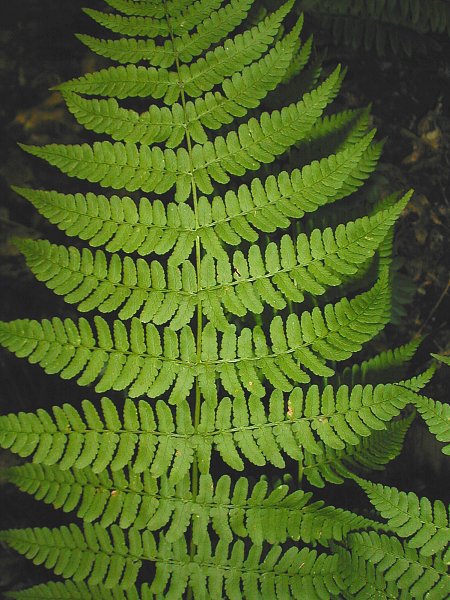
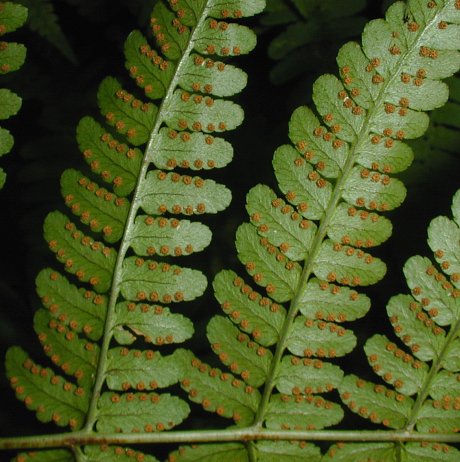
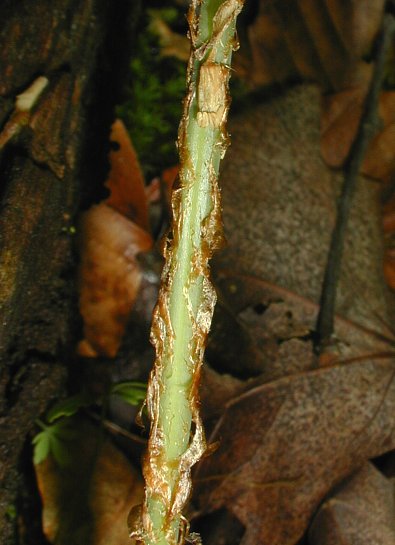
The petioles are 3-10" long and light green or pale reddish-green; they are more or less covered with brown membranous scales (especially along the lower half), otherwise they are glabrous. The rachises (central stalks) of compound leaves are light green to nearly white and glabrous to slightly scaly; they are narrowly grooved above and convex below. Both the compound leaves and their leaflets can be straight, or they may curve gently in one direction or another. The sori (spore-bearing structures) develop on the undersides of the leaves; they are located along the margins of the subleaflets. Subleaflets can have 1-6 pairs of sori along their margins. These small sori are orange-brown to brown and round in shape; the sori are covered have thin indusia (protective membranes). Eventually, these indusia wither away so that the sori can release their spores to the wind; this usually occurs during the late summer or autumn. The root system consists of stout scaly rhizomes with fibrous roots. Clonal colonies of plants are occasionally formed from the rhizomes.
Cultivation:
The preference is medium to light shade, mesic conditions,
and rocky soil with an acid pH. This fern prefers a location
with high humidity that is protected from prevailing winds.
Range & Habitat:
The native Marginal Shield Fern is common in southern Illinois, and
occasional to rare elsewhere in the state (see Distribution
Map). Habitats include rocky woodlands, rocky wooded slopes,
sandstone ravines, and wooded slopes of stabilized sand dunes. This
fern is often found in areas where sandstone is exposed to the ground
surface; it is especially common in the Shawnee Hills of southern
Illinois.
Faunal Associations:
The Marginal Shield Fern and other shield ferns (Dryopteris spp.)
are
host plants of an aphid, Amphorophora
ampullata; the Marginal Shield
Fern is also a possible host plant of another aphid, Macrosiphum miho
(Blackman & Eastop, 2013). The latter aphid has been found on
ferns growing along rocky cliffs in Illinois. The evergreen foliage of
the Marginal Shield Fern is considered toxic to mammalian
herbivores; it is rarely browsed by White-Tailed Deer. Both
the rhizomes and leaves are toxic to humans.
Photographic
Location:
A sandstone ravine at Fall Creek Gorge (aka "The Potholes") in
west-central Indiana.
Comments:
This medium-large fern has elegantly shaped evergreen fronds. Because
it has a fairly conventional appearance for a fern, it may not be easy
to identify at first glance. The most distinctive trait of the Marginal
Shield Fern is the location of its sori: they can be found along the
margins of its subleaflets. During the late spring or early summer,
immature sori will look like small green bumps along the margins of
subleaflets. Later
in the year, the sori become orange-brown and they are much more
conspicuous. In
Illinois, other species in the Shield Fern family have their sori
closer to the central veins of their subleaflets. Other common names of
Dryopteris marginalis include Marginal Wood Fern
and Leather Fern; the latter name refers to the texture of its
evergreen leaves.