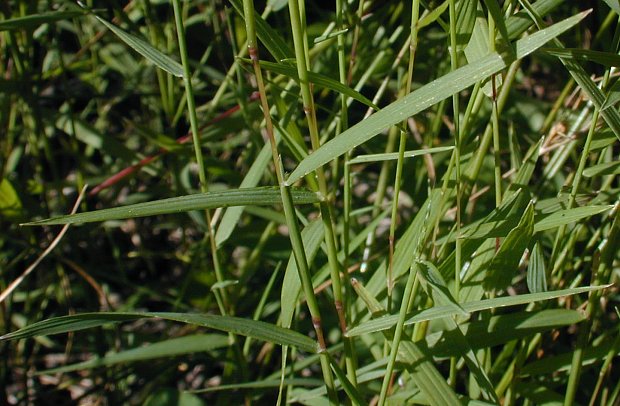
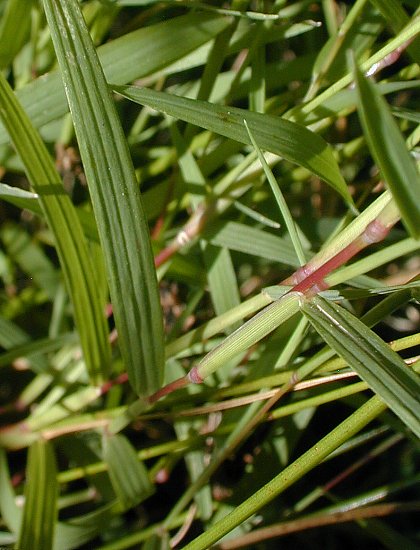
Description: This perennial grass is ¾–1½' tall. The leafy culms of this grass are initially erect, but they have a tendency to sprawl later in the year when their inflorescences develop. The culms are light green to pale purple (less often bright red), terete, and glabrous; they are often decumbent at their bases and abundantly branched above. The leaf blades are up to 3½" long and 5 mm. across; they are medium green or grayish green, hairless, and ascending to widely spreading. The leaf blades are either flat or they are furrowed longitudinally (often with a central furrow and 2 smaller lateral furrows). The leaf sheaths are light green to medium green, longitudinally veined, and hairless; they are rather short and expose the culms at intervals. The lower nodes are swollen, glabrous, and pale green to pale red; the upper nodes are more dark and sunken in appearance. The ligules are inconspicuously hairy. The upper culms terminate in narrow panicles of spikelets about 2-8" long.
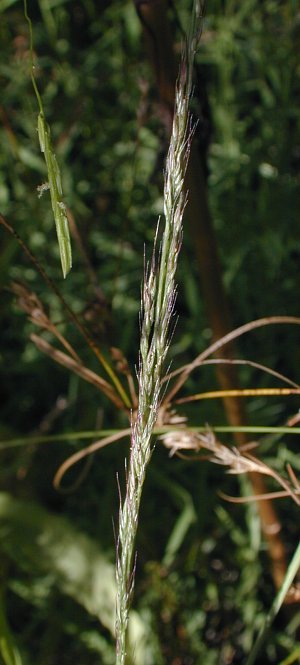
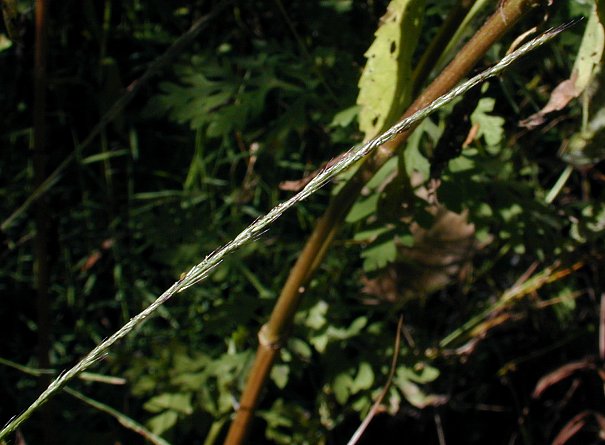
Each panicle has a central stalk (rachis), short erect branches (up to 2" long), and a spike-like appearance; it is grayish green, purplish green, or silvery green and rather shiny in appearance during the period of bloom. The spikelets are about 2–2.5 mm. in length (excluding their awns) and narrowly lanceoloid in shape; each spikelet has 1-2 tiny glumes (up to 0.2 mm. in length), a single awned lemma, and a membranous palea enclosing a perfect floret. The bodies of the lemmas are as long as the spikelets; they are narrowly lanceolate, convex along their outer surfaces, longitudinally 3-veined, and finely hairy toward their bases. The tips of these lemmas have slender awns about 2-5 mm. in length. The blooming period occurs from mid-summer to early autumn. The florets are cross-pollinated by the wind. Afterwards, mature spikelets disarticulate above their glumes and fall to the ground. The grains are 1–1.5 mm. in length, spindle-shaped (fusiform), and brownish. The root system is fibrous. This grass can reproduce vegetatively by forming rootlets along the lower nodes of its culms. Even though it doesn't have rhizomes, this grass often forms colonies.
Cultivation:
The
preference is light shade to partial sun, moist to mesic conditions,
and a rich loamy soil. It also adapts to a somewhat acid soil that is
sandy or rocky.
Range & Habitat:
Nimblewill is occasional to locally common throughout Illinois (see Distribution
Map),
where it is native. Habitats include open woodlands, low
woodlands, sandy woodlands, sandstone glades, thinly wooded
rocky slopes, thickets, woodland edges, areas along woodland paths (if
the soil is not too compacted), powerline clearances in wooded areas,
degraded meadows, fence rows, grassy areas along back alleys in cities,
partially shaded areas of lawns, and waste areas. This native grass
prefers habitats with a history of disturbance, although it is
sometimes found in higher quality habitats. Occasionally, it becomes a
lawn weed, particularly in northern Illinois.
Faunal Associations: Insects that are known to feed on Nimblewill include the Rusty Plum Aphid (Hysteroneura setariae), Short-winged Meadow Katydid (Conocephalus brevipennis), and a stink bug (Hymenarcys nervosa). The aphid sucks plant juices from the leaves and inflorescences of this grass during the summer, while the meadow katydid feeds on the florets and spikelets. Other insects that feed on satin grasses (Muhlenbergia spp.) include various aphids, leafhoppers (Flexamia imputans, Plesiommata tripunctata), a plant bug (Stenodema vicinum), the larvae of gall flies (Astictoneura spp.), the leaf-mining larvae of a moth (Elachista brachyelytrifoliella), and the larvae of a gall wasp (Eurytomocharis muhlenbergiae). See the Insect Table for more information about these species. The small seeds of Nimblewill are a minor source of food to some birds, including the Tree Sparrow, Song Sparrow, Slate-Colored Junco, and Wild Turkey (Martin et al., 1951/1961). The Wild Turkey may eat the foliage as well. The young foliage of this grass is palatable and readily eaten by cattle and other livestock (Georgia, 1913). In urban and suburban areas, lawn-mowers can spread the seeds to new areas.
Photographic
Location:
Along a woodland path at Busey Woods in Urbana, Illinois.
Comments:
This delicate grass blends into the background readily. Among the
various satin grasses (Muhlenbergia spp.) in
Illinois, Nimblewill (Muhlenbergia
schreberi) is the one that you are most likely to
encounter in suburban and urban areas; it has low fidelity to any
particular habitat and can appear almost anywhere that is sufficiently
moist and receives a little shade. Many satin grasses are more robust
in appearance than Nimblewill, their inflorescences are often
more stout, and their spikelets may lack awns. Woodland Muhly (Muhlenbergia sylvatica)
is somewhat similar in appearance, but its awns are somewhat longer
than those of Nimblewill. Woodland Muhly also has conspicuous
glumes that are almost as long as its spikelets, while the glumes of
Nimblewill are tiny and inconspicuous – as a matter of fact, it has the
smallest glumes of any satin grass in Illinois.