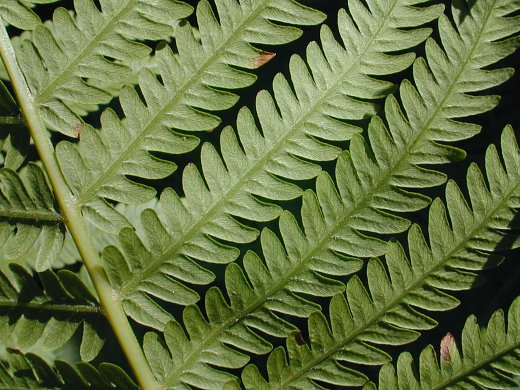
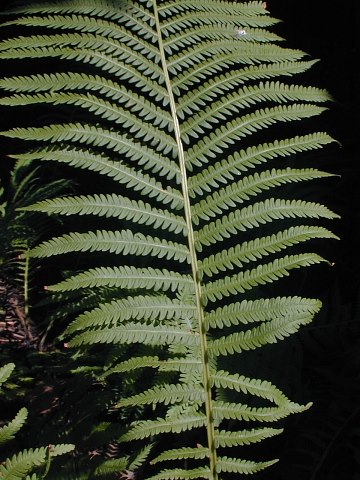
Description: This perennial fern develops either individual leaves or a rosette of arching leaves about 3-5' tall during late spring. The compound leaves are pinnate-pinnatifid and dimorphic; the sterile leaves are much larger than the fertile leaves in the center of the rosette. The sterile leaves are up to 5' long, 12" across, and oblanceolate in outline, consisting of 20-50 pairs of leaflets. The sterile leaves taper abruptly toward their tips, while toward their bases the leaflets become very small (less than 1" long). Individual leaflets are up to 6" long, linear-oblong in outline, and deeply pinnatifid with 15-40 pairs of lobes. These lobes are short-oblong to ovate in shape, while their margins are smooth and folded downward. The sterile leaves are medium to dark green and glabrous on their upper surfaces, while their lower surfaces are light to medium green and glabrous. The venation on the undersides of lobes is simple-pinnate; the lateral veins are not forked. The rachises (central stalks) of sterile leaves are light green and glabrous (sometimes becoming finely short-pubescent below); the upper surfaces of these rachises are furrowed, angular, and somewhat flattened, while their lower surfaces are convex.
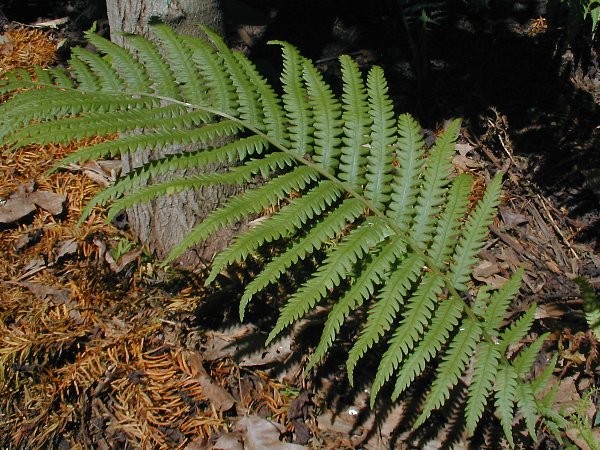
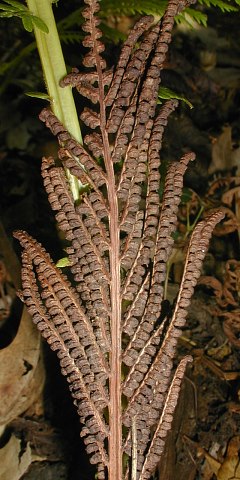
The petioles of the sterile leaves are relatively short (2-12" in length), light green to brown, and relatively stout; they are usually glabrous or finely short-pubescent, although young petioles have chaffy scales that are pale orange-brown. The fertile leaves are up to 1½' long, 4" across, pinnate-pinnatifid, and oblanceolate or elliptic in outline. Immature fertile leaves are greenish, while mature fertile leaves become dark brown. The fertile leaves have 10-30 pairs of leaflets that are ascending and contracted. The lobes of these leaflets are bead-like in shape from the presence of sporangia (spore-bearing structures); there are up to 30 pairs of lobes per leaflet. The petioles of fertile leaves are 2-8" long, greenish to dark brown, and rather stout at their bases. The fertile leaves are produced during mid- to late summer; immature or weak plants often fail to produce them. The spores aren't released from the sporangia of fertile leaves until the early spring, when they are distributed by the wind. The sterile leaves are deciduous and die down during the winter. The root system consists of a stout vertical rootstock with a dense mass of fibrous roots; long rhizomes occasionally develop from the rootstock, forming cloned offspring of the mother plant.
Cultivation:
The
preference is light shade or dappled sunlight, wet to moist conditions,
and a somewhat acidic soil that is peaty and/or sandy. Average moisture
conditions are
tolerated if this fern is watered during dry spells. The leaves are
delicate and easily damaged. In more heavily shaded areas, Ostrich Fern
often fails to produce fertile leaves.
Range & Habitat:
The native Ostrich Fern occurs in widely scattered locations in
northern and western Illinois, where it is rare (see Distribution
Map); elsewhere in the state, this fern is absent from
natural areas. Outside of Illinois, Ostrich Fern is
circumboreal in its distribution, occurring in parts of North America,
Eurasia, and East Asia. The North American variety is identified as var.
pensylvanica. Habitats include moist rich woodlands, low
areas along woodland
borders, swamps, and soggy
thickets. Ostrich Fern is more common in habitats that are somewhat
sandy. This fern is often cultivated in semi-shaded gardens and
along the foundations of houses and other buildings.
Faunal
Associations:
Caterpillars of the Ostrich Fern Borer Moth (Papaipema
sp.)
bore through the stalks and/or root system of this fern. This rare moth
has been found in
the New England area of the United States, where the Ostrich fern is
more common, although it has not been found in Illinois. At the present
time, this moth has not been scientifically described. Another insect,
the aphid Amphorophora
ampullata, feeds on Ostrich Fern and other ferns (Blackman
& Eastop, 2013). Because Ostrich Fern has large leaves and
often forms colonies, it can provide substantial protective cover to
various kinds
of wildlife where it is locally common.
Photographic Location:
On the grounds of Japan House, near the Arboretum of the
University of Illinois in Urbana, Illinois.
Comments: This a lovely fern with tall arching leaves. It is relatively easy to identify because of the oblanceolate shape of its large leaves and the very short leaflets (pinnae) near its petioles. Very few species of ferns have such short leaflets. One of them, New York Fern (Thelypteris noveboracensis), has elliptic leaves that taper very gradually toward both their bottoms and their tips. The leaves of Ostrich Fern (Matteuccia struthiopteris), in contrast, taper abruptly toward their tips. Another distinctive characteristic is the simple-pinnate venation on the undersides of the leaflet lobes, where the lateral veins are undivided. Other similar ferns (e.g., Osmunda spp.), often have forked lateral veins on the undersides of their leaflet lobes. The unfurled sterile leaves of Ostrich Fern, when they first appear above the ground during the spring, are rolled and circular in shape. At this stage of development, they are referred to as 'fiddleheads' or 'croziers.' In the New England area especially, these unfurled leaves of Ostrich Fern are collected, sold, and eaten as gourmet food.