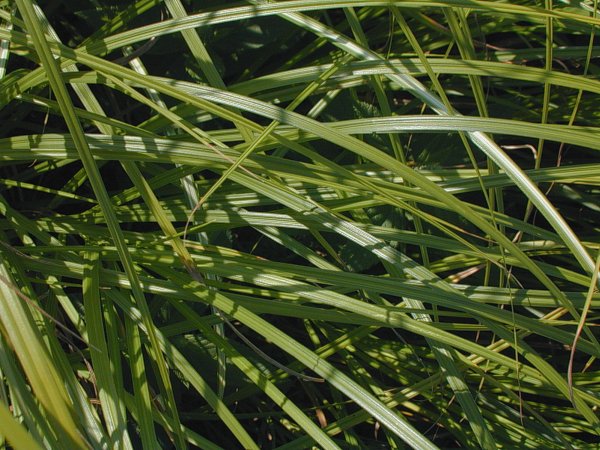
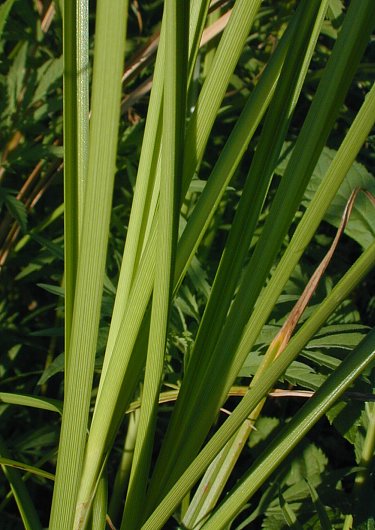
Description: This perennial sedge is 2½–3½' tall; infertile shoots are more common than fertile shoots. The erect culms (central stems) are unbranched, glabrous, light green, and triangular in cross-section; infertile shoots have shorter culms than fertile shoots. On infertile shoots, there are 6-12 alternate leaves that ascend the entire length of each culm; on fertile shoots, there are 3-5 alternate leaves that are found along the lower half of each culm. For both kinds of shoots, the leaf blades are light to medium green, glabrous, shallowly channeled along their central veins, and rough-textured along their margins. On infertile shoots, the blades are up to 25" long and 6 mm. across; they are very long and whip-like. On fertile shoots, the blades are up to 14" long and 6 mm. across; they are substantially shorter than the blades of infertile shoots. Generally, each blade is recurved – ascending at the base, arching near the middle, and descending toward the tip. The leaf sheaths are light green, glabrous, and longitudinally veined; they often become loose toward the bottom of each culm, where a netting of fine veins may persist. Each ligule is short-membranous, forming a blunt upside-down "V" shape on the culm.
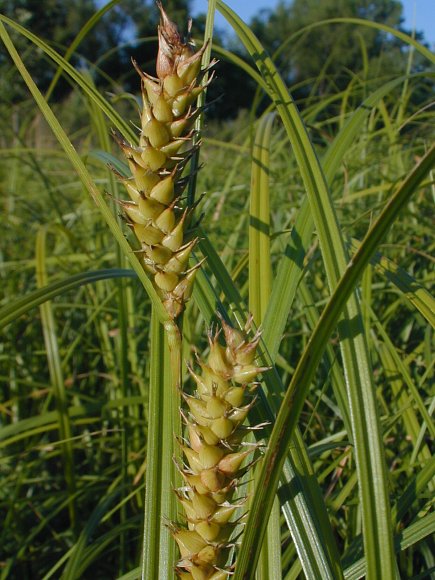
The inflorescence of fertile shoots consists of 2-4 pistillate spikelets with their leafy bracts and 3-5 staminate spikelets. The leafy bracts are up to 12" long and 5 mm. across, becoming smaller as they ascend the inflorescence. The pistillate spikelets are 1¾–2" long, about 1/3" (1 cm.) across, erect to ascending, and straight. The lower pistillate spikelets have slender pedicels up to 1" long that are stiff and straight, while the upper pistillate spikelets are nearly sessile. Immature pistillate spikelets are light green to yellowish green, becoming brown with age. The staminate spikelets are up to 1" long and very narrow; after releasing their pollen, they soon become tan or brown. The lower staminate spikelets are sessile, while the uppermost staminate spikelet has a stiff pedicel about ¾" long. The staminate spikelets are above the pistillate spikelets in each inflorescence. Each pistillate spikelet is densely crowded with ascending to spreading perigynia and their scales. The perigynia are 6-8 mm. long, 3 mm. across, and ovoid-lanceoloid with long slender beaks. The tip of each beak has a pair of teeth about 1-2 mm. long. The perigynia are glabrous with numerous longitudinal veins. The pistillate scales are 4-6 mm. long, lanceolate, and slightly awned; they are membranous, except for their green/brown central veins.
The blooming
period occurs from late spring to mid-summer; pollination is by agency
of the wind. Each perigynium contains a single achene. After
disarticulation, the inflated perigynia have the capacity to distribute
their achenes by floating on water. The achenes are
2-3 mm. long and about one-half as much across; they are
ovoid-ellipsoid, 3-angled, and glabrous. The root system is fibrous and
long-rhizomatous; large clonal colonies are often formed from the
rhizomes.
Cultivation:
The preference is full or partial sun, wet to moist conditions, and a
fertile loamy soil, although soil containing rocky, gravelly, or sandy
material is
also tolerated. This sedge can spread aggressively. Occasional standing
water is tolerated.
Range & Habitat:
The native Plains Slough Sedge is occasional in northern and
west-central
Illinois, but uncommon or absent in other areas of the state (see Distribution
Map).
Illinois
is located near the eastern range-limit of this species; this sedge is
more common in wetlands of the Northern Plains. Habitats include wet to
moist black soil prairies, dolomite prairies, river-bottom prairies,
prairie swales and sloughs, sedge meadows, openings in floodplain
woodlands, swamps, low areas along ponds and rivers, marshes, and
roadside
ditches. This sedge adapts to both pristine and degraded habitats if
there is sufficient sunlight and moisture.
Faunal
Associations:
Various insects feed on sedges (Carex
spp.) in wetlands. These species include sedge
grasshoppers
(Stethophyma spp.),
semi-aquatic leaf beetles (Donacia
spp., Plateumaris
spp.), billbugs (Sphenophorus
spp.), stem-boring larvae of various flies, seed bugs,
plant bugs, aphids, and leafhoppers (Cosmotettix spp.).
Caterpillars of the butterfly, Satyrodes
eurydice (Eyed Brown), feed on these sedges, as do the
caterpillars of several skippers (Euphyes
spp., Poanes
spp.) and various moths (see
Lepidoptera Table). Among vertebrate animals, waterfowl,
rails,
and some songbirds eat the seeds or seedheads of sedges; the Bird Table
lists many of these species. Plains Slough Sedge often forms dense
colonies of tall plants. This provides good cover for many kinds of
wildlife, including ducks, rails, snakes, frogs, small rodents, and
invertebrates. Some wetland birds also use the culms and leaves as
nesting materials. Deer occasionally use the foliage of this and
similar sedges as "bedding" when they are hiding or resting.
Photographic Location:
A prairie swale at Meadowbrook Park in Urbana, Illinois.
Comments:
This sedge is closely related to Carex trichocarpa
(Hairy-fruited Sedge) and occasionally these two species hybridize.
They are
indistinguishable from each other until their inflorescences are
produced – Carex laeviconica (Plains Slough Sedge)
has perigynia that are hairless and shiny, while Hairy-fruited Sedge
has
dull-colored perigynia that are covered with fine hairs. Both of these
species prefer similar habitats. These large sedges are similar to Carex
lacustris (Lake Sedge) and Carex hyalinolepis
(Southern Lake Sedge). The latter differ primarily by having wider leaf
blades (up to ¾" across) and they are more stout in appearance.