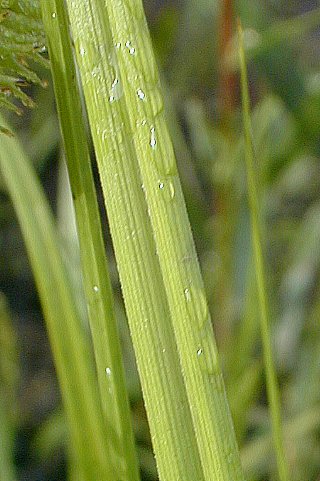
Description: This perennial sedge forms a dense to loose tuft of culms with alternate leaves; there are both fertile and infertile shoots. The culms are ¾–2½' long, light to medium green, glabrous, sharply triangular in cross-section, and unbranched. The edges of each culm are rough underneath the inflorescence, otherwise they are smooth. Along each culm, there are about 2-3 alternate leaves and withered remnants of older leaves near the base. The ascending to widely spreading leaf blades are 5-10" long and up to 6 mm. across; they are light to medium green, glabrous, and longitudinally channeled. The upper blade surface is smooth, while the lower blade surface is rough. The leaf sheaths are light to medium green and glabrous; the apices of inner sheaths are concave along their upper margins.
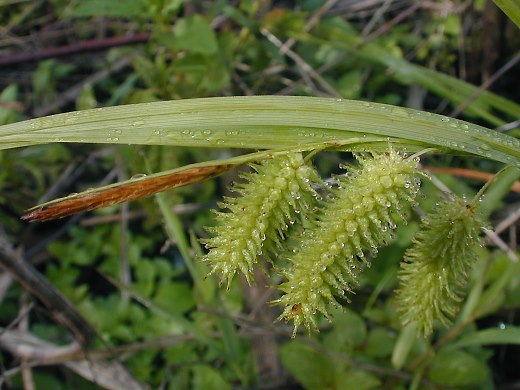
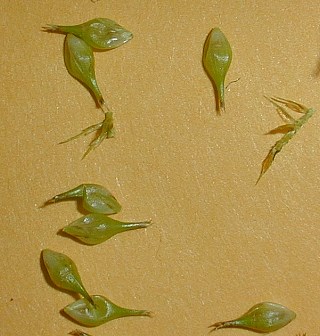
Each fertile culm terminates in an inflorescence consisting of a single staminate spikelet at the apex and 2-4 pistillate spikelets below. The slender staminate spikelet soon becomes brown after shedding its pollen. Along the side of this spikelet, there is a bristly bract up to 2" long. The pistillate spikelets are ¾–1¾" long and about ½" across; they are densely packed with widely spreading perigynia and their scales. The pistillate spikelets are short-oblongoid in shape and light green while immature; they have a spiky appearance because of the long beaks of their perigynia. The pistillate spikelets have slender pedicels about ¼–¾" long; they usually droop from their pedicels. At the base of each pistillate spikelet, there is a linear leafy bract about 3-5 mm. across and 4-6" long. The inflated perigynia are 5-6 mm. long and about 2 mm. across; they are ovoid-lanceoloid with long slender beaks and wedge-shaped bottoms. The apex of each perigynium's beak has a pair of teeth less than 1 mm. long. Immature perigynia are light green and glabrous; they have fine longitudinal veins along their sides (may require 10x magnification to see). The pistillate scales are 3-4 mm. long and lanceolate-ovate in shape, tapering into awns at their apices. The pistillate scales have wide membranous margins, otherwise they are green-veined. The blooming period occurs from late spring to mid-summer, lasting about 1-2 weeks. The florets of the spikelets are wind-pollinated. The achenes are about 1.5 mm. long, obovoid, bluntly 3-angled, and glabrous. The root system is fibrous and short-rhizomatous.
Cultivation:
This
sedge prefers full to partial sun, wet to moist conditions, and soil
containing loam, silt, or sand with decaying organic material.
Temporary flooding is tolerated.
Range & Habitat:
The native Porcupine Sedge is occasional in central and northern
Illinois, while
in southern Illinois it is uncommon or absent (see Distribution
Map). Habitats include wet prairies, swamps, grassy fens,
sedge meadows, calcareous seeps, marshes (sandy &
non-sandy), and ditches. This sedge is often found in wetlands that
are calcareous.
Faunal Associations:
A variety of insects feed on wetland sedges (Carex spp.),
including Stethophyma spp. (sedge grasshoppers), Donacia spp. and Plateumaris
spp. (semi-aquatic leaf beetles), billbugs (Sphenophorus spp.),
stem-boring larvae of various flies, seed bugs, plant bugs, various
aphids, and leafhoppers (especially Cosmotettix spp.).
Larvae of the butterfly Satyrodes
eurydice (Eyed Brown), skippers (Euphyes spp., Poanes spp.), and
various
moths feed on sedges (see Lepidoptera Table). Among
vertebrate animals, the seeds and seedheads are an important
source of food
to waterfowl, rails, and some songbirds (see Bird Table).
Muskrats occasionally eat the rhizomes, culms, and young shoots.
Photographic
Location:
A sandy marsh at the Heron Boardwalk in Vermilion County.
Comments:
This is one of the "bottlebrush" sedges of wetland habitats. Species in
this group of sedges have pistillate spikelets that are cylindrical and
spiky in appearance; they can be difficult to distinguish from each
other. In particular, Porcupine Sedge closely resembles Carex
lurida (Sallow Sedge) and Carex comosa
(Bottlebrush Sedge). Sallow Sedge has larger perigynia (greater than 6
mm. in length & 2.5 mm. in width) and shorter pedicels (less
than ¼" long); its pistillate spikelets don't droop from their pedicels
to the same extent as the pistillate spikelets of Porcupine Sedge.
Bottlebrush Sedge differs in having longer teeth at the upper tips of
its perigynia (greater than 1 mm. in length) and its achenes are ovoid
in shape, rather than obovoid. Other similar sedges in this group have
pistillate scales that lack awns. Some authors refer to Porcupine Sedge
as Carex hystricina, but this is a misspelling of
its scientific name.