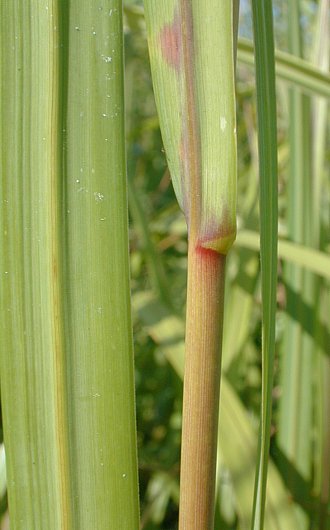
Description: This perennial grass is about 3-7' tall and unbranched. The central culm is light green, terete (round in cross-section), and glabrous. The alternate leaves are located primarily along the lower half of the culm. The leaf blades are up to 2½' long and ¾" (20 mm.) across; they are linear, flat, green to yellowish green, and glabrous. The leaf blades have a rather thick succulent texture, fine parallel veins, and prominent midribs; they are typically arching (curving upward from their bases next to the culm and then curving downward toward their tips). The leaf sheaths are green, yellowish green, or light brown; they are glabrous with fine longitudinal veins. Each ligule at the junction of the blade and sheath consists of a ring of dense white hairs. The culm terminates in a raceme of floral spikes up to 1½' long; there are 10-30 alternating spikes per raceme. These spikes are widely spaced along the rachis (central stalk) of the raceme and they are erect, ascending, or widely spreading.
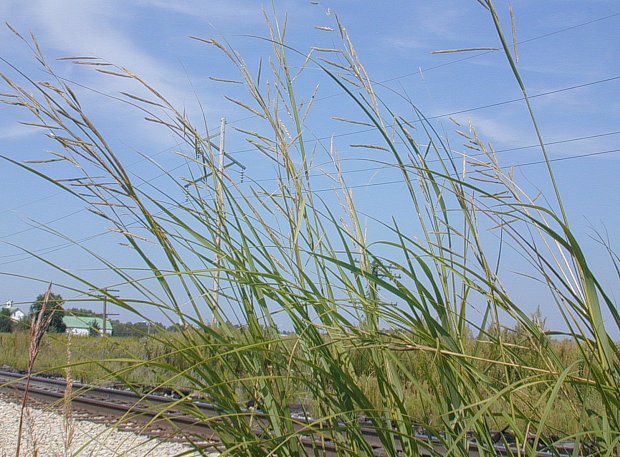
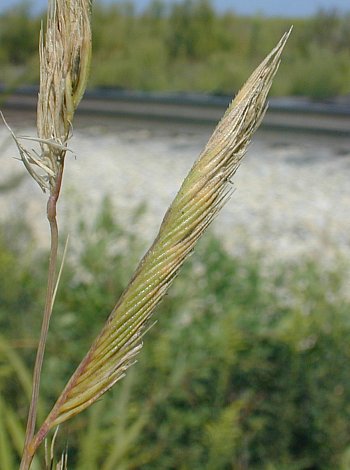
The floral spikes are 2-6" long. Each spike consists of 10-25 pairs of narrow spikelets that are obliquely appressed together along one side of its rachilla (secondary stalk). The rachilla is often pale red or burgundy. At the base of each spike, there is a glabrous peduncle up to 1" long. The spikelets are initially green and glabrous, although they later become light brown after the blooming period. Each spikelet consists of a pair of glumes, a fertile lemma, a membranous palea, and a perfect floret. The first glume is 5-10 mm. long, linear-lanceolate in shape, strongly keeled, and tapering to an awn-like tip. The second glume is 10-25 mm. long (including its awn), linear-lanceolate in shape, strongly keeled, and conspicuously awned. The keels of the glumes are rough-textured or bristly. The lemma is 7-10 mm. long, linear-lanceolate in shape, and keeled. Each floret has 3 stamens with white anthers and 2 feathery stigmata. The blooming period occurs from mid-summer to early fall, lasting about 1-2 weeks. The florets are cross-pollinated by the wind. With maturity, the spikelets disarticulate below the glumes and fall to the ground with their grains. The root system is fibrous and strongly rhizomatous. Clonal colonies of plants are often produced from the rhizomes.

Cultivation:
The
preference is full to partial sun, wet to mesic conditions, and a
fertile loamy soil to sustain the prodigious growth of this grass. It
also adapts to soil that is rocky or sandy if adequate moisture is
available. This grass is somewhat aggressive, although it won't
tolerate regular mowing. Because the florets are self-incompatible and
they may be subjected to heavy insect predation, it can be
difficult to obtain viable seeds. Therefore, it is easier to establish
new plants through division of the rhizomes. Most growth and
development occurs during the summer. This grass is able to tolerate
periods of hot dry weather because of its C4 metabolism.
Range & Habitat:
The native Prairie Cordgrass is occasional to locally common in central
and northern Illinois, while in southern Illinois it is occasional or
absent (see Distribution
Map). Habitats include openings in bottomland forests, wet to
moist prairies (including black soil, sand, & dolomite),
prairie swales and sloughs, low areas along rivers and ponds, edges of
marshes, swamps, roadside ditches, low areas along railroads, edges of
fields, and poorly drained areas of vacant lots. This grass is often
found in wet to moist prairie remnants; it is able to survive low to
moderate levels
of degradation because of its robust nature.
Faunal Associations: The larvae of several moth species are oligoleges (specialist feeders) of Prairie Cordgrass. This includes Resapamea stipata (Four-lined Borer Moth), Photedes enervata (Many-Lined Cordgrass Moth), and Photedes inops (Spartina Borer Moth), and the Tortricid moth Aethes spartinana (Panzer et al., 2006; Prasifka et al., 2012). Other insect feeders include the leafhopper Destria fumidus, the leafhopper Neohecalus magnificus, the leafhopper Cicadula smithi, Ischnodemus falicus (Cordgrass Seed Bug), the plant bug Trigonotylus tarsalis, the billbug Sphenophorus pertinax, Pseudopomala brachyptera (Short-winged Toothpick Grasshopper), Haplothrips shacklefordi, and other thrips (Dmitriev & Dietrich, 2010; Cedar Creek, 2000; DeLong, 1948; Hoffman, 1996; Knight, 1941; Vaurie, 1983; Brust et al., 2008; Stannard, 1968). The rootstocks and seedheads of Prairie Cordgrass are eaten by the Canada Goose. The seedheads are occasionally eaten by the Black Duck, Mallard, and other ducks. Muskrats feed on the rootstocks and foliage. The awned spikelets of the seeds can cling to the fur of animals or clothing of humans; this spreads the seeds to new locations. Because Prairie Cordgrass forms dense colonies of tall vegetation, it is an important source of protective cover and nesting habitat for many wetland birds and other kinds of wildlife.
Photographic
Location:
The Red Bison Railroad Prairie in Savoy, Illinois, where this grass
occurs in wet to mesic locations.
Comments:
Prairie Cordgrass has attractive foliage with a succulent appearance.
It was the dominant grass of wet prairies in Illinois and no other
grass species in the state resembles it. There are similar Spartina
spp. (Cordgrasses) in brackish and saltwater marshes along
both the Eastern and Gulf coasts of the United States, but they don't
occur in Illinois.
Prairie Cordgrass can be distinguished from other species of this genus
by the longer
awns of its second glumes (2-12 mm. in length) and the relative
length of its first glumes, which are about the same length as the
lemmas (7-10 mm. in length). Other Cordgrasses have shorter awns and
their first glumes are shorter than their lemmas.