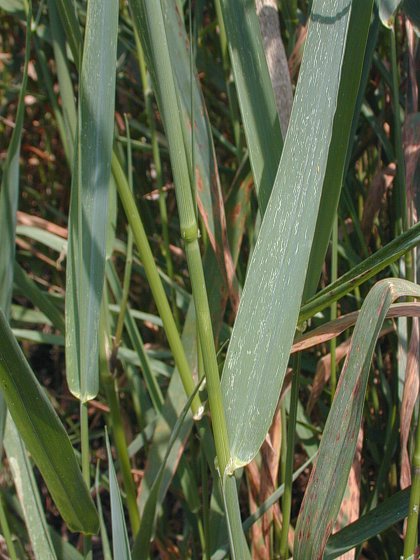
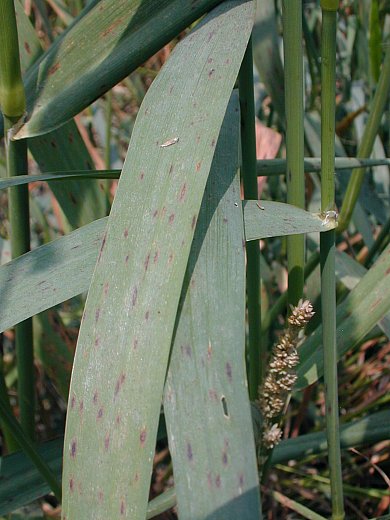
Description: This perennial grass is 3-5' tall. The culms are light to medium green, hairless, terete (circular in cross-section), and unbranched. Several alternate leaves occur primarily along the lower one-half of the culm. The leaf blades are up to 10" long and ¾" (20 mm.) across; they are green or grayish blue, linear in shape, flat, hairless, and rough-textured along their margins. The base of each leaf blade is much wider than the culm. The leaf sheaths are the same color as the blades and hairless; their margins are narrowly membranous, often becoming separated toward their apices. The ligules are white-membranous, while the nodes are green to yellowish green, glabrous, and slightly swollen. The culm terminates in a slender panicle of spikelets up to 10" long and 2-3" across. The lateral branches of this panicle are erect to ascending.
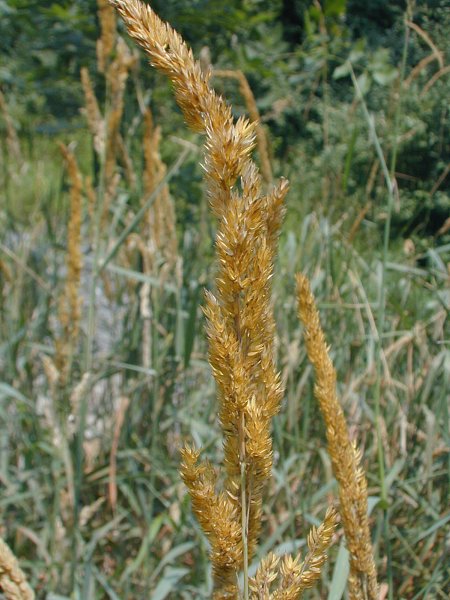
The spikelets are initially light green, but they later become golden tan and finally light tan. Each spikelet has a pair of glumes at its base; these glumes are keeled, lanceolate, hairless, and up to ¼" (6.5 mm.) in length. There are 2 sterile lemmas that are quite small and inconspicuous, while the fertile lemma is lanceolate, finely pubescent along its lower margins, and up to 4.5 mm. in length. This lemma encloses a membranous palea containing the grain. The blooming period occurs from early to mid-summer, lasting about 1-2 weeks. The perfect florets of the fertile lemmas are cross-pollinated by the wind. At maturity, the spikelets disarticulate above the glumes; there is one grain per spikelet. The grains are 3-4 mm. in length, narrowly ellipsoid-lanceoloid in shape, and light-colored. The root system produces extensive rhizomes. This grass forms clonal colonies that often exclude other species of plants.
Cultivation:
The
preference is full or partial sun, wet to moist conditions, and a
fertile soil containing organic matter. This grass can spread
aggressively in wetland habitats if there is enough sunlight. It
develops quickly during the spring, becoming mature during early
summer, after which it dies down. However, this grass redevelops during
late summer and fall to store energy in its roots so that it can
survive the winter in a dormant state.
Range & Habitat:
Reed Canary Grass is quite common in central and northern Illinois,
while it is less common in southern Illinois, especially in the SE
section of the state (see Distribution
Map).
This grass is native to both North America and Eurasia,
although some authorities think that aggressive strains from Eurasia
are now dominant in Illinois. Habitats include borders of floodplain
woodlands, small openings in floodplain woodlands, swamps, marshes,
prairie swales, moist meadows, low areas along creeks and ponds,
ditches, and inlets along sandy beaches. Reed Canary Grass occurs in
slightly less wet areas than cattails (Typha spp.).
The aggressive habits of this species can be troublesome for managers
of wetlands seeking greater biodiversity. Sometimes Reed Canary Grass
is deliberately cultivated as a source of forage for livestock; it is
also planted to control soil erosion. However, its usefulness for
erosion control is debatable.
Faunal
Association:
Various insects feed on the foliage and other parts of Reed Canary
Grass. These species include Camnula
pellucida (Clear-winged Grasshopper), Melanoplus femurrubrum
(Red-legged Grasshopper), Melanoplus
differentialis (Differential Grasshopper), caterpillars of
the butterfly Enodia
anthedon (Northern Pearly Eye), Oulema melanopus
(Cereal Leaf Beetle), Rhopalosiphum
oxyacanthae (Apple-Grass Aphid), the aphid Rhopalomyzus poae,
and the aphid Rhopalomyzus
lonicerae.
Reed Canary Grass is the preferred host plant of the last aphid during
the summer. Muskrats feed on rhizomes, culms, and young shoots of
this grass to a limited extent. Canada Geese feed on the young
foliage when it occurs near bodies of water; the young foliage is also
palatable to cattle. Because this grass is tall and often forms
colonies, it provides protective cover for wetland birds, small
mammals, snakes, insects, and other kinds of wildlife.
Photographic Location:
Within the floodplain of a drainage ditch at Judge Webber Park in
Urbana, Illinois, and a meadow at Meadowbrook Park of the same city.
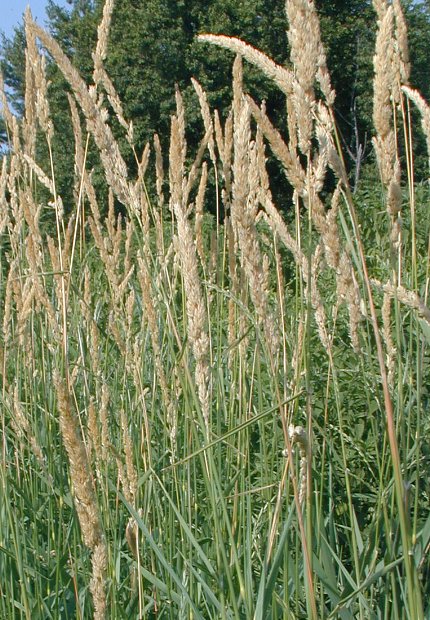
Comments: This is often the dominant grass in wetlands with a history of disturbance. While Reed Canary Grass is primarily a wetland species, it can colonize neighboring meadows and other open areas. Shortly after the blooming period, the seedheads of this grass are an attractive golden tan, but this stage of development doesn't persist for very long. It is fairly easy to distinguish Reed Canary Grass from other grass species, especially when its panicles of spikelets are present. After the blooming period, these panicles become narrow and their appearance is spike-like. The glumes and lemmas of these panicles are relatively long and they lack awns. The leaf blades are quite broad at their bases (up to ¾" across), where they clasp the culms. The sheaths and leaf blades of this grass are hairless or nearly so. Other grasses often have wider panicles of spikelets, or they have shorter glumes and lemmas, or their glumes and lemmas have awns, or they have more narrow leaf blades, or their sheaths and leaf blades are pubescent to hairy. Another species in the same genus, Phalaris canariensis (Canary Grass), is a common source of food for caged birds. This latter species is shorter and less aggressive than Reed Canary Grass; it rarely naturalizes in Illinois.