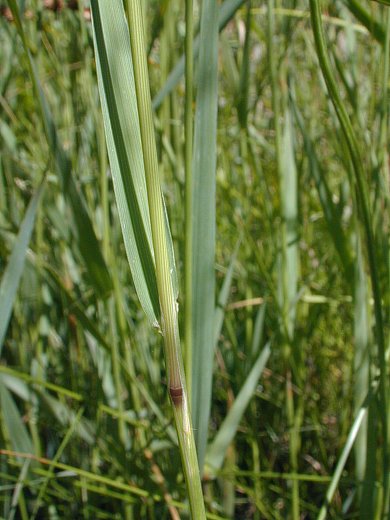
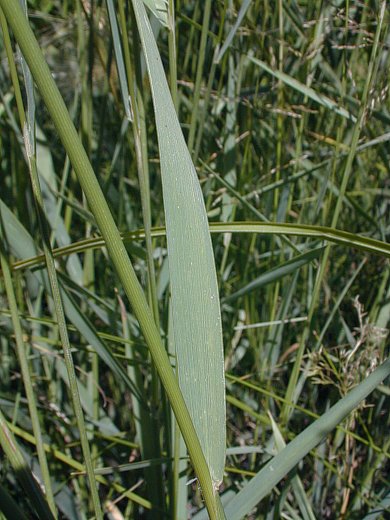
Description: This perennial grass is about 2-3' tall and unbranched. Each culm is green, slender, glabrous, and terete in cross-section. The leaf blades are up to 8" long and 1/3" (8 mm.) across; they are green, bluish green, or grayish blue, linear in shape, hairless, and rather flat. The sheaths are green, glabrous, longitudinally veined, and open; they often split open at their apices, forming a deep V-shape. The nodes of the culm are red and glabrous, while the ligules are white-membranous. The culm terminates in a panicle of one-flowered spikelets. This panicle is up to 8" long and one-half as much across; when fully open, it is broader at the base than at the top and rather airy in appearance. Along the rachis (central stalk) of the panicle, there are whorls of ascending to widely spreading lateral branches; these branches are reddish green or pale red, glabrous, and straight. The spikelets and pedicels are held in alignment with the lateral branches. The short pedicels of the spikelets are reddish green or pale red and glabrous. Each spikelet is 2-3 mm. in length; it consists of 2 glumes about 2-3 mm. long, a single fertile lemma about 1.5-2 mm. long, an inner palea that is a little shorter than the lemma, and a perfect floret. The glumes are lanceolate in shape and keeled; there are often fine hairs or bristles along the edges of their keels, although this is difficult to see without magnification. The fertile lemma is greenish white to white, translucent, and lanceolate in shape; the inner palea is white-membranous.

While the flowers
are blooming, the spikelets are light silver-red. Shortly afterwards,
the spikelets become light gray and rather dull. The
blooming period usually occurs from late spring to mid-summer, lasting
about 1-2 weeks for a colony of plants. The florets are
cross-pollinated by the wind. At maturity, the spikelets disarticulate
above the glumes. The grains are 1.0-1.5 mm. long, ellipsoid
in shape, and light brown.
The root system is fibrous, also producing rhizomes or low
stolons. Redtop
is a sod-forming grass that forms dense clonal colonies. This grass
also readily reseeds itself.
Cultivation:
The preference is full sun, moist to mesic conditions, and soil
containing loam or clay-loam. This grass adapts well to worn-out soil
in agricultural fields.
Range & Habitat:
Redtop is a common grass that can be found in every county of Illinois
(see Distribution
Map). It has a circumboreal distribution, occurring in both
North America and Eurasia. This grass was probably introduced into
North America from Eurasia (majority view), although it has also been
considered native to some parts of North America (minority view).
Habitats include
degraded prairies (especially clay prairies), moist meadows near
streams, ditches, and fields. Redtop is still used in agriculture
as a source of forage (particularly for horses); it is often grown in
SE Illinois for this purpose. Disturbed areas are preferred.
Faunal
Associations:
The
caterpillars of several skippers feed on the foliage of Redtop,
including Amblyscirtes vialis (Common Roadside
Skipper), Hesperia leonardus (Leonard's Skipper),
and Hylephila phyleus (Fiery Skipper). Other insect
feeders include the caterpillars of a butterfly, Cercyonis pegala
(Common Wood Nymph), and the caterpillars of a moth, Leucania pseudargyria
(False Wainscot). The spikelets of this grass are eaten by Conocephalus brevipennis
(Short-winged Meadow Katydid) and Conocephalus
fasciatus (Slender Meadow Katydid), while Neoconocephalus ensiger
(Sword-bearing Conehead) eats the seeds and Pseudopomala brachyptera
(Short-winged Toothpick Grasshopper) eats the leaves (Gangwere, 1961).
Redtop is also a host plant of Sphenophorus
minimus (Little Billbug) and Sphenophorus parvulus
(Bluegrass Billbug) according to Vaurie (1983).
The seeds are eaten by the Field Sparrow to a limited extent, while the
Cottontail Rabbit occasionally browses on the foliage. Redtop is quite
palatable to livestock.
Photographic Location:
A moist grassy area along a drainage ditch in Champaign, Illinois.
Comments: Redtop is an attractive grass during its short period of bloom, otherwise it is rather ordinary looking. In areas where it is grown as an agricultural crop, it can become a significant source of hay fever during the late spring or early summer. Redtop can be distinguished from other Agrostis spp. (bent grasses) by its colorful inflorescence during the blooming period and the width of its leaf blades (up to 1/3" or 8 mm. across). Other bent grasses in Illinois usually have inflorescences that are green or grey during the blooming period and their leaf blades are more narrow. Some spikelets of Redtop are located near the rachis (central stalk) of the inflorescence; the spikelets of other bent grasses are often more remote from their rachises. In general, bent grasses can be distinguished from other grasses by their tiny one-flowered spikelets, their claw-like persistent glumes, and the absence of conspicuous tufts of hair on their spikelets and ligules. Redtop is often referred to as Agrostis alba, although this scientific name is considered obsolete.