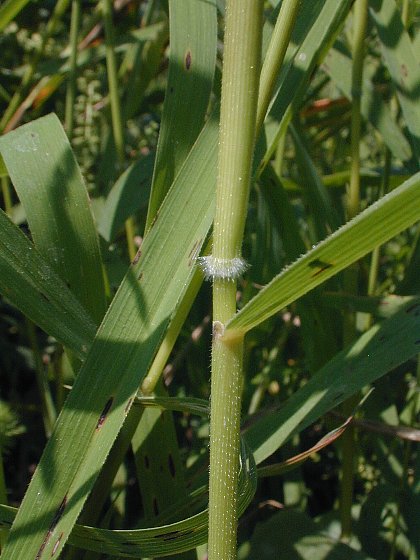
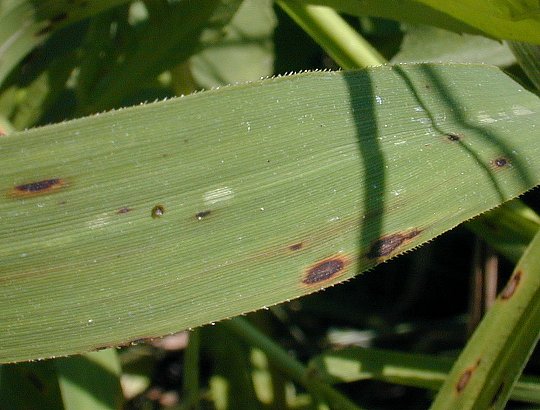
Description: This perennial grass is 2–3½' tall and more or less erect. The culms are light green to yellowish green, terete, hollow, and sparsely covered with short stiff hairs; they are unbranched or sparingly branched. Alternate leaves occur along the entire length of each culm. The leaf blades are up to 10" long and 10 mm. across; they are linear in shape, dull green, and somewhat rough-textured along their upper and lower surfaces from minute stiff hairs (see Leaf Blades). The margins of leaf blades are very rough-textured and sharp from minute stiff hairs that resemble serrated teeth. The leaf sheaths are light green, longitudinally veined, and quite rough-textured from short stiff hairs; the sheaths wrap around the culms rather tightly and they have V-shaped openings at their apices. The ligules are white-membranous. The nodes along each culm are pubescent and slightly swollen.
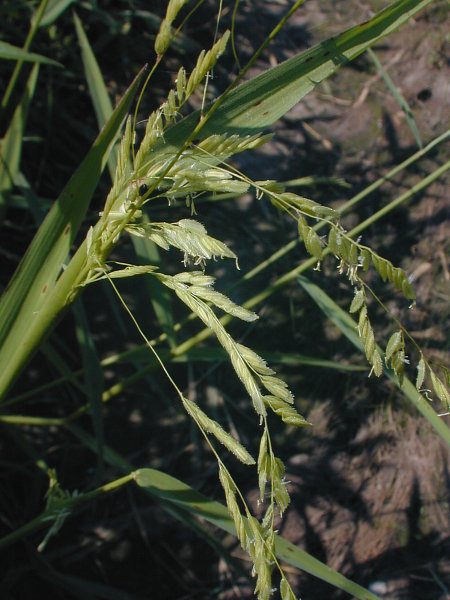
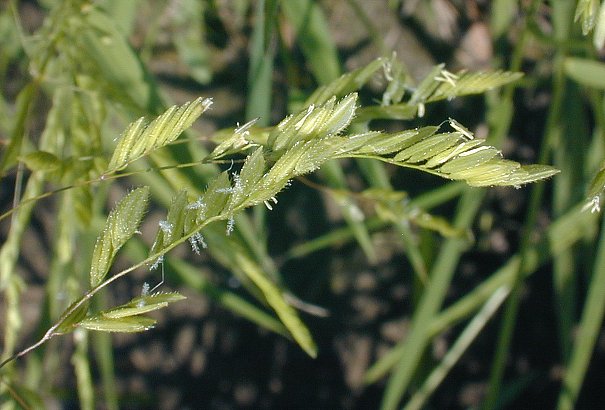
Each culm terminates in a panicle of spikelets about 4-10" long and 3-6" across; when it is fully open and exerted from the uppermost sheath, the panicle is broader at the base than the apex (pyramidal in shape) and its lateral branches are widely spreading However, young panicles are often only partially exerted from the uppermost sheath and their lateral branches are more erect. Each lateral branch is naked along the lower one-half of its length, while the upper one-half of its length has 4-14 adjacent spikelets. These spikelets are often arranged in a row along one side of a lateral branch; their pedicels are up to 1 mm. long. The spikelets are 4-5 mm. long, 1.5–2 mm. across, light green, ellipsoid-oblongoid, and flattened in shape. Each spikelet has a single fertile lemma, a palea, and a perfect floret; there are no glumes (or they are insignificant). The lemmas are the same length as the spikelets, while the paleas are slightly shorter. The lemmas are elliptic-oblong in shape, strongly keeled, and 5-veined; their keels have short stiff hairs. The paleas are similar to the lemmas in shape, strongly keeled, and 3-veined; their keels are sometimes hairless, otherwise they have short stiff hairs.
The florets of the lemmas are perfect; each floret has 3 stamens with white anthers, 2 plumose white stigmas, and an ovary. Some anthers are exserted from their spikelets, while others remain enclosed within their spikelets (cleistogamous). The blooming period occurs from late summer into autumn, lasting about 1-2 weeks for a colony of plants. The florets are cross-pollinated by the wind. Afterwards, mature spikelets fall in their entirety to the ground. Each fertile spikelet contains a single slender grain that is enclosed within a persistent pericarp (lemma and palea); this grain is about 1.5–2 mm. long (excluding the surrounding pericarp). The root system is fibrous and long-rhizomatous. Dense colonies of clonal plants are often produced from the rhizomes.
Cultivation:
The preference is full sun, wet to moist conditions, and fertile soil
that is mucky or silty. This adaptable grass tolerates partial sun and
other kinds of soil, including those that are gravelly or
sandy. It is somewhat aggressive and weedy in disturbed wetlands.
Range & Habitat:
Rice Cutgrass is a common plant that occurs throughout Illinois (see Distribution
Map), where it is native. This grass is distributed worldwide
on every continent, except South America. Habitats include marshes,
sandy pannes, gravelly seeps, swamps, prairie swales, low-lying areas
along rivers and ponds, seasonal wetlands, and drainage
ditches. This grass is often found in degraded wetlands with a history
of disturbance, although it also occurs in higher quality wetland
habitats.
Faunal
Associations:
Insects that feed on Rice Cutgrass include the larvae of Ancyloxypha
numitor (Least Skipper), the larvae of Polites
peckius (Peck's Skipper), the larvae of the moth Crocidophora serratissimalis (Angelic Crocidophora), Sphenophorus melanocephalus
(Black-headed Billbug), Sphenophorus
minimus (Little Billbug), and Conocephalus brevipennis
(Short-winged Meadow Katydid); see Bouseman et al. (2006), Vaurie
(1983), Gangwere (1961), and the Natural History Museum (website, accessed 2010). The seeds of Rice Cutgrass are eaten
by such birds as the Swamp
Sparrow, Tree Sparrow, Sora Rail, Canada Goose, Mallard, and other
ducks (see
the Bird
Table
for a listing of these species). The harsh foliage of
this grass deters most mammalian herbivores, although
muskrats feed on the rootstocks to a limited extent
(Hamerstrom
& Blake, 1939).
Photographic Location:
A drainage ditch in Champaign, Illinois.
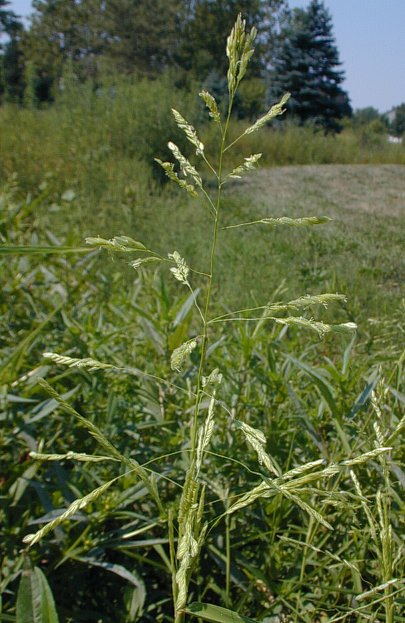
Comments: As the common name suggests, Rice Cutgrass (Leersia oryzoides) has leaf blades that can slice through human flesh. In addition to its sharp leaf blades, the rough foliage of this grass can cling tenaciously to clothing, flesh, or fur. It is an unpleasant experience to walk through a dense colony of this grass. These unpleasant characteristics help to distinguish Rice Cutgrass from other grasses: In my experience, no other grass species in Illinois has such sharp leaf blades and rough foliage! The spikelets of Rice Cutgrass are somewhat unusual because they lack glumes (at least, of any significance) and each spikelet has only a single lemma. The spikelets of other grasses usually have pairs of glumes and 2 or more lemmas. A less common species that occurs in wetlands, Catchfly Grass (Leersia lenticularis), has a similar appearance to Rice Cutgrass. However, Catchfly Grass has flattened-ovoid spikelets that are at least 3 mm. across and its foliage is less rough-textured and sharp. In contrast, the spikelets of Rice Cutgrass are more narrow and they are no more than 2 mm. across.