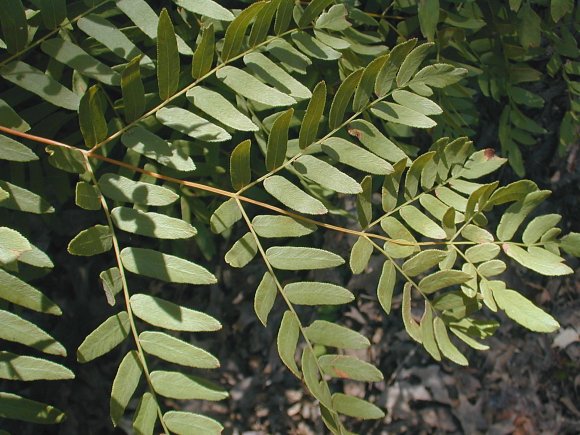
Description: This perennial deciduous fern consists of either a solitary compound leaf or a tuft of compound leaves about 3-5' tall on petioles that are more or less erect. Very young leaves and petioles are covered with woolly hairs, but they soon become glabrous. The petioles of these leaves are light green, yellowish tan, or brown. The petioles are somewhat flattened at their bases, otherwise they are terete. Both sterile leaves and partially fertile leaves are produced; the former are more common than the latter. Sterile leaves are up to 3½' long, 2½' across, and deltate or deltate-ovate in outline; they are ascending to widely spreading. Sterile leaves are bipinnate or tripinnate, consisting of 6-9 pairs of pinnate leaflets or 2-3 pairs of bipinnate leaflets. Because pinnate subleaflets of tripinnate leaves and pinnate leaflets of bipinnate leaves are structurally the same, they will both be referred to as pinnate leaflets in the following description, and their subdivisions will be referred to as subleaflets (pinnules). Pinnate leaflets consist of 8-15 pairs of subleaflets and a terminal leaflet; pairs of subleaflets are usually not directly opposite from each other. Individual subleaflets are 1–2¾" (2.5-7 cm.) long and about one-third as much across; they are oblong or lanceolate-oblong in shape and smooth to minutely serrated along their margins.
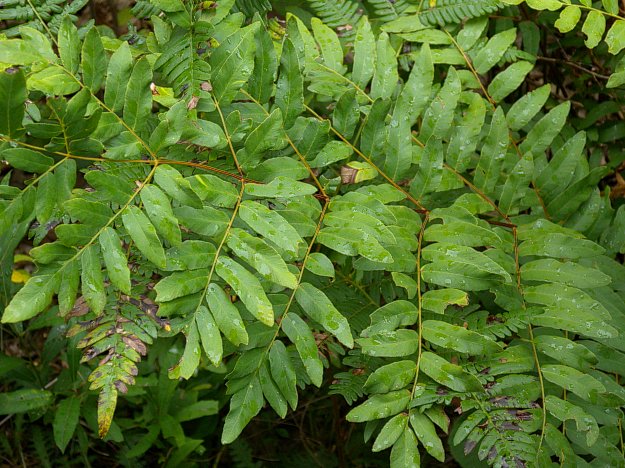
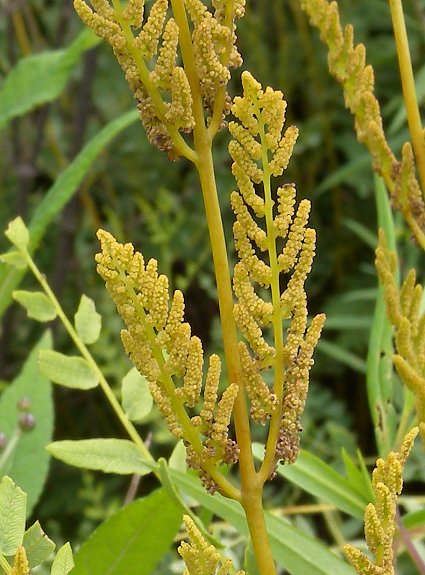
The upper surfaces of the subleaflets are yellowish green to medium green, while their lower surfaces are light green to nearly white. Tips of subleaflets are bluntly acute to obtuse, while their bases are truncate to rounded. Some subleaflets may have 1 or 2 basal lobes. The venation of each subleaflet is pinnate, consisting of a central vein and dichotomously forked lateral veins; some lateral veins are dichotomously forked more than once. Subleaflets usually have short basal stalklets about 0.5-2 mm. in length, although on rare occasions they may be sessile. Along the central stalk of each pinnate leaflet, pairs of subleaflets usually spread outward in opposite directions, although sometimes they spread upward at about a 30º angle. The central stalks of pinnate leaflets are light green to yellowish brown, grooved along their upper surfaces, and convex below. Some compound leaves are partially fertile; their upper leaflets are fertile, while their lower leaflets are sterile. Compared to sterile leaflets, fertile leaflets are more ascending and the rachis supporting them is more yellow, erect, and stout. The proportion of leaflets in a partially fertile leaf that are either fertile or sterile can be highly variable. Fertile leaflets have the same underlying structure as sterile leaflets, but they are more narrow and contracted. Unlike sterile leaflets, fertile leaflets are densely covered with bead-like sporangia.
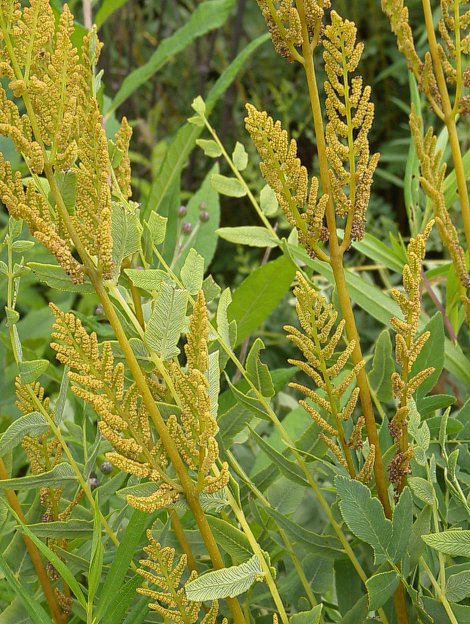
Depending on their
maturity, these sporangia vary in color from pale yellow to reddish
brown or brown. Partially fertile leaves develop during the late spring
or early summer, and the spores of the sporangia are released to the
wind later in the year. These tiny spores are typically green and they
are short-lived. The root system consists of a stout vertical
rootstalk that produces the compound leaves; this rootstalk is
surrounded by a dense mass of wiry fibrous roots. Older plants can form
small tussocks above the dense mass of their root systems. In addition
to the rootstalk, long rhizomes with abundant fibrous roots may be
produced. Clonal colonies of
plants are occasionally formed from the rhizomes at favorable sites.
Cultivation:
Royal Fern prefers
full sun to light shade, wet to mesic conditions, and sandy acidic
soil with organic matter. Rocky or gravelly soil with organic matter is
also tolerated if it is acidic and not too dry. Periods of standing
water are readily tolerated. However, floodplain areas exposed to soil
erosion and moving water with suspended sediment are not tolerated
because of their effects on the root mass. The foliage has a tendency
to become pale yellowish green in full
sun, particularly during hot dry weather. At suitable locations, this
fern is long-lived (up to 100 years), but it develops and spreads
slowly.
Range &
Habitat:
The native Royal Fern occurs in scattered locations across Illinois
(see Distribution
Map).
It is
occasional in sandy areas of northern Illinois, sandy areas of central
Illinois, and rocky areas of southern Illinois where sandstone occurs;
elsewhere in the state, it is rare or absent. Royal Fern is broadly
distributed across North America, South America, Africa, and Eurasia.
In Illinois, habitats
include sandy savannas, moist sandy thickets, borders of moist sandy
woodlands, wet to moist sand prairies, swamps, sandy or gravelly seeps,
remnant bogs, rocky edges of streams, rocky bluffs, and
semi-shaded sandstone cliffs. This fern is found in high
quality natural habitats. In wet sand prairies and moist sandy
savannas, Royal Fern often occurs with Bracken Fern (Pteridium
aquilinum) and Sensitive Fern (Onoclea sensibilis).
It also occurs with Cinnamon Fern (Osmunda cinnamomea)
in sandy swamps
and similar habitats.
Faunal Associations:
The larvae of Papaipema
speciosissima
(Osmunda Borer Moth) bore through the stems and rhizomes of Royal Fern
(Eastman, 1995). This fern is a possible host plant for larvae of the
sawfly Strongylogaster
tacita (Smith, 2006). When this large fern occurs in
colonies, it provides protective cover for wildlife.
Photographic
Location:
Photos of sterile leaves: Along a path in a sandy savanna at the Hooper
Branch Savanna Nature
Preserve in Kankakee County, Illinois, and border of a moist sandy
woodland at the Iroquois County Conservation Area in Illinois. Photos
of partially fertile leaves: A wet sand prairie at the Indiana Dunes
National Lakeshore in NW Indiana.
Comments:
From a distance, Royal Fern (Osmunda
regalis)
has a shrub-like appearance. This fern can become quite large
and imposing, and there is really nothing else that resembles it. Royal
Fern tolerates more light than most ferns, but it requires
consistently moist conditions in order to stay healthy. This fern is
highly variable across local populations. In
particular, the shape, margins, size, and coloration of its
subleaflets (pinnules) are variable, and its fertile leaves vary in
their height, the proportion of pinnate leaflets that are covered with
sporangia, and the coloration of sporangia. Other members of the
Royal Fern family in Illinois
include the Interrupted Fern (Osmunda claytoniana)
and Cinnamon Fern (Osmunda
cinnamomea). These very attractive ferns have
pinnate-pinnatifid leaves with a more conventional appearance than the
bipinnate to tripinnate leaves of Royal Fern. Ancestral ferns in the
Royal Fern family (Osmundaceae) have been found in fossil beds dating
to the Permian era about 365 million years ago.