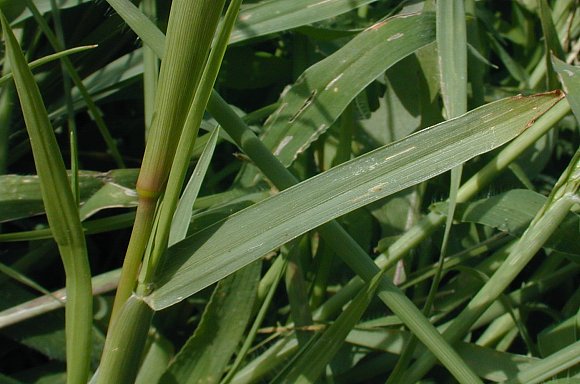
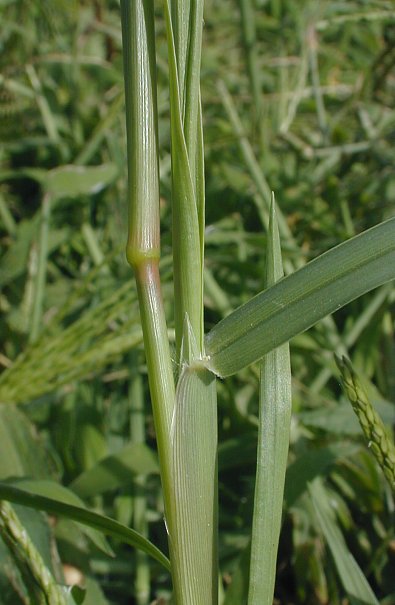
Description: This grass is a summer annual with branching culms up to 2½' long; it produces several culms from the base that are either ascending or sprawl across the ground. The culms are usually light green, hairless, terete, and mostly covered by the sheaths of the leaves; sometimes the culms are reddish toward their bases. The nodes along these culms are green or reddish green and glabrous. Alternate leaves occur along the entire length of each culm. The leaf blades are up to 6" long and 8 mm. across; they are dull green, hairless, flat to slightly indented along the middle, broadest near their bases, and linear in shape. The upper surface and margins of these blades are scabrous (rough-textured). The leaf sheaths are usually dull green, mostly hairless, keeled, and somewhat flattened; sometimes the lowest sheaths are reddish. All of the sheaths are inflated and they wrap loosely around the culms; sometimes scattered hairs occur along their margins and throats. The ligules are short-hairy. Each culm and any upper branches terminate in racemes of 4-20 spiny fruits (one raceme per culm or upper branch); these racemes are up to 4" long and ¾" across.
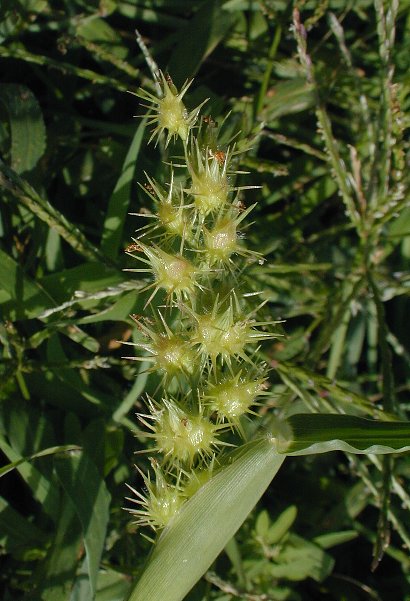
The rachis (central stalk) of each raceme zigzags between the fruits; this rachis is light green, angular, and hairless. The pedicels of the fruits are up to ¼" long, light green, angular, hairless, and ascending. The spiny fruits (or burs) are 6-8 mm. across (excluding the spines) and globoid to globoid-ovoid in shape; each fruit consists of a pair of cup-like bracts that are joined together, enclosing 2-3 sessile spikelets. The outer surfaces of these fruits are covered with flattened spines up to 6 mm. long and they are more or less pubescent. Each spikelet is 5-6 mm. long, consisting of 2 glumes and 2 lemmas (only one lemma per spikelet is fertile). The glumes and lemmas are lanceolate-ovate in shape, membranous, longitudinally veined, and convex along their outer surfaces. The lemmas are the same length as the spikelets (5-6 mm.), while the glumes are smaller in size (2-5 mm. long). The anthers and plumose styles of the florets of the fertile lemmas are exerted from the apices of the spiny fruits. The blooming period occurs from early summer to early fall, lasting 1-2 weeks for a colony of plants. The florets are cross-pollinated by the wind. Afterwards, the maturing spiny fruits change color from light green, to yellow, and finally light tan. Each of these fruits contains 1-3 grains. Mature grains are 2-4 mm. long, 1.5-2.5 mm. across, ovoid to obovoid in shape, smooth-textured, and brown. The root system is fibrous.
Cultivation:
The
preference is full to partial sun, mesic to dry conditions, and open
sandy soil. Sandbur will grow in non-sandy soil as well, especially
where the ground vegetation is sparse.
Range & Habitat:
Sandbur is occasional to locally common throughout Illinois (see Distribution
Map), where it is native. This grass is more common in sandy
areas. Habitats include sand prairies, sandy savannas, fields, areas
along railroads and roadsides, sandy lawns, and waste ground. Sandbur
prefers areas with a history of disturbance. This is a rather weedy
grass and it is considered a nuisance in some areas.
Faunal Associations:
Information about floral-faunal relationships for this grass is rather
limited. The Yellow Sugar Cane Aphid (Sipha flava)
sucks plant juices from the foliage of Sandbur and other grasses
(Blackman & Eastop, 2013). The seeds of Sandbur are cached and
eaten by the Prairie Deer Mouse (Howard & Evans, 1961). The
spiny
fruits (or burs) cling readily to animal fur and the clothing of
humans; this helps to distribute the seeds across considerable
distances. The spines of the fruits are very sharp and they can
easily penetrate flesh, causing mechanical injury to the
mouth parts of grazing animals. They are also painful to step on when
people wander outside in bare feet.
Photographic
Location:
A waste area along a railroad in Urbana, Illinois. Another species,
Common Crabgrass (Digitaria sanguinalis), is present
in the background of the photographs.
Comments:
This is the only sandbur grass (Cenchrus sp.) in
Illinois, therefore its identification within the state is easy. Other
species of sandbur occur elsewhere in the United States, especially in
sandy areas of the southeast and southwest. Other common names for Cenchrus
longispinus are Matted Sandbur and Long-spined Sandbur. The
foliage of Sandbur and its habit of growth are quite similar to those
of crabgrasses (Digitaria spp.),
and they even grow together in weedy lawns and other habitats. However,
crabgrasses are easily distinguished by their inflorescences,
consisting of narrow digitate spikes.