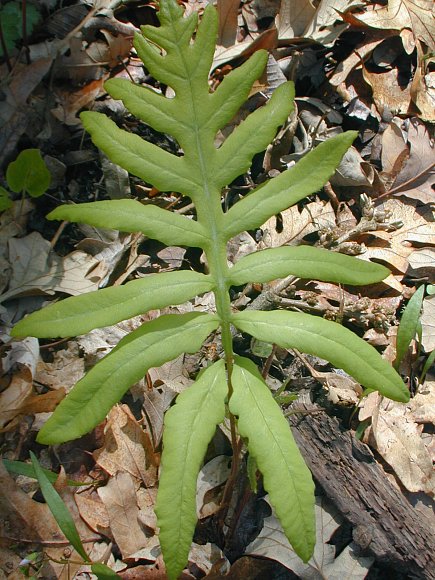
Description: This perennial fern consists of a few loose leaves that develop directly from the rootstock. The infertile leaves (including their petioles) are 1½–3' tall and erect or ascending, while the fertile leaves (including their petioles) are ¾–1½' tall and erect. Infertile leaves are more common than fertile leaves. The infertile leaves are yellowish green to medium green, hairless, and ovate in outline; they are deeply pinnatifid for the most part, although their tips are more shallowly pinnatifid, while their bases are more pinnate. The central stalk (or rachis) of each infertile leaf is winged. The spreading narrow lobes of the infertile leaves are generously spaced from each other; their margins are smooth to undulate and gently roll downward. Each infertile leaf has about 8 opposite pairs of these lobes; the upper lobes are ascending, the middle lobes are widely spreading, and the lower lobes are descending. The petioles of infertile leaves are usually shorter than their blades; they are light yellowish green to reddish brown and glabrous to slightly scaly. The infertile leaves persist all summer, but die down during the autumn in response to frost.
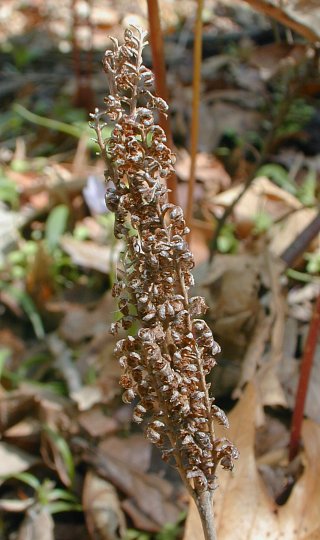
The fertile leaves
have a very different appearance. Their leaflets are contracted to form
hardened structures that support the bead-like sporangia and their
spores. In outline, each fertile leaf is ellipsoid-oblongoid, forming a
narrow panicle of erect contracted leaflets with sporangia on a central
stalk (or rachis).
The fertile leaves become dark brown and persist through the winter
into the following year. Eventually, the sporangia split open to
release their spores; these spores are distributed by the wind. The
root system consists of a stout smooth rhizome with spreading fibrous
roots. This rhizome occasionally branches. Small clonal
colonies of plants are often formed from the branching rhizomes.
Cultivation:
The preference is partial sun to light shade, wet to moist conditions,
and sandy or loamy soil containing decaying organic matter. The
infertile leaves emerge from the ground after the danger of spring
frost has passed. Full sun is tolerated if the ground is consistently
moist, but the infertile leaves will become an unattractive yellowish
green. This fern prefers a humid location that is sheltered from
prevailing winds.
Range &
Habitat:
Sensitive Fern is fairly common and can be found in most areas of
Illinois (see Distribution
Map).
It is native to eastern North America and East Asia. Habitats include
wet to mesic deciduous woodlands, lowland sandy savannas, wooded
bluffs, soggy
thickets, forested bogs, swamps, moist meadows, moist sand prairies,
edges of marshes, shaded seeps, and low shaded areas along small
streams and vernal pools. The Sensitive Fern is usually found in
natural areas of moderate to high quality.
Faunal Associations:
Insects that feed on Sensitive Fern include the aphid Amphorophora ampullata,
larvae of the sawfly Hemitaxonus
dubitatus, and larvae of Papaipema inquaesita
(Sensitive Fern Borer Moth). The aphid sucks plant juices from this
fern, the sawfly larvae feed on the leaves, and the moth larvae bore
into the stems and roots (Blackman & Eastop, 2013; Smith, 2006;
Covell, 1986/2005). The foliage of this fern is toxic to horses
if it is eaten in quantity; deer may browse on the infertile leaves to
a limited extent. The value of this fern to wildlife is low overall.
Photographic Location:
A wooded bluff in Vermilion County, Illinois.
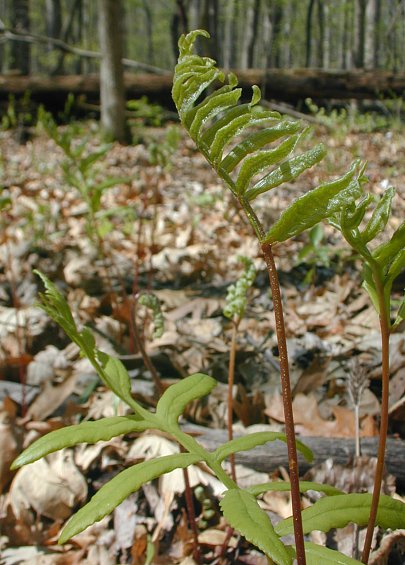
Comments: The common name of this fern refers to the deciduous nature of its infertile leaves and their sensitivity to frost; they do not coil back in response to being touched. Fossil imprints have been found that closely resemble the Sensitive Fern; these imprints date back to the time of the dinosaurs. Thus, the Sensitive Fern appears to have changed very little from its ancestors during millions of years. The Sensitive Fern is the only member of its genus; its nearest living relative (in Illinois, anyway) is Matteuccia struthiopteris (Ostrich Fern), which looks very different. The Sensitive Fern can be readily distinguished from other ferns by the shape of its infertile leaves and the occasional presence of its peculiar fertile leaves – each fertile leaf resembles an elongated cluster of dark brown beads on a stalk. These fertile leaves are very persistent; they can be observed near the infertile leaves in a dried-up state throughout most of the year. Another group of ferns, Botrychium spp. (Grape Ferns, Moonworts), have fertile leaves with a similar appearance. However, their fertile leaves originate from the same stalks as the infertile leaves at ground level or above, while the fertile leaves and infertile leaves of Sensitive Fern have separate stalks that originate from the rootstock.