Description: This perennial sedge consists of a tuft of arching leaves and flowering culms up to 3' long. Infertile shoots are bunched together, producing rosette-like clusters of leaves, while fertile shoots produce alternate leaves along the lower halves of their culms. Each culm is green, glabrous, 3-angled, and strongly winged along each angle; its interior tends to be soft and spongy, especially along the lower half of its length. The culms are erect or ascending and rather stiff, but easily broken if they are subjected to pressure. With age, there is a tendency for culms with maturing spikelets to lean sideways. Immediately underneath the terminal inflorescence, the texture of each culm is rough along its angles, otherwise it is usually smooth.
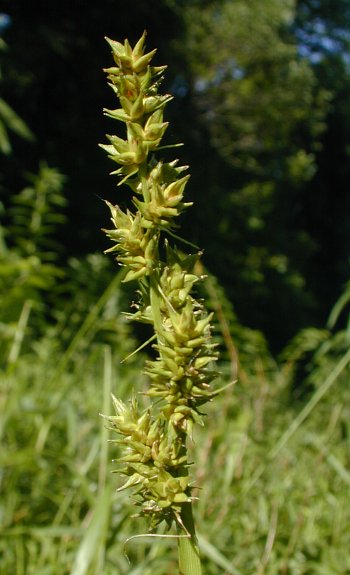
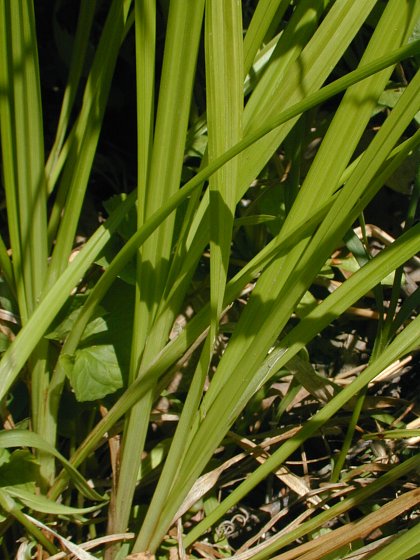
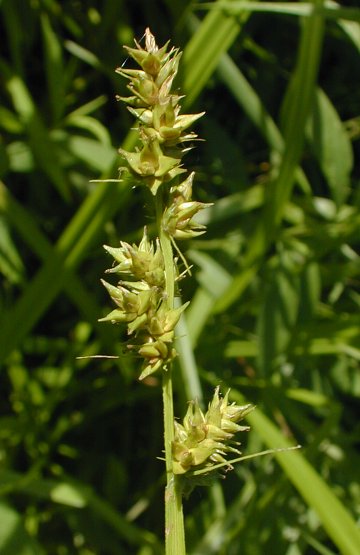
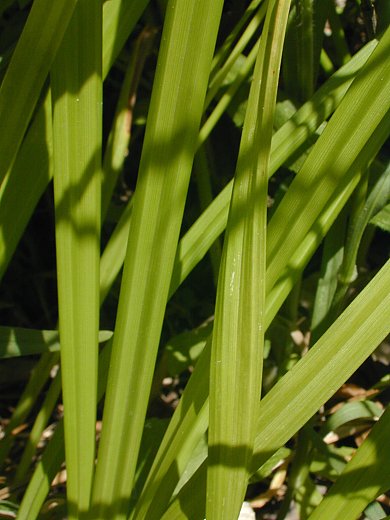
The leaf blades are up to 18" long and 8 mm. (1/3" across), or slightly wider; they are light green to green, linear, glabrous, and slightly scabrous (rough-textured) along their margins. The larger leaves are often longitudinally furrowed; they are rather floppy. The leaf sheaths are rather fragile, separating easily from the culm. Each sheath is light to medium green and glabrous on two sides, while its inner side is membranous. The latter's membranous surface is often puckered and transversely wrinkly in appearance. At the base of each plant, there are often the withered brown remnants of last year's leaves. Each culm terminates in a narrow inflorescence up to 2¾" long. About 6-15 short spikelets are located along the rachis of this inflorescence; most pairs of adjacent spikelets are partially overlapping, although sometimes they are separated by short distances. The spikelets are initially green, but they later become yellowish brown. Each spikelet consists of a dense cluster of several perigynia, pistillate florets, and their scales; the perigynia are widely spreading to ascending. There are also staminate florets at the apex of each spikelet, but they are few in number and inconspicuous.
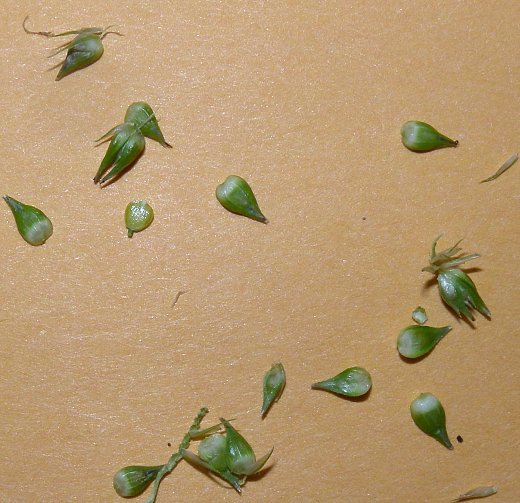
The perigynia of pistillate florets are lanceoloid-ovoid and flattened, tapering into long beaks; they are convex on one side and flat on the other side (plano-convex). The perigynia are 3-4 mm. long, about 2 mm. across, wingless along their margins, and glabrous; their bottoms are either rounded or slightly cordate. The outer sides and sometimes the inner sides of the perigynia have a few longitudinal veins. The pistillate scales are lanceolate-ovate in shape and their tips are either narrowly acute or short-awned; they are a little shorter than the perigynia. These scales are green-veined in the middle and their margins are membranous. There are usually a few linear bracts among the spikelets; these bracts are up to 1½" long. The blooming period occurs during the late spring, lasting 1-2 weeks. The florets are cross-pollinated by the wind. Afterwards, the achenes within the perigynia become mature by mid-summer. These achenes are about 2 mm. long and a little less across; they are flattened-ovoid in shape and glabrous, becoming yellowish brown at maturity. The root system is fibrous and short-rhizomatous.
Cultivation:
The preference is light shade to partial sun, moist conditions, and a
fertile loamy soil. Occasional flooding during the spring is tolerated.
The heavy culms of this sedge have a tendency to lean to one side as
the spikelets become mature. Some protection from the wind is desirable.
Range & Habitat:
The native Soft Fox Sedge occurs occasionally in most areas of central
and
northern Illinois; it is less common or absent in the southern section
of the state (see Distribution
Map). Habitats include bottomland woodlands, openings in
bottomland woodlands, moist meadows in wooded areas, thickets,
riverbottom prairies, shaded to partially shaded streambanks,
and powerline clearances in moist woodlands. This sedge occurs
primarily in moist deciduous woodlands and adjacent open areas.
Faunal
Associations:
The flowers are wind-pollinated and do not attract many insects.
Insects that feed on Carex
spp. (sedges) in moist wooded areas include
larvae of the butterfly Satyrodes
appalachia (Appalachian Brown), leaf-mining larvae of the
moths Elachista
argentosa and Elachista
madarella, and larvae of the moth Apamea indocilis
(Ignorant Apamea). The seeds of such sedges are eaten by the Wood Duck,
some upland gamebirds, and either granivorous or omnivorous songbirds
(see the Bird
Table
for a listing of these species). While it is not preferred as a source
of food, horses and livestock (e.g., cattle) will browse on the
foliage when it becomes available, while deer browse the foliage
sparingly.
Photographic Location:
A powerline clearance at Busey Woods in Urbana, Illinois.
Comments: Soft Fox Sedge can be distinguished from most other Carex spp. (sedges) by its 3-angled strongly winged culms. Other sedges have terete or 3-angled culms (usually the latter), but they are rarely winged. However, Carex alopecoidea (Foxtail Sedge) has 3-angled strongly winged culms and its inflorescence is similar to the inflorescence of Soft Fox Sedge. Foxtail Sedge can be distinguished by its more narrow leaves (up to 6 mm. or ¼" across), the lack of wrinkled puckering along the inner sides of its sheaths, and its more narrowly shaped perigynia (up to 1.75 mm. across). Otherwise, these two sedges are quite similar to each other. A commonly encountered species, Carex vulpinoidea (Brown Fox Sedge), has 3-angled culms that are not winged and its inflorescence is usually longer than the preceding species (up to 4" long). Otherwise, its appearance is similar to Soft Fox Sedge and Foxtail Sedge.