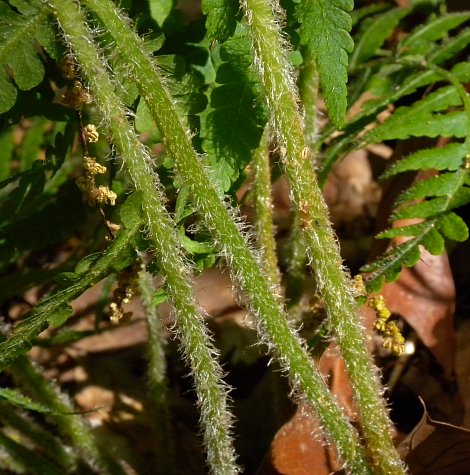
Description: This perennial fern has deciduous compound leaves up to 3' tall and 1' across; the ascending to widely spreading leaves are arranged together in loose tufts. The petioles are shorter than the leaf blades; they are terete and variably colored – usually light green, green, or yellowish tan. The petioles usually have scattered light brown scales and abundant white hairs, particularly near their bases. Individual leaves are pinnate-pinnatifid in structure and ovate to ovate-lanceolate in outline; the leaves are widest toward the middle or lower-middle, and they have about 15-25 pairs of leaflets. The leaflets are usually arranged alternately along the rachis (central stalk of the compound leaf), rather than oppositely from each other. The leaflets are perpendicular to the rachis, or angled slightly upward toward the tip of the leaf.
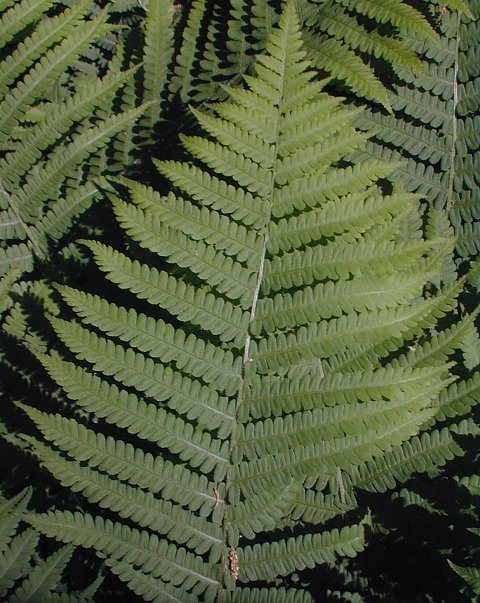
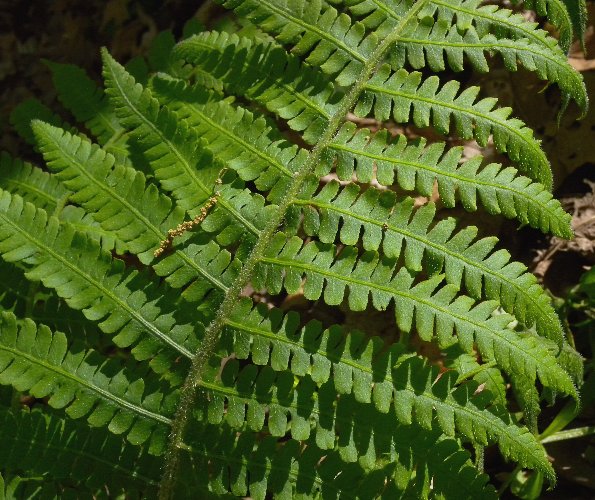
The deeply pinnatifid leaflets are up to 6" long and linear-oblong to linear-lanceolate in outline; they have about 8-22 pairs of closely spaced lobes. The lobes of leaflets are short-oblong in shape and smooth to slightly crenate-serrate along their margins. The lobes of leaflets have pinnate venation; the lateral veins are not forked. The upper leaf surface is hairless to sparsely hairy and dull olive green to bright medium green. The lower leaf surface is pale to medium green and mostly hairless to sparsely hairy. The rachis of each leaf is sparsely to moderately covered with fine white hairs, especially on the underside; the secondary rachises (or central stalklets) of the leaflets are also sparsely to moderately covered with fine white hairs on their undersides.
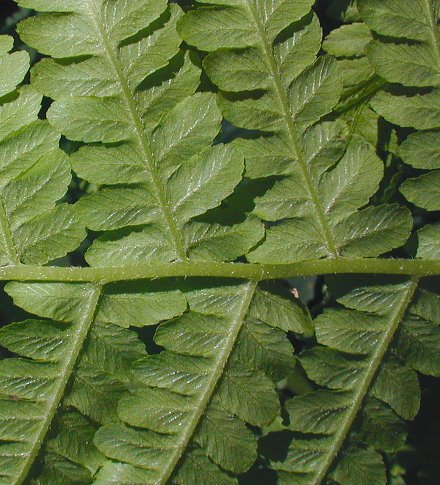
On the underside of fertile leaves, there
are 2 rows of slender sori (spore-bearing structures) that are parallel
to the lateral veins on the lobes of leaflets. These sori are
partially covered along one side by slender indusia (protective
membranes) that
become silvery in appearance. The sori and indusia are straight to
slightly curved. The spores are released from the sori during the
summer or autumn; they are distributed by the wind. The root system
consists of stout lateral rhizomes and abundant fibrous roots. Dense
clonal colonies of leaves are often formed from the rhizomes.
Cultivation:
The preference is dappled sunlight to medium shade, moist to mesic
conditions, and
a light loamy soil with decaying organic matter (slightly acid to
neutral pH). Fairly high humidity and some protection from the wind are
desirable as the leaves are rather fragile.
Range &
Habitat:
The native Silvery Glade Fern is distributed throughout Illinois (see Distribution
Map). It is occasional in most areas, but colonies of plants
are often widely scattered from each other. Habitats include moist to
mesic deciduous woodlands, wooded valleys, bottoms of rocky canyons,
and slopes of wooded ravines
above streams. This terrestrial fern is often found along wooded slopes
that were formed from either glacial till or underlying bedrock.
Faunal Associations:
Larvae
of a moth, Stathmopoda
aenea,
feed on the spores of the leaf undersides of Silvery Glade Fern
(Microleps website). Other information about floral-faunal
relationships is unavailable for this fern.
Photographic Location:
Along the slope of a wooded ravine in Vermilion County, Illinois, and
bottom of a rocky canyon at the Portland Arch Nature Preserve in
west-central Indiana.
Comments: This is a rather stout and handsome fern. The Silvery Glade Fern has an unstable taxonomic history. Older scientific names of this fern include Asplenium acrostichoides, Athyrium acrostichoides, Athyrium thelypterioides, and Diplazium acrostichoides. Because of an early assignment to the Asplenium genus, this fern is sometimes called 'Silvery Spleenwort,' even though it bears little resemblance to the ferns in this genus. In many ways, the Silvery Glade Fern is similar in appearance to Athyrium felix-femina (Lady Fern). However, the latter fern lacks hairy petioles and rachises, and the shape of its elongated sori and indusia are usually more curved (sickle-shaped). Unlike the Silvery Glade Fern, which has undivided lateral veins on its leaflet lobes, the similar-looking Osmunda claytoniana (Interrupted Fern) and Osmunda cinnamomea (Cinnamon Fern) have forked lateral veins. These latter two ferns also differ by producing unexpanded leaves or leaflets that are heavily covered with brown sori.