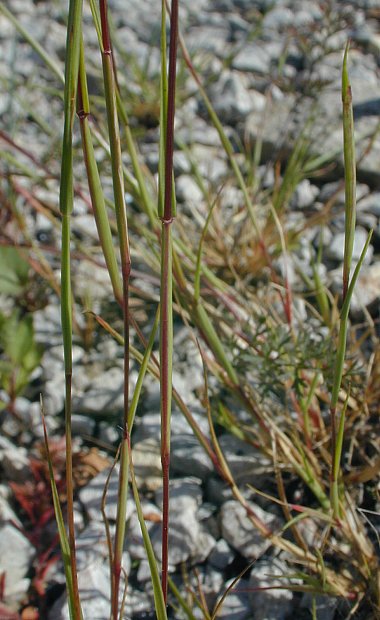
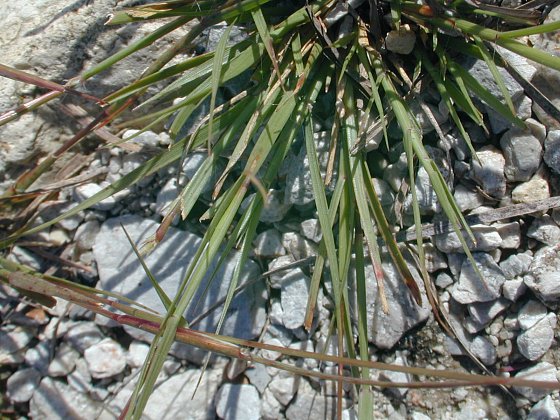
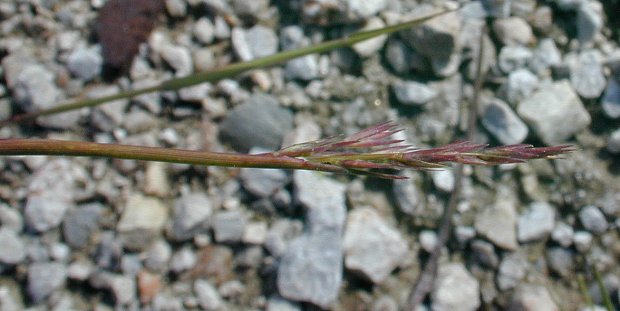
Description: This grass is a summer annual that forms a tuft of basal leaves, from which one or more leafy culms are produced. The culms are 6-12" long and erect to widely spreading; they are light green to reddish purple, slender, and often somewhat flattened. The culms are glabrous to slightly short-hairy (in the latter case, they have lines of short fine hairs that are difficult to see). Each culm has up to 7 alternate leaves along its entire length; the blades of these leaves are erect to ascending (relative to the culm). The blades of alternate leaves are about 2 cm. (¾") long and 1 mm. across; they are dull light green and hairless, except for a few long hairs at their bases. The blades of basal leaves are somewhat longer and wider, otherwise they are similar to the blades of alternate leaves. The leaf sheaths are light green, swollen, and hairless (or nearly so); they are shorter than the internodes. Each culm terminates in a spike-like panicle that is up to 4 cm. (1½") long; this panicle is exserted, in whole or part, from the uppermost sheath. There are similar panicles contained within the sheaths underneath; they are either completely hidden or only slightly exserted from their sheaths.
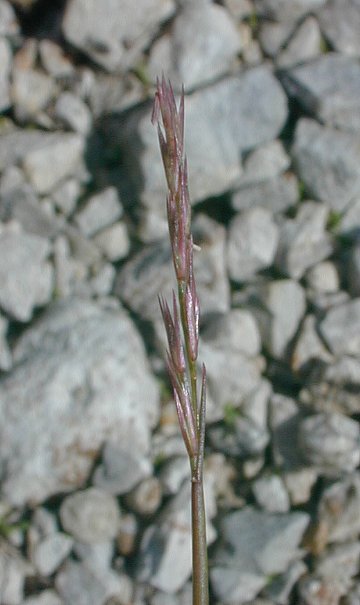
The lateral branches of each panicle are up to 12 mm. (½") long; they are either erect or ascending. One or more pedicellate spikelets occur along each lateral branch. The spikelets are pink, purple, or pale purplish green; they are often shiny. A typical spikelet is 4.0–4.5 mm. long, consisting of a pair of glumes, a lemma, a palea, and a perfect floret. The glumes are 3.5–4.0 long, linear-lanceolate in shape, keeled, and glabrous; one glume is usually slightly longer than the other. The lemma is 3.5–4.5 mm. long, linear-lanceolate in shape, and keeled; it has fine hairs that are appressed and ascending. The blooming period occurs during early autumn, lasting about 1-2 weeks. The florets are either cross-pollinated by wind or self-pollinating. Shortly afterwards, the foliage and spikelets become light tan. There is a single grain per spikelet. The root system is shallow and fibrous. This grass spreads by reseeding itself.
Cultivation:
The preference is full sun, dry conditions, and barren soil containing
sand or gravel. Most vegetative growth occurs during the summer. The C4
metabolism of this grass enables it to withstand drying winds and
drought. It is unable to withstand much competition from taller plants.
Range & Habitat:
Sheathed Dropseed is occasional throughout Illinois (see Distribution
Map), where it is native. Habitats include rocky openings in
upland woodlands, dry sand prairies, hill prairies, limestone and
sandstone glades, fields and pastures, roadsides,
gravelly areas along railroads, and barren waste areas. This grass
prefers disturbed areas with sparse ground vegetation. It is often
found in proximity to a similar species, Small Dropseed (Sporobolus
neglectus).
Faunal
Associations:
Little is known about the floral-faunal relationships for this species.
A false spider mite, Dolichotetranychus
carnea, deforms the seedheads of Dropseed grasses (Sporobolus spp.);
see Felt (1917). The seeds of these grasses are eaten by the Mourning
Dove, Field Sparrow, Tree Sparrow, and other granivorous
songbirds, particularly during the winter (Martin et al., 1951/1961).
Sheathed Dropseed (Sporobolus
vaginiflorus)
provides poor forage for cattle and other livestock.
Photographic Location:
A gravelly area along a railroad in Champaign, Illinois.
Comments: This is another small weedy grass that is easily overlooked. Sheathed Dropseed is similar in appearance to Small Dropseed (Sporobolus neglectus), except that it has longer glumes and lemmas (about 4 mm. in length). In contrast, Small Dropseed has glumes and lemmas that are about 2 mm. in length and they are less slender and pointed. Both of these grass species bloom late in the year and they both produce spike-like inflorescences that are partially or totally hidden by their sheaths. Other Dropseed grasses (Sporobolus spp.) with such inflorescences are larger perennial grasses; their narrow panicles are at least 5 cm. (2") in length. Other common names of Sporobolus vaginiflorus are Sheathed Rush Grass and Poverty Grass.